



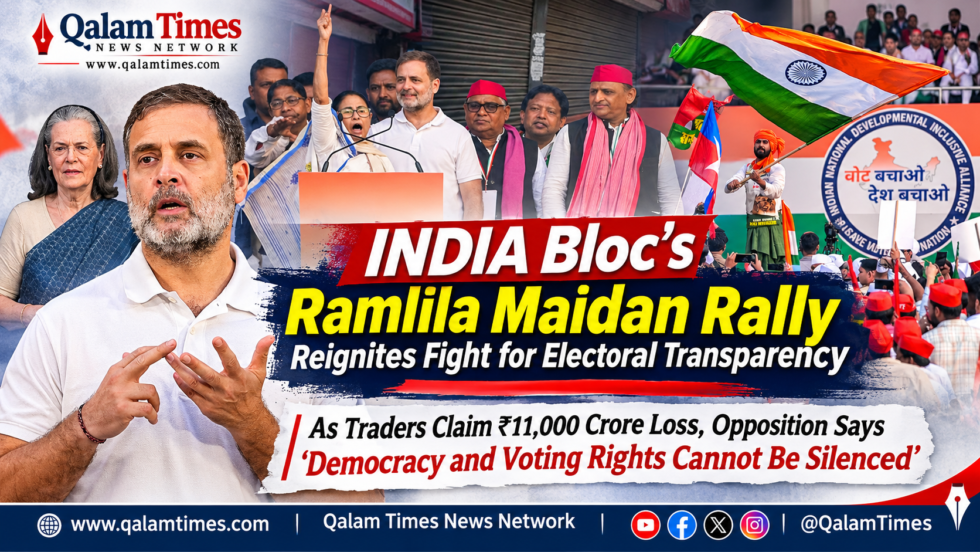
Democratic Protest takes centre stage as the INDIA bloc gathers at Ramlila Maidan to demand electoral transparency, constitutional accountability and protection of voting rights.
Economic Disruption Cannot Overshadow the Larger Democratic Questions of Electoral Transparency, Constitutional Rights and the Freedom to Protest
Dr. Mohammad Farooque
Qalam Times News Network
Kolkata, November 2, 2026
Democratic Protest is an inseparable part of a functioning democracy. When opposition parties, political organisations and citizens assemble to raise concerns about electoral transparency, constitutional safeguards and the functioning of democratic institutions, their actions deserve to be examined in the larger context of constitutional freedoms. The INDIA bloc’s massive gathering at Delhi’s historic Ramlila Maidan on November 1 was one such political mobilisation. Bringing together leaders and workers from 21 opposition parties, the rally sought to turn concerns over alleged electoral irregularities and the Special Intensive Revision (SIR) exercise into a broader national debate about the future of India’s democratic institutions.
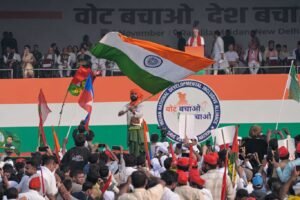
The controversy surrounding the rally, however, has taken another direction following claims by the Chamber of Trade and Industry (CTI) that Delhi suffered approximately ₹11,000 crore in economic losses on November 1. While the concerns of traders and small businesses deserve attention, an important distinction must be maintained: the economic consequences of a large public gathering and the constitutional legitimacy of holding that gathering are two separate questions. One should not automatically be used to invalidate the other. The reported figure is an estimate presented by the CTI and requires independent verification before being treated as an established economic loss.
Ramlila Maidan: A Historic Platform for Democratic Expression
Ramlila Maidan is not an ordinary public ground in India’s political imagination. It has witnessed numerous movements, public demonstrations and political gatherings that have contributed to the country’s democratic discourse. From campaigns against corruption to mass political mobilisation, the ground has repeatedly provided citizens and political organisations with an opportunity to express disagreement with those in power.
The INDIA bloc’s November 1 gathering must also be understood within this democratic tradition. The opposition parties assembled to question the electoral process, demand accountability from constitutional institutions and express their concerns regarding the functioning of the Election Commission.
The central slogan, ‘Vote Chor, Gaddi Chhod’, reflected the opposition’s political position that electoral transparency must remain beyond question. Whether individual allegations are established or not is a matter for evidence, investigation and institutional examination. Nevertheless, raising such questions through peaceful democratic mobilisation is a legitimate political activity.
In a parliamentary democracy, the opposition is not expected to remain silent whenever it disagrees with the government. Its responsibility includes questioning decisions, demanding explanations and presenting alternative political arguments before the public.
Electoral Transparency Cannot Be a Secondary Concern
The speeches delivered at Ramlila Maidan revealed the breadth of the opposition’s concerns. Congress president Mallikarjun Kharge questioned the credibility of the electoral process and alleged that democratic institutions were being undermined. Rahul Gandhi reiterated his demand for accountability from Chief Election Commissioner Gyanesh Kumar and argued that protecting the Constitution must remain a national priority. Mamata Banerjee raised concerns about the electoral process in West Bengal and criticised the SIR exercise. Akhilesh Yadav referred to alleged irregularities and complaints submitted to the Election Commission, while Tejashwi Yadav questioned the ruling establishment’s claims about patriotism and its approach towards democratic participation. PDP president Mehbooba Mufti emphasised the importance of protecting constitutional rights, particularly the right to vote. Left leaders, including Dipankar Bhattacharya and M.A. Baby, also expressed concerns about the implications of SIR for ordinary voters. These speeches reflected a common political concern: electoral processes must remain transparent, accessible and credible. The Election Commission, as a constitutional authority, has a particularly important responsibility to ensure that every eligible citizen can exercise the right to vote without unnecessary obstacles. The allegations raised by opposition leaders require appropriate examination. Equally, the Commission should respond to legitimate complaints with transparency and documentary clarity. Public confidence in elections cannot depend solely on official assurances; it must be strengthened through verifiable procedures and accessible explanations.
The Economic Loss Argument: A Question of Perspective
The CTI’s claim of ₹11,000 crore in economic losses has attracted considerable attention. According to its assessment, retail and wholesale businesses suffered approximately ₹8,800 crore in losses, transportation and logistics incurred ₹1,500 crore, hospitality and tourism faced ₹500 crore in losses, and daily wage earners lost approximately ₹200 crore. The organisation also claimed that nearly 2.5 lakh shops remained closed and that approximately 20 lakh people, including workers, loaders, transport operators and street vendors, were affected. These claims should be investigated rather than accepted or rejected without examination. However, the larger question is whether such estimates should become the principal measure of the significance of a democratic gathering. A political demonstration is not a commercial event whose success or failure can be determined by daily sales figures. Its purpose is to express public concerns, mobilise opinion and demand institutional accountability.
India has witnessed numerous historical movements in which public demonstrations temporarily affected normal activities. The freedom struggle itself involved marches, boycotts, civil disobedience and mass mobilisation. These movements cannot be understood simply through the economic inconvenience associated with them. Their political significance lay in the questions they brought before society and the institutions they challenged. This historical comparison does not mean that economic hardship should be ignored. It means that economic disruption and democratic expression must be examined separately and proportionately.
Who Is Responsible for Managing Public Demonstrations?
If shops were closed, roads blocked and commercial activity disrupted, the responsibility for examining these circumstances cannot be placed exclusively on the organisers of the rally. The Delhi administration, police and other relevant authorities have a duty to maintain public order while protecting the constitutional right to peaceful assembly. Traffic diversions, security arrangements and access restrictions must be proportionate to actual requirements. Rahul Gandhi alleged that shops around Connaught Place had been forcibly closed by the BJP-led government. This allegation deserves a clear response from the authorities. If unnecessary restrictions were imposed, the administration should explain why businesses were prevented from operating and whether alternative arrangements were considered. At the same time, the CTI stated that it had written to opposition leaders, including Rahul Gandhi, requesting postponement of the rally until after Diwali. The opposition leadership should clarify its response to these concerns. A democratic society must allow traders to raise their grievances just as it allows political parties to organise demonstrations. The solution lies in better coordination, not in questioning the legitimacy of peaceful protest itself.
Rahul Gandhi‘s Appeal to Support Local Businesses
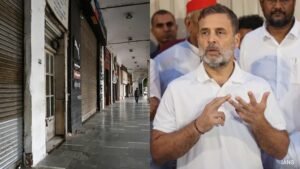
Interestingly, Rahul Gandhi reportedly appealed to people attending the rally to purchase goods from local shops and support Delhi’s trading community. His appeal deserves to be considered alongside the criticism directed at the opposition. It indicated an acknowledgement that political mobilisation should not become disconnected from the economic concerns of ordinary citizens. The political leadership of the INDIA bloc could take this discussion further by establishing regular communication with traders’ associations before major demonstrations. Such coordination could help ensure that markets remain accessible, deliveries continue and small businesses are not unnecessarily affected. But the existence of economic concerns should not become a reason to discourage political participation. The right to protest is not reserved for political parties in government, nor should it depend on whether a demonstration is convenient for those holding administrative authority. One of the most significant aspects of the Ramlila Maidan gathering was the repeated invocation of the Constitution. Rahul Gandhi spoke about constitutional values, equality, communal harmony and the need to protect the rights of every citizen. He also criticised the concentration of economic and institutional power, while calling for a political environment based on brotherhood rather than hatred. Kharge emphasised the importance of protecting democratic institutions. Mehbooba Mufti raised concerns about constitutional rights, while leaders from different political backgrounds called for greater public participation in safeguarding democracy. Their arguments reflect a larger constitutional debate about the relationship between the government, the opposition and independent institutions. The Constitution does not give any political party permanent ownership of democracy. Governments are elected for a defined period, opposition parties have a recognised democratic role, and constitutional institutions must function according to their legal responsibilities. The freedom to disagree is therefore not a weakness of democracy. It is one of its defining characteristics.
The Opposition’s Responsibility and the Democratic Protest Future
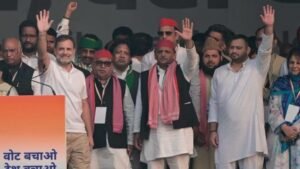
The INDIA bloc’s rally also demonstrated the importance of cooperation among opposition parties despite their ideological and regional differences. Congress, Trinamool Congress, Samajwadi Party, Rashtriya Janata Dal, Left parties, PDP and other political organisations shared a common platform. Their participation showed how different political formations can come together around a particular constitutional or electoral concern without necessarily abandoning their independent political identities. The presence of student organisations, including AISA, and the participation of different civil society groups further broadened the character of the gathering. However, the long-term significance of such mobilisation will depend on what follows. Opposition parties must translate their demands into specific questions, documentary evidence, institutional complaints and sustained democratic engagement. If the INDIA bloc is demanding transparency from the Election Commission, it must consistently pursue evidence-based scrutiny. If it is raising concerns about voting rights, it must present practical proposals to protect eligible voters. If it is defending the Constitution, its own political conduct must reflect respect for constitutional principles. Democratic accountability is not a responsibility that belongs exclusively to the ruling establishment. It applies to every political organisation. The reported economic losses in Delhi deserve examination, and the difficulties faced by traders and daily wage workers should not be dismissed. But neither should an unverified financial estimate become a political instrument to discredit a peaceful opposition gathering. The INDIA bloc’s Ramlila Maidan rally raised questions about electoral transparency, the functioning of constitutional institutions and the protection of democratic rights. These issues deserve serious public discussion, regardless of political affiliation. The government must answer legitimate questions about the electoral process. The Election Commission must maintain public confidence through transparency. The administration must ensure that demonstrations are managed without unnecessary disruption. Opposition parties must continue to exercise their constitutional freedoms responsibly. India’s democracy cannot be reduced to the functioning of its markets alone, just as economic development cannot be separated from democratic rights. A country needs both: thriving businesses and strong constitutional institutions. The real question is not whether Delhi should have witnessed a political rally or whether its markets should have remained open. The real challenge is how a democratic state can protect both the freedom of citizens to raise their voices and the ability of other citizens to earn their livelihoods.
A democracy must never be so concerned about the inconvenience of protest that it forgets the importance of the right to protest. Ramlila Maidan has once again brought this fundamental question into the national conversation.