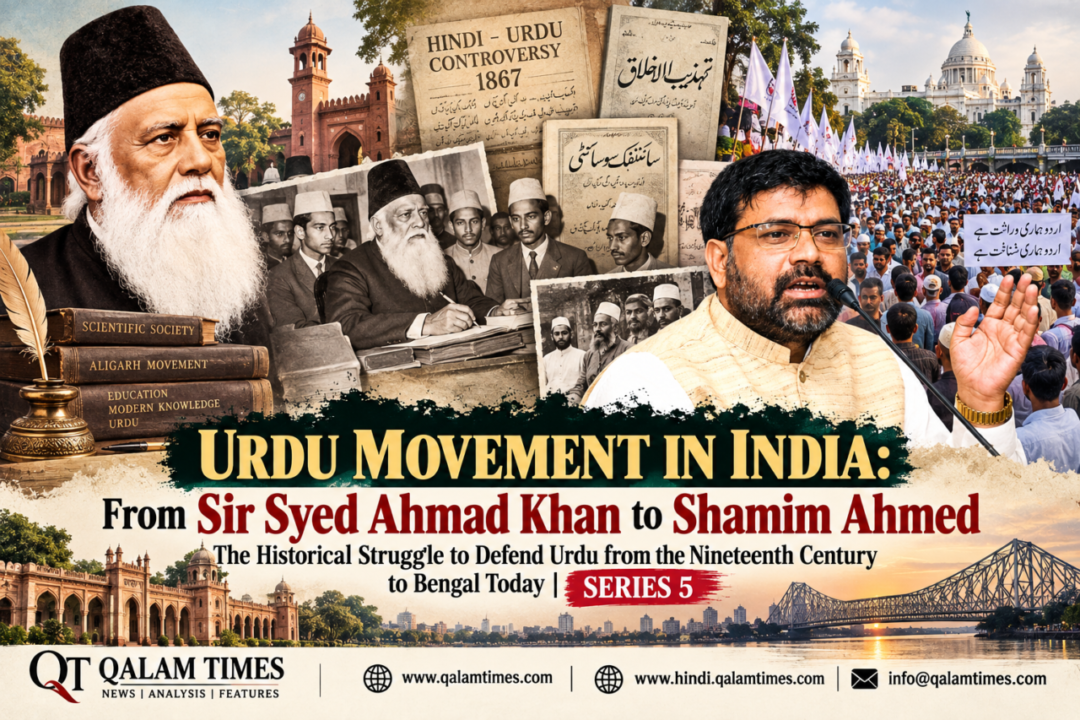




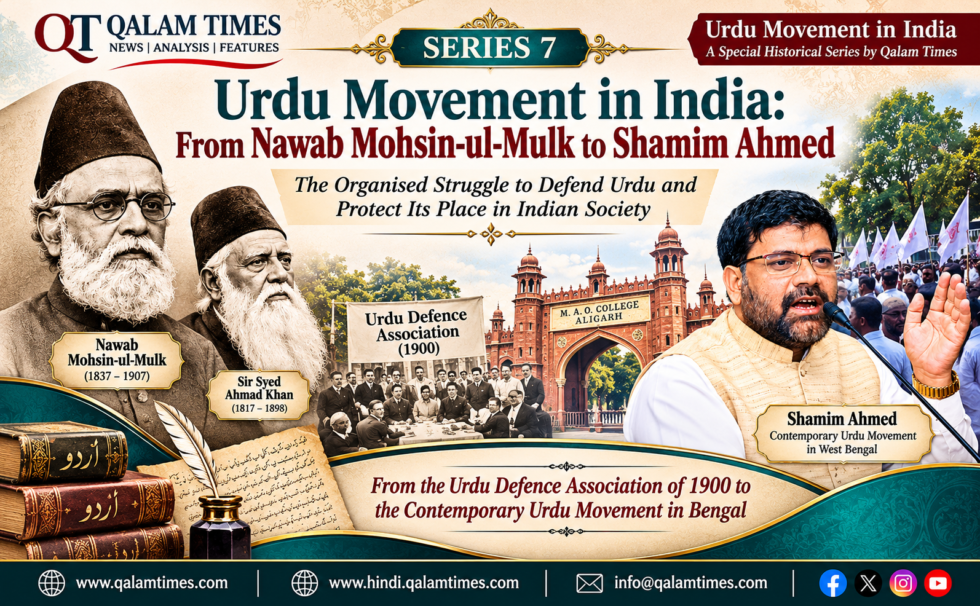
Explore Nawab Mohsin-ul-Mulk’s historic role in the Urdu Defence Association, the Hindi–Urdu controversy of 1900 and its historical connection with Shamim Ahmed’s contemporary Urdu movement in Bengal.
From the Urdu Defence Association of 1900 to the Contemporary Urdu Movement in Bengal: A Historical Journey of Language, Identity and Public Advocacy
Qalam Times News Network
Kolkata | November 1, 2026
The Urdu Movement in India has passed through several important historical phases, each shaped by the political, educational and cultural circumstances of its time. From Sir Syed Ahmad Khan’s efforts to promote modern education and strengthen Urdu’s intellectual position to Maulvi Abdul Haq’s work for linguistic scholarship and institutional development, successive generations of reformers and activists contributed to the preservation and advancement of the language. Yet the history of Urdu also includes moments when its position in public administration became a subject of organised debate, requiring leadership, collective mobilisation and a coordinated response. One such important moment came at the beginning of the twentieth century, when Nawab Mohsin-ul-Mulk emerged as a prominent figure in the campaign to defend Urdu against changes in the official language arrangements of the United Provinces.
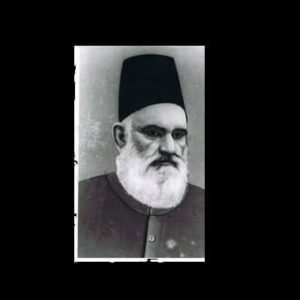
Nawab Mohsin-ul-Mulk, whose original name was Syed Mehdi Ali, belonged to the generation that followed Sir Syed Ahmad Khan and carried forward several concerns associated with the Aligarh educational movement. His contribution became particularly significant during the Hindi–Urdu controversy, when the question of language was no longer confined to literary preference or educational practice but increasingly involved official recognition, administrative access and the cultural position of Urdu. In 1900, the government of the United Provinces accepted the use of Devanagari-script Hindi in official proceedings alongside Urdu, a decision that generated strong reactions among sections of the Urdu-speaking public. Mohsin-ul-Mulk responded by helping organise a collective campaign for the protection of Urdu, associated with the establishment of the Urdu Defence Association in that year. This development marked an important stage in the history of organised Urdu advocacy.
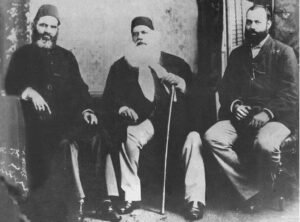
More than a century later, the contemporary Urdu movement associated with Shamim Ahmed in West Bengal represents another chapter in the long history of public efforts to secure recognition and strengthen Urdu’s position in Indian society. The political circumstances, legal framework and methods of mobilisation in modern West Bengal are very different from those of colonial-era northern India. Nevertheless, both historical experiences can be examined through a broader question: how do language communities organise themselves when they believe that their linguistic interests, educational opportunities or place in public life require greater attention? This article brings the work of Nawab Mohsin-ul-Mulk into conversation with the contemporary Bengal movement, not by claiming a direct organisational connection, but by examining the historical themes of language protection, collective organisation and public advocacy.
Nawab Mohsin-ul-Mulk: The Successor to an Important Educational Legacy
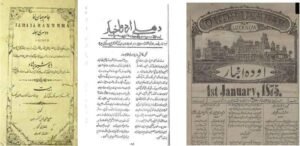
Nawab Mohsin-ul-Mulk, born Syed Mehdi Ali in 1837, was an important educational organiser and public figure associated with the Aligarh Movement. He came into prominence during a period when Indian society was experiencing major changes in education, administration and political representation under British rule. Sir Syed Ahmad Khan had already initiated a broad programme of educational reform, seeking to encourage modern learning and create institutions that could improve access to contemporary knowledge. Mohsin-ul-Mulk became closely associated with this reformist environment and eventually played a significant role in the development of the Muhammadan Anglo-Oriental College at Aligarh. His contribution extended beyond administrative responsibilities, as he also became an important figure in discussions concerning the position of Urdu and the educational interests of the people who used it.
Following Sir Syed Ahmad Khan’s death in 1898, Mohsin-ul-Mulk became one of the prominent figures associated with the continuation of the Aligarh educational mission. He served as secretary of the Muhammadan Anglo-Oriental College and was closely involved in its administration and institutional development. His responsibilities required him to balance the needs of an educational institution with the wider public concerns of the period. The position of Urdu became especially sensitive as debates about official language and script intensified in the United Provinces. Mohsin-ul-Mulk increasingly believed that the language question required an organised response rather than isolated expressions of concern. His leadership during the Urdu Defence Association campaign demonstrated his willingness to bring people together around a specific linguistic issue, even when doing so created difficulties for the institution with which he was associated.
The importance of Mohsin-ul-Mulk’s role lies partly in the transition he represented. Sir Syed’s work had emphasised education, intellectual reform and the development of modern institutions, while Mohsin-ul-Mulk’s intervention brought the defence of Urdu into a more organised public campaign. These activities were not entirely separate: educational opportunities, administrative language and cultural identity were closely connected in the circumstances of the period. The growing debate over Urdu’s official position raised questions about the language in which people could communicate with government offices, pursue administrative work and participate in public institutions. Mohsin-ul-Mulk’s response reflected the concern that changes in language policy could have consequences beyond the formal recognition of a script or language. It was within this wider environment that the Urdu Defence Association emerged as a significant chapter in the history of the Urdu movement.
The Hindi–Urdu Controversy: The Background to the Campaign of 1900
The Hindi–Urdu controversy developed over several decades and became particularly prominent in northern India during the second half of the nineteenth century. Urdu, written in the Perso-Arabic script, had an established position in administration and courts in parts of the region. At the same time, advocates of Hindi written in the Devanagari script increasingly demanded recognition for their language in official and educational settings. The controversy involved questions of script, vocabulary, educational policy, administrative convenience and cultural identity. It should be understood within the wider multilingual history of the subcontinent, where Hindi and Urdu developed through extensive interaction and shared linguistic traditions, even as their public and political identities became increasingly differentiated during the colonial period.
An important development occurred in 1898, when a memorandum was submitted to the government of the United Provinces seeking greater official recognition for Hindi written in Devanagari. The issue became more consequential in 1900, when the provincial government under Lieutenant-Governor Anthony MacDonnell announced changes that allowed Hindi in the Devanagari script to be used alongside Urdu in certain official contexts. For supporters of Urdu, this decision raised concerns about the language’s established administrative position and the future opportunities available to those educated in Urdu. The response was not simply a literary disagreement; it reflected wider anxieties about employment, education, public communication and the relationship between language and institutional access. Historical studies describe the decision as a major turning point in the Urdu–Hindi controversy and an important context for the emergence of organised Urdu advocacy.
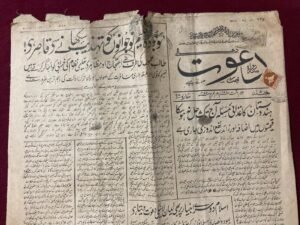
It is important, however, to avoid presenting the controversy as an inevitable conflict between two religious communities. Hindi and Urdu have long histories of cultural interaction, and their literary traditions cannot be reduced to a simple communal division. The political circumstances of colonial India, the growing importance of print culture, administrative competition and changing ideas of cultural identity all contributed to the intensification of the debate. Different individuals and organisations supported different language policies for a variety of reasons. A responsible historical account must therefore examine the actual decisions, demands and responses of the period without assuming that every Hindi advocate or Urdu supporter shared the same political or cultural outlook. The central concern of this instalment is the organised response led by Mohsin-ul-Mulk and the historical importance of the Urdu Defence Association.
The Urdu Defence Association of 1900: A New Phase of Collective Organisation
The formation of the Urdu Defence Association in 1900 represented an important development in the history of organised Urdu advocacy. In response to the official changes concerning Hindi and Urdu in the United Provinces, Mohsin-ul-Mulk and other supporters of Urdu sought to bring together individuals and public figures who believed that the language’s established position required protection. Historical accounts record the organisation of meetings and public gatherings in Aligarh and Lucknow, where the implications of the government’s decision were discussed and objections were expressed. The campaign helped transform concern about Urdu’s administrative position into a more organised public issue, drawing attention to the importance of collective representation and coordinated action.
The Association’s significance was not limited to its name or formal establishment. It represented an attempt to create a platform through which Urdu advocates could communicate their concerns, organise meetings and make their position visible to the colonial administration. At a time when political participation was limited and administrative decisions were largely controlled by colonial authorities, public meetings and petitions were among the methods through which organised groups could express disagreement. Mohsin-ul-Mulk’s intervention demonstrated that the defence of a language could become a matter of collective organisation involving educated professionals, public figures and people concerned about the future of Urdu. It also showed that language questions were closely connected with wider debates about representation and access to public institutions.
The response of the colonial government revealed the difficulties involved in such mobilisation. Mohsin-ul-Mulk’s position as secretary of the Muhammadan Anglo-Oriental College placed him in a particularly complicated situation. The college depended partly on government assistance, and the authorities were concerned about the political implications of the Urdu Defence Association. Historical accounts describe pressure from Lieutenant-Governor MacDonnell and the possibility that government financial support for the college could be affected if the campaign continued. Mohsin-ul-Mulk was therefore faced with a difficult choice between his institutional responsibilities and his commitment to defending Urdu. This episode illustrates the pressures that language advocates could face when public campaigns came into conflict with the priorities of colonial administration.
The campaign also demonstrated that the defence of a language required more than emotional attachment. It involved organising public opinion, presenting arguments, communicating with authorities and considering the institutional consequences of government policy. The Urdu Defence Association became an important reference point in later discussions of Urdu’s organised defence because it showed how linguistic concerns could be converted into collective public action. Although the Association’s early campaign faced serious constraints, its historical significance lies in the example it provided of organised advocacy during a period of changing language policy.
Mohsin-ul-Mulk and the Difficult Choice Between Aligarh College and Urdu Advocacy
One of the most revealing aspects of Mohsin-ul-Mulk’s campaign was the tension between his responsibilities at the Muhammadan Anglo-Oriental College and his role in the defence of Urdu. The college was an important educational institution, and its continued development depended on maintaining resources, administrative stability and a workable relationship with the colonial government. Mohsin-ul-Mulk, as its secretary, was responsible for protecting the institution’s interests. At the same time, he believed that the question of Urdu’s position required a public response. This placed him in a difficult situation because the authorities viewed the organised campaign with suspicion and reportedly warned that continued opposition could affect financial assistance to the college.
Historical accounts describe how the pressure placed upon the institution led Mohsin-ul-Mulk to reconsider his administrative position. Rather than allow the controversy to endanger the college’s future, he ultimately relinquished his position as secretary, allowing him to continue his public engagement with the Urdu question without the same institutional responsibilities. The episode became an important part of his historical reputation because it demonstrated the personal and institutional difficulties associated with language advocacy under colonial rule. It also illustrates that movements for linguistic recognition often operate within complicated relationships involving educational institutions, government funding and public pressure. The available historical accounts differ in some details concerning the sequence of meetings and administrative decisions, so exact dates and quotations should be checked against original correspondence and contemporary records before publication.
The wider significance of this episode lies in the relationship between education and language rights. The Aligarh institution had been established as part of a reformist educational project, but the language controversy demonstrated that educational development could not be entirely separated from administrative and cultural questions. If the language used in public institutions changed, the consequences could affect students, teachers, applicants and people seeking government employment. Mohsin-ul-Mulk’s campaign therefore reflected concerns that extended beyond the immediate issue of script. It raised the question of how a community could protect its educational and linguistic interests while operating within a political system in which the final authority rested with the colonial government.
From the Urdu Defence Association to the Wider Urdu Movement
The campaign of 1900 formed part of a wider period in which Urdu advocates increasingly recognised the importance of organised institutions and public platforms. The Urdu Defence Association was primarily concerned with responding to the immediate controversy surrounding the language’s official position. Other organisations and initiatives, including those associated with the wider educational movement and later Anjuman Taraqqi Urdu, pursued broader objectives involving the development, promotion and scholarly advancement of Urdu. These organisations should not be treated as identical, because they emerged in different circumstances and had distinct programmes. Nevertheless, their histories reveal a growing recognition that the future of Urdu required sustained organisation, public engagement and intellectual resources.
The later development of Anjuman Taraqqi Urdu, associated particularly with Maulvi Abdul Haq, represented another important dimension of this wider movement. While the Urdu Defence Association focused on the defence of Urdu in the context of the 1900 controversy, Anjuman Taraqqi Urdu became closely associated with scholarship, publications, research and the institutional development of the language. The distinction between these approaches is important. A language requires protection when its position is challenged, but it also requires active development through education, literature, research and translation. The history of Urdu demonstrates that public advocacy and scholarly institution-building are complementary dimensions of a broader effort to sustain a language across generations.
The experience of Mohsin-ul-Mulk also helped establish an important historical precedent: linguistic concerns could become subjects of organised public discussion rather than remaining confined to literary circles. This does not mean that every later Urdu campaign followed the same organisational model or inherited a direct institutional structure from the Association. Instead, the significance of the 1900 campaign lies in the historical example it provides of collective mobilisation around a language-related issue. Later movements in different parts of India developed their own leadership, methods and priorities, responding to the political and administrative circumstances of their respective periods.
West Bengal: A Different Regional Chapter in the Urdu Movement
The history of Urdu in West Bengal developed within a distinct linguistic, cultural and political environment. Kolkata has long been associated with Urdu journalism, literary activity, publishing and cultural exchange. The language has been sustained by writers, teachers, readers, educational institutions and cultural organisations, and its regional history forms an important part of Bengal’s multilingual heritage. However, the position of Urdu in West Bengal cannot be understood simply by applying the historical experiences of Aligarh, Lucknow or the United Provinces to a different region. The state has its own linguistic landscape, administrative arrangements and social history, all of which have influenced the nature of Urdu-related demands and the methods through which advocates have sought public recognition.
The challenges facing Urdu-speaking communities in West Bengal have included questions concerning educational opportunities, administrative use, public visibility and the preservation of regional literary and cultural traditions. These concerns have developed within the constitutional framework of independent India and the state’s own official-language policies. The history of Urdu in Bengal also requires greater documentation, because local organisations, individual activists and public campaigns may not always receive the same attention as nationally recognised figures and institutions. Newspaper archives, government records, organisational documents, photographs and oral histories can help establish a more complete record of how Urdu-related concerns developed in the state.
One important legislative development was the West Bengal Official Language (Amendment) Act, 2012. The legislation amended the existing framework to provide for the use of Urdu, subject to specified conditions, in areas where the Urdu-speaking population exceeded the prescribed threshold. The provisions addressed matters including certain official rules, notifications, petitions, public-office documents, government announcements and signposts. The legal text is important because it establishes the precise scope of the amendment and the conditions attached to its application. The legislation should not be described as granting unrestricted official-language status to Urdu throughout West Bengal; its provisions are geographically and legally qualified.
Shamim Ahmed and the Contemporary Urdu Movement in Bengal
In the contemporary history of Urdu advocacy in West Bengal, Shamim Ahmed has been associated with efforts to bring the concerns of Urdu-speaking communities into wider public discussion. As documented in Qalam Times’ previous coverage, the campaign gained renewed momentum from the mid-2000s and sought to take the Urdu question beyond literary gatherings and established institutional circles. Its activities included public-awareness programmes, the circulation and distribution of Urdu newspapers, public meetings and peaceful demonstrations. The movement presented Urdu not merely as a language of literary heritage but also as an issue involving education, cultural dignity, public participation and the recognition of linguistic rights within the constitutional framework of India.
One of the significant events associated with this campaign was the 36-hour sit-in protest organised in Kolkata on June 28, 2008, near the Gandhi statue. The event became an important part of the movement’s public history and helped bring Urdu-related demands into wider political and social discussion. The slogan “No Urdu, No Vote” was also used as part of the campaign’s messaging, seeking to communicate that linguistic concerns should receive attention in public and political life. Qalam Times’ earlier reporting describes the movement as an effort to build awareness across communities and to present Urdu as part of Bengal’s shared cultural and linguistic heritage rather than as the exclusive concern of one religious group. These historical details should continue to be supported by contemporary press reports, photographs and organisational records as the movement’s history is documented.
The 2012 amendment to West Bengal’s Official Language Act was an important development in the legal recognition of Urdu under specified conditions. However, the existence of a legal provision and its practical implementation are two different matters. Questions concerning the availability of Urdu in public offices, the use of the language in designated areas, educational opportunities and administrative practice require examination through government notifications and records. The campaign associated with Shamim Ahmed can therefore be studied not only through its public events but also through the wider debate about how linguistic recognition is translated into institutional practice. For Qalam Times, recording these developments is part of a broader responsibility to preserve Bengal’s Urdu history and to document the individuals and organisations that have brought language-related concerns into public debate.
From Nawab Mohsin-ul-Mulk to Shamim Ahmed: A Historical and Thematic Connection
Nawab Mohsin-ul-Mulk and Shamim Ahmed belonged to different centuries and worked under very different political conditions. Mohsin-ul-Mulk’s campaign developed under British colonial rule, when administrative language decisions were made by a government that did not derive its authority from democratic representation in the modern sense. Shamim Ahmed’s contemporary movement has operated within independent India, where constitutional rights, state legislation, elections and public participation provide a different framework for raising language-related concerns. Their methods and immediate objectives should not be treated as identical. Nevertheless, examining their work together reveals several themes that recur throughout the history of Urdu advocacy and help explain why language movements continue to emerge in different regions and periods.
-
Language as a Matter of Public Recognition
For Mohsin-ul-Mulk, the controversy of 1900 raised concerns about Urdu’s established position in official administration and the implications of changes in language policy. The Urdu Defence Association sought to bring these concerns into organised public discussion. In contemporary West Bengal, the movement associated with Shamim Ahmed has similarly sought to make Urdu-related concerns visible in public life and to draw attention to the importance of linguistic recognition. The historical circumstances are different, but both examples demonstrate that language questions can extend beyond literature and become connected with access to institutions, public communication and the recognition of linguistic communities.
-
Collective Organisation and Public Mobilisation
The Urdu Defence Association represented an attempt to organise people around a specific language-related concern through meetings and collective representation. The campaign associated with Shamim Ahmed has used different methods, including awareness programmes, newspaper-related activities, public gatherings and peaceful protests. These approaches should not be confused or presented as a direct organisational continuation of one another. Their comparison is useful because it demonstrates that public mobilisation has been an important feature of Urdu advocacy in different historical settings. The methods available to campaigners have changed over time, but the need to communicate concerns collectively has remained relevant.
-
The Relationship Between Language and Institutions
The experience of Mohsin-ul-Mulk revealed how closely language questions could be connected with educational institutions and government policy. His responsibilities at the Muhammadan Anglo-Oriental College placed him in a difficult position when his public campaign for Urdu came into tension with the colonial administration. In West Bengal, the contemporary debate concerns the relationship between linguistic recognition, public offices, education and the implementation of state legislation. Both experiences show that language movements must engage with institutions, although the institutions and political systems involved are very different.
-
Preserving the History of Urdu Advocacy
The Urdu Defence Association is an important historical subject because it provides evidence of organised efforts to defend Urdu at the beginning of the twentieth century. Similarly, the movement associated with Shamim Ahmed deserves careful documentation through contemporary reports, photographs, public statements and organisational records. The historical record should include the names of participants, the dates of major events, the demands raised and the responses received. Preserving this information will help future researchers understand how Urdu advocacy developed in different parts of India and how regional campaigns contributed to the wider history of the language.
The connection between Mohsin-ul-Mulk and Shamim Ahmed is therefore historical and thematic rather than organisational. There is no claim that Shamim Ahmed’s campaign is a direct continuation of the Urdu Defence Association or that the two figures belonged to a common organisation. Rather, their contributions are examined as distinct examples of public efforts to protect and strengthen Urdu under very different historical conditions. This distinction is essential to responsible historical writing because it allows the achievements and limitations of each movement to be understood within its own context.
The Lessons of the Urdu Defence Association for Later Generations
The history of the Urdu Defence Association offers several lessons for understanding the development of language movements in India. First, it demonstrates that linguistic concerns can become matters of wider public importance when changes in administrative policy affect the position of a language. Second, it shows that collective organisation can provide a platform through which individuals and groups communicate their concerns to authorities. Third, the experience of Mohsin-ul-Mulk highlights the institutional pressures that can arise when public advocacy conflicts with government priorities. Finally, the campaign demonstrates the importance of preserving documentary evidence so that future generations can understand the circumstances in which a movement emerged and the methods through which it operated.
These lessons should not be interpreted as a formula that every later movement must follow. The political conditions of colonial India were fundamentally different from those of the present constitutional system. Contemporary campaigns can use democratic institutions, public representation, legal processes, media and civil-society organisations in ways that were not available in the same form to activists in 1900. Nevertheless, the historical record can help present-day researchers and campaigners understand the importance of clear demands, reliable documentation, public communication and institutional engagement. It can also remind them that linguistic rights require sustained attention rather than occasional public discussion.
The history of Urdu in India also demonstrates the need to balance language advocacy with respect for the country’s multilingual traditions. Hindi, Urdu, Bengali and other Indian languages have developed through long histories of interaction, cultural exchange and literary creativity. Protecting the rights and opportunities of Urdu-speaking communities does not require denying the importance of other languages. A constructive approach to language policy recognises the value of linguistic diversity and seeks to ensure that people can preserve and develop their languages while participating fully in public life. This wider perspective is relevant to both the historical study of the Urdu Defence Association and the contemporary discussion of Urdu in West Bengal.
From the Urdu Defence Association of 1900 to Bengal’s Contemporary Movement
The history of the Urdu movement in India is a story of different generations responding to changing challenges. Sir Syed Ahmad Khan promoted modern education and helped shape nineteenth-century discussions about Urdu’s intellectual and cultural position. Maulvi Abdul Haq devoted his life to scholarly work and the institutional development of the language. Nawab Mohsin-ul-Mulk brought the defence of Urdu into a more organised public campaign during the controversy of 1900, demonstrating how linguistic concerns could become matters of collective representation and public advocacy. Each of these figures belonged to a different phase of history, and their contributions should be understood through the circumstances in which they worked.
The Urdu Defence Association of 1900 occupies an important place in this history because it reflected an organised response to changes in the official language arrangements of the United Provinces. Mohsin-ul-Mulk’s leadership, the public meetings associated with the campaign and the pressure placed upon the Aligarh institution reveal the complex relationship between language, education and colonial administration. The campaign also provides a historical example of how linguistic concerns could be brought into organised public debate. Its significance lies not in suggesting that every later Urdu movement followed the same path, but in showing that collective action became an important part of the language’s history.
In contemporary West Bengal, the Urdu movement associated with Shamim Ahmed represents a different chapter, shaped by the constitutional framework of independent India and the particular linguistic conditions of the state. Public-awareness initiatives, demonstrations and campaigns for recognition have brought Urdu-related concerns into wider discussion. The 2012 amendment to the West Bengal Official Language Act provides an important legal reference point, although the exact scope and implementation of its provisions must be assessed through official records. The history of this movement deserves continued documentation so that the contributions of regional activists and the experiences of Urdu-speaking communities remain part of India’s wider linguistic history.
For Qalam Times, connecting Nawab Mohsin-ul-Mulk with Shamim Ahmed is an opportunity to examine the changing nature of Urdu advocacy across more than a century. The connection is not one of direct organisational succession, but of recurring historical concerns: the protection of language, collective organisation, institutional recognition and the right of linguistic communities to participate in public life. From the Urdu Defence Association of 1900 to the contemporary movement in Bengal, the methods have changed, the political circumstances have changed and the institutions have changed. Yet the importance of preserving Urdu’s history and ensuring that its regional stories are not forgotten remains a subject worthy of serious research and public discussion.
The story of Urdu is not simply the story of a language facing challenges; it is also the story of scholars, organisers, writers and activists who, in different generations, sought to give that language a meaningful place in education, culture and public life. From Nawab Mohsin-ul-Mulk’s organised defence of Urdu to Shamim Ahmed’s contemporary campaign in Bengal, this historical journey continues to deserve documentation, examination and responsible reporting.
#UrduMovementInIndia #NawabMohsinUlMulk #UrduDefenceAssociation #HindiUrduControversy #UrduHistory #UrduLanguage #ShamimAhmed #UrduMovementInBengal #LanguageRights #QalamTimes