



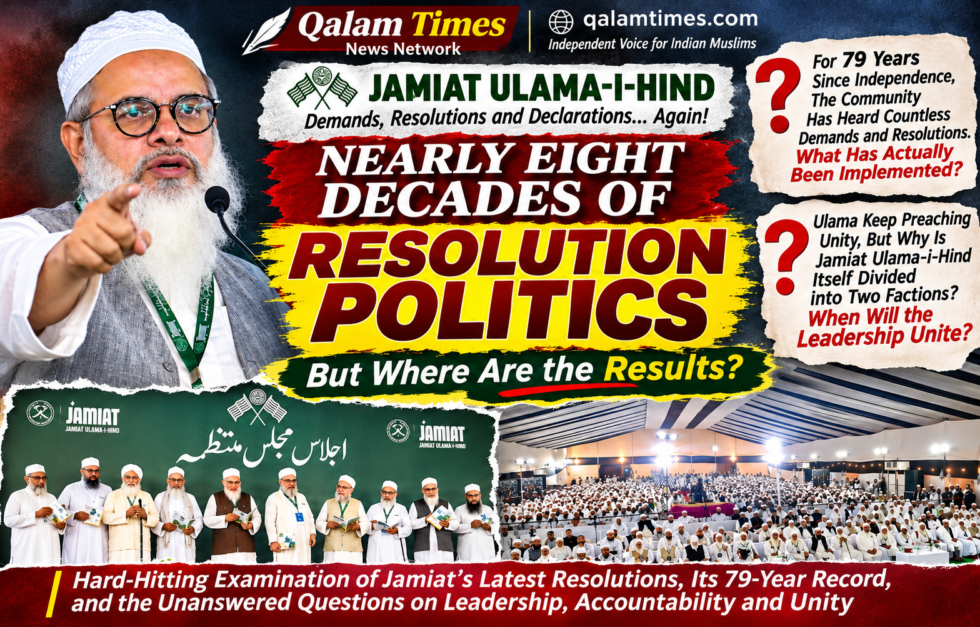
Nearly Eight Decades of Resolution Politics expose questions about Muslim leadership, unfulfilled demands, institutional accountability and the division within Jamiat Ulama-i-Hind.
By Qalam Times News Network
Kolkata, October 31, 2026
The Politics of Endless Demands, Unfulfilled Promises and Divided Leadership
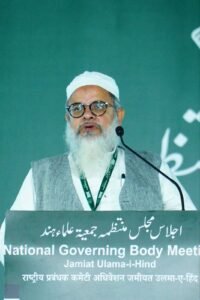
Resolution Politics has become an uncomfortable question that Muslim leadership in India can no longer escape. For nearly eight decades since India’s independence in 1947, the Muslim community has witnessed countless resolutions, declarations, memorandums, appeals and demands from its religious and organisational leadership. Yet, the fundamental question remains: Where is the comprehensive record of implementation, and what tangible results have these repeated resolutions delivered?
The latest press release issued by Jamiat Ulama-i-Hind following its two-day meeting on October 30 and 31, 2026, once again presents an extensive list of concerns relating to Islamophobia, hate speeches, mob lynching, bulldozer demolitions, attacks on mosques, madrasa harassment, Waqf properties, the Uniform Civil Code and Palestine. These are serious issues deserving sustained attention. But after nearly eight decades of independence, the Muslim community has every right to ask why its leadership continues to announce demands without presenting a comprehensive account of what has been achieved.
Nearly eight decades have passed, but how many resolutions have translated into concrete results? How many promises have been fulfilled? How many demands have secured lasting policy changes? Where is the institutional record showing what was achieved, what failed and who was responsible?
The community needs answers, not another collection of declarations.
Nearly Eight Decades of Resolution Politics : Where Are the Results?
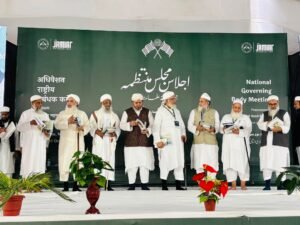
The question is straightforward: What has the Muslim leadership achieved through its repeated resolutions and demands since independence?
A resolution is not an achievement. A memorandum is not a victory. A press statement is not an implementation report. The latest meeting again called for action against hate crimes, special fast-track courts, protection of mosques, reconsideration of Waqf legislation and safeguards for madrasas. These are important demands. But where is the detailed record of their implementation?
Why has the organisation not published a comprehensive performance report documenting its major resolutions, the actions taken, the government departments approached, the legal proceedings initiated and the outcomes secured?
The organisation has instructed its provincial and local units to submit memorandums to the authorities on a designated day. It has also directed mosque committees to complete their land records and other legal documentation within six months.
But what happens after the memorandums are submitted? Who will monitor the authorities? Who will follow up on the demands? Who will publish the progress report? Who will be held responsible if the instructions remain unimplemented?
The same questions apply to madrasa protection, mob lynching, hate crimes and bulldozer demolitions. How many affected families have received meaningful legal assistance? How many cases have reached successful conclusions? How many institutions have been protected through sustained intervention?
It would be unfair to deny the organisation’s historical achievements and individual interventions. However, isolated successes cannot replace a systematic record of institutional performance.
The Muslim community deserves a transparent account of nearly eight decades of organisational activity, based on available historical records.
Preaching Unity While Remaining Divided: Why Did Jamiat Split?

Perhaps the most uncomfortable contradiction in the latest declaration concerns the repeated emphasis on unity and mutual understanding. The press release speaks about national unity, collective responsibility and the importance of resolving differences through dialogue. Maulana Mahmood Asad Madani also emphasises that differences of opinion should not automatically become hostility. These are admirable principles. But the question is unavoidable:
Why did Jamiat Ulama-i-Hind itself split into two factions in 2008?
Why did an organisation with a historic legacy dating back to 1919 fail to resolve its internal leadership differences?
Why did the differences between Maulana Arshad Madani and Maulana Mahmood Madani develop into two separate organisational factions?
If unity is a fundamental religious and communal obligation, why has it proved so difficult to establish within the leadership itself?
Why should ordinary Muslims be instructed to forget their differences when senior leadership has struggled to demonstrate the same commitment?
Is unity important only when the community is being asked to demonstrate it, or is it equally important when leadership positions and organisational authority are involved?
Religious scholars have every right to disagree. Differences of opinion are natural. But when disagreements become permanent organisational divisions, the consequences extend far beyond the individuals involved.
What message does this send to younger generations who are looking for credible, united and accountable Muslim leadership?
If the differences were administrative, why could they not be resolved through transparent constitutional procedures and mediation?
If both factions genuinely claim to represent the interests of the Muslim community, what prevents them from building a common institutional platform?
The community deserves a clear answer.
Who Will Hold the Leadership Accountable?
Maulana Mahmood Madani’s appeal to workers to stop complaining and enter the field of practical struggle raises an important question.
Who will ensure that the leadership itself follows this advice?
When resolutions are passed, who monitors their implementation? When campaigns fail to produce results, who explains the failure? When local units receive instructions, who checks their performance?
The community cannot continue operating under a system in which leaders announce resolutions, evaluate their own performance and expect unquestioning approval. If Jamiat can instruct its provincial and district units to prepare annual action plans, the central leadership should also publish an annual accountability report. Such a report should include completed programmes, pending commitments, legal achievements, expenditure, measurable outcomes and reasons for delays.
Why should accountability apply to local office-bearers but not to the central leadership?
Memorandums Are Not Movements
Submitting memorandums is a legitimate democratic activity. But a memorandum should be the beginning of a campaign, not its conclusion. Consider the Waqf issue. The latest resolution calls for reconsideration of the Waqf (Amendment) Act 2025 and proposes an independent institution modelled on the Shiromani Gurdwara Parbandhak Committee. Where is the detailed blueprint? Who will prepare the legal framework? What institutional safeguards will be established? What is the timetable for pursuing the proposal?
The same questions apply to mosque protection, the Places of Worship Act 1991, madrasa security and legal challenges.
A serious organisation must move beyond announcing what it demands and demonstrate how it intends to secure those demands.
Religious Authority Must Not Become Immunity from Questions
Religious scholars deserve respect for their knowledge and service. But respect must never become immunity from institutional scrutiny.
The Muslim community must be able to question organisational decisions without being accused of disrespecting scholars.
It must be able to demand financial transparency, constitutional compliance and measurable results without being labelled disloyal.
Constructive criticism is not an attack on religion. It is a necessary condition for institutional improvement.
The greater the moral authority an organisation claims, the greater its responsibility to demonstrate transparency and accountability.
Questions That Cannot Be Avoided Any Longer
After nearly eight decades of independence, the following questions deserve direct answers:
- Where is the comprehensive record of the resolutions passed and demands made by Muslim organisations since 1947?
- How many major demands have translated into measurable legal, administrative or policy outcomes?
- Why is there no publicly accessible consolidated accountability report covering the organisation’s work?
- Why did Jamiat Ulama-i-Hind split into two factions in 2008?
- What is the present status of reconciliation between the two factions?
- Why has institutional unity remained so difficult among those who repeatedly preach unity to the Muslim community?
- When will leadersh
Nearly Eight Decades Have Passed. The Community Deserves Results.
Jamiat Ulama-i-Hind has a distinguished historical legacy, and its contribution to India’s freedom movement deserves recognition. But historical prestige cannot serve as a permanent substitute for contemporary accountability. The Muslim community needs institutions capable of defending constitutional rights, protecting educational establishments, safeguarding places of worship, providing legal assistance and developing a new generation of responsible leadership. It does not need an endless cycle of meetings, declarations and resolutions without transparent evaluation. The most important question arising from the latest meeting is not how many resolutions were passed or how many prominent scholars attended.
It is this: What will actually change because of what was announced today? And to the religious scholars who repeatedly preach unity, one final question must be asked:When will you unite your own institutions before asking the entire Muslim community to unite?
Nearly eight decades after independence, the community cannot afford another generation of unanswered questions. The time has come for leadership to move beyond the politics of announcements and submit itself to the discipline of performance.The community needs results, not rhetoric; accountability, not ceremonial resolutions; and united leadership, not competing centres of authority.
By Dr. Mohammad Farooque