



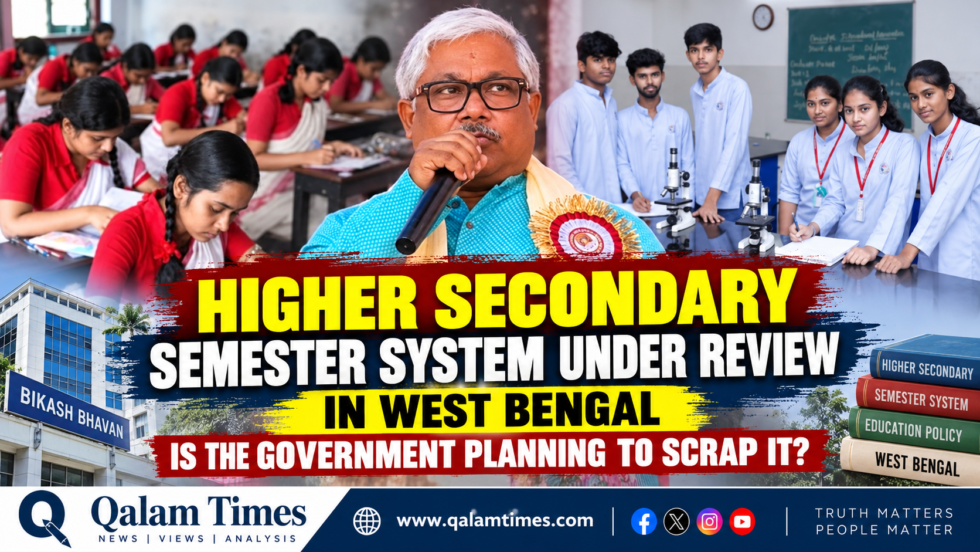
Higher Secondary Semester System in West Bengal may face changes as Education Minister Dipak Barman reviews teachers’ concerns. Will the government scrap the semester pattern?
By Qalam Times News Network
Kolkata, October 30, 2026
The Higher Secondary Semester System in West Bengal may undergo a major review, with growing speculation that the state government could reconsider the examination pattern introduced during the previous Trinamool Congress administration. Recent remarks by Education Minister Dipak Barman have triggered discussions among teachers, students and educational circles about the future of the semester-based system.
Although no official decision has been announced regarding its withdrawal, the Education Minister‘s comments suggest that the government is examining concerns raised by teachers about the effectiveness of the existing examination structure. The possibility of changes to the Higher Secondary Semester System has therefore become an important subject of discussion in the state’s education sector.
Speaking about the issue, Barman said that several teachers had approached the government and expressed dissatisfaction with the way the semester system was functioning. According to him, a considerable section of the teaching community believes that students are not receiving the expected academic benefits under the current arrangement.
The minister stated that, from his perspective as a teacher, the matter deserves serious consideration and that the government has kept it under review.
He said, “Many teachers have told us that students are not benefiting adequately from the semester system. This is the opinion held by a significant section of the teaching community. As someone who is also a teacher, I believe the matter needs to be examined, and we are keeping it under review.”
However, the minister did not announce any immediate change or confirm that the existing examination structure would be discontinued.
How the Semester System Changed Higher Secondary Education in West Bengal
West Bengal’s Higher Secondary examination structure has undergone several changes over the years.
Initially, students appeared for the Higher Secondary examination after completing Classes XI and XII, with the two academic years forming part of the overall assessment structure. Subsequently, the examination system was revised, and the final Higher Secondary examination was primarily based on the Class XII syllabus.
A further major reform was introduced during the previous Trinamool Congress government, when the semester-based examination pattern was implemented.
Under the revised arrangement, students are required to appear for four examinations across Classes XI and XII. The system was introduced with the objective of dividing the academic assessment process into smaller stages rather than concentrating the entire evaluation at the end of the Class XII academic year.
However, the implementation of the new structure has reportedly generated concerns among sections of the teaching community.
Several teachers have argued that the semester-based arrangement has created additional academic pressure and practical difficulties for students. Some educators have also questioned whether the system is contributing meaningfully to students’ overall academic development.
According to the concerns raised by teachers, the frequent examination schedule and the demands of completing the syllabus within the prescribed time have made the academic process more challenging in certain circumstances.
Government Reviewing Teachers’ Concerns as Possible Changes Emerge
The concerns surrounding the semester system have reportedly reached the state government’s School Education Department, with representations seeking a reconsideration of the existing examination pattern.
Following the change in government, discussions about reviewing the previous examination structure have gained attention. Reports also suggest that discussions have taken place at Bikash Bhavan, the administrative headquarters associated with the state’s education department, involving officials connected with the West Bengal Council of Higher Secondary Education.
These developments have further fuelled speculation about a possible revision of the examination system.
However, it is important to distinguish between discussions and an officially approved policy decision. Neither the Education Minister nor the concerned authorities have confirmed that the semester system will be scrapped from the next academic session. For the moment, the government appears to be examining the feedback received from teachers and other stakeholders before taking any final decision.
What Could the Decision Mean for Students?

Any decision concerning the future of the Higher Secondary examination system could have a direct impact on thousands of students studying in Classes XI and XII across West Bengal. If the government decides to modify the existing arrangement, the changes could affect examination schedules, syllabus distribution, academic planning and assessment methods. Students, teachers and parents are therefore waiting for greater clarity from the Education Department and the West Bengal Council of Higher Secondary Education.
Until an official notification is issued, students should continue preparing according to the existing examination rules rather than assuming that the semester system has already been withdrawn. The coming months may prove important for the future direction of Higher Secondary education in West Bengal. Whether the government retains the current semester arrangement, introduces modifications or returns to an earlier examination pattern will depend on the outcome of its review and the final policy decision.
For now, the Education Minister’s remarks have opened the door to a wider debate over whether the present examination structure is serving students’ academic interests as intended.