




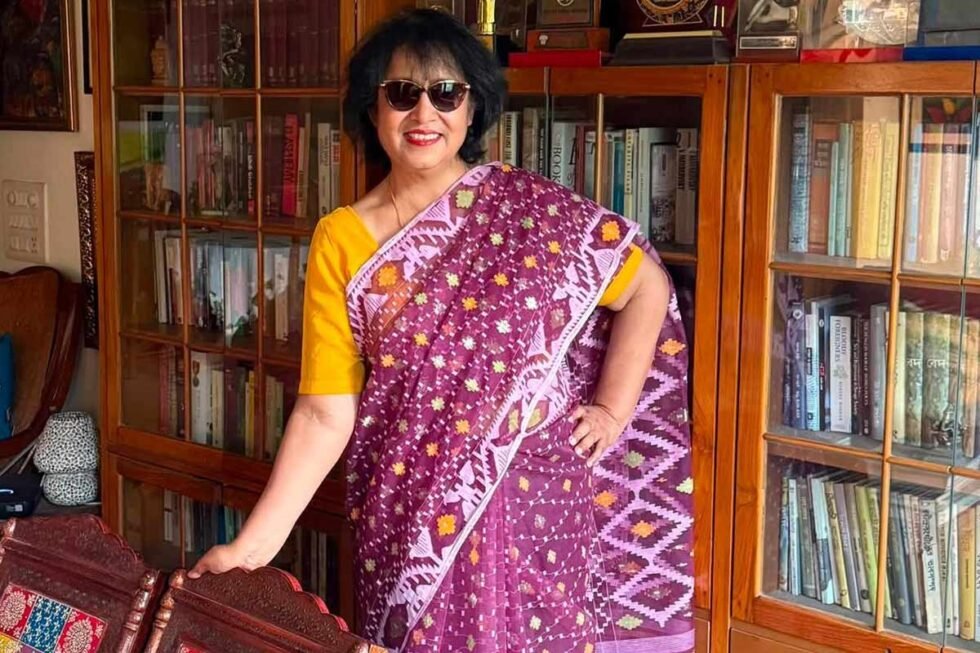
Vande Mataram sparks fresh debate as Taslima Nasrin speaks about her Bengali roots, cultural heritage, Partition memories and pluralistic Indian identity.
Qalam Times News Network
Kolkata. August 23, 2026
The writer says her salute to Vande Mataram is an affirmation of history, Bengali identity and a shared cultural inheritance—not a declaration of religious allegiance
Vande Mataram has once again become a subject of intense political and cultural debate in West Bengal, but writer Taslima Nasrin has approached the controversy from a distinctly personal and historical perspective. In a detailed Facebook post, the writer said she has no hesitation in saying Vande Mataram, explaining that for her the expression is connected with her roots, history and cultural inheritance rather than with any particular religious identity.
The debate surrounding Vande Mataram has gained fresh prominence as the country marks 150 years of Bankim Chandra Chattopadhyay’s celebrated composition. In West Bengal, the issue has acquired an additional political dimension, with the state’s new BJP government arguing that the song has not received the respect it deserves. The Chief Minister recently said that people living in the state would have to sing it, while sections of the Left have maintained that patriotism cannot be measured simply by whether a person sings a particular song.
It was against this politically charged backdrop that Nasrin, who recently returned to Kolkata after a long absence, made her position public. Her statement is significant not merely because of her views on the song, but because she connected the debate to the larger questions of identity, Partition, Bengali culture and the relationship between Bengal and the wider Indian civilisation.
Nasrin wrote that when she says Vande Mataram, she does not regard the expression as a declaration of religious identity. Rather, she sees it as an acknowledgement of her history, her roots and the cultural world from which she emerged.
That distinction is central to understanding her argument. For Nasrin, cultural identity does not necessarily fit within the boundaries created by modern political borders. She was born after Partition, but her parents belonged to undivided Bengal. The division of 1947 created a political and geographical boundary, she argues, but it could not erase the shared history, language, literature, memories and cultural traditions that existed before the border was drawn.
Her argument also reflects a broader understanding of Bengali identity. Bengal, she says, developed its distinctive cultural character through centuries of interaction with the wider Indian civilisation. But that relationship was never one-sided. Bengal did not simply receive influences from elsewhere; it also contributed significantly to India’s intellectual, literary, musical and reformist traditions.
This idea challenges a narrow interpretation of cultural nationalism. Nasrin’s reference to an undivided cultural India should not, in her formulation, be understood as a political demand for territorial reunification. Instead, she presents it as a reference to a historical and cultural space that existed before Partition and in which her ancestors participated.
That distinction is particularly relevant at a time when historical symbols are increasingly being interpreted through contemporary political arguments. A song, a language, a literary tradition or a cultural practice can carry meanings that extend beyond the political circumstances in which it is being debated.
Nasrin’s own relationship with Bengal adds another layer to the discussion. The Bangladeshi-born writer has spent decades at the centre of controversy because of her writings and outspoken criticism of religious fundamentalism. Her views resulted in serious opposition in Bangladesh and subsequently contributed to periods of displacement and uncertainty outside the country.
Her relationship with Kolkata has also been complicated. Although she found a degree of familiarity in West Bengal, her presence and writings remained controversial, eventually forcing her to spend extended periods outside the region. Her recent return to Kolkata, after roughly two decades, therefore carried considerable symbolic significance.
Her visit was organised by the voluntary organisation Secular Mission, while the state government also extended support and security. At Rabindra Sadan, she received a civic honour, and the Chief Minister publicly stated that she could visit Kolkata whenever she wished and that the government would be responsible for her security.
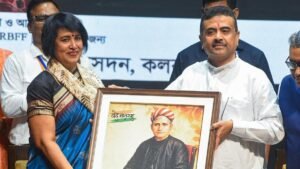
Nasrin responded with appreciation, but also made an important distinction: gratitude, she indicated, should not be confused with political loyalty. Her position was that receiving support from a government does not require surrendering one’s independence of thought.
That principle runs through her broader comments on Bengal and India. She has repeatedly placed freedom of expression and cultural pluralism at the centre of her public arguments. Her latest remarks similarly suggest that cultural belonging should not be reduced to a single political interpretation.
The controversy over Vande Mataram therefore raises a question larger than whether people should or should not sing a particular song. It asks how a democratic society should accommodate different understandings of patriotism.
For some, the song represents a powerful expression of national devotion. For others, patriotism is expressed through constitutional values, civic responsibility, social service, artistic creation or respect for fellow citizens. These approaches do not necessarily have to be mutually exclusive.
The danger begins when one interpretation of patriotism is presented as the only legitimate one. A democratic culture should have room for people to express their attachment to the country in different ways, provided that such expression does not infringe upon the rights of others.
Nasrin’s statement is particularly interesting because she does not reject the cultural symbolism associated with Vande Mataram. Instead, she claims it for herself through a different historical lens. Her invocation of the song is rooted in family history, pre-Partition Bengal and the cultural inheritance shared across geographical boundaries.
This perspective also highlights the complicated nature of Partition’s legacy. The border created in 1947 divided territories and transformed citizenship, but it could not instantly divide literary traditions, family memories, dialects, food, music and cultural practices. Bengali identity continues to contain memories of a landscape that existed before the political map was redrawn.
At the same time, such historical memory should not be used to erase the realities of present-day nations and their citizens. Respect for shared cultural heritage does not require denying contemporary political identities. The challenge is to acknowledge both realities without allowing one to destroy the other.
The response to Nasrin’s remarks will inevitably remain divided. Supporters may view her statement as an assertion of cultural confidence and pluralism, while critics may interpret it through the current political debate over nationalism. But the importance of her intervention lies precisely in the fact that it introduces another dimension into an argument that is often reduced to political slogans.
Her comments remind us that symbols acquire different meanings depending on the person, family and history through which they are experienced. For one citizen, Vande Mataram may primarily evoke national pride; for another, it may carry religious or literary associations; for Nasrin, it represents a connection to a cultural history that predates the Partition of Bengal’s political landscape.
The larger lesson is that India’s cultural inheritance is too vast and layered to be confined to a single interpretation. Bengal’s contribution to Indian literature, music, social reform and intellectual life is itself evidence of a civilisation shaped through continuous exchange.
A mature national conversation should therefore allow disagreement without turning cultural symbols into instruments of exclusion. Patriotism becomes stronger, not weaker, when citizens can engage with their history honestly and acknowledge its complexity.
Taslima Nasrin’s declaration that she says Vande Mataram without hesitation is ultimately less a statement about conformity than about ownership of cultural memory. Her argument is that she can recognise a historical and cultural inheritance without surrendering her right to interpret that inheritance independently.
In an era when identity is frequently presented as a choice between opposing camps, her intervention offers a different possibility: that people can acknowledge multiple layers of belonging at once. Bengal can be distinctly Bengali and deeply connected with the broader Indian cultural tradition; historical memory can coexist with present political realities; and patriotism can be expressed without demanding intellectual uniformity.
The debate over Vande Mataram is unlikely to end soon. But perhaps the more important conversation is about whether India’s plural society can make room for different ways of remembering, belonging and expressing love for the land.



Sahida Fakir: Husband Awaits Return Of Bengal Woman Sent To Bangladesh As ‘Infiltrator’ - Qalam Times