



Rajasthan UCC Bill tabled in Assembly amid Congress protests and walkout, with key provisions on marriage, inheritance, live-in relationships and polygamy.
By Qalam Times News Network
Jaipur, August 22, 2026
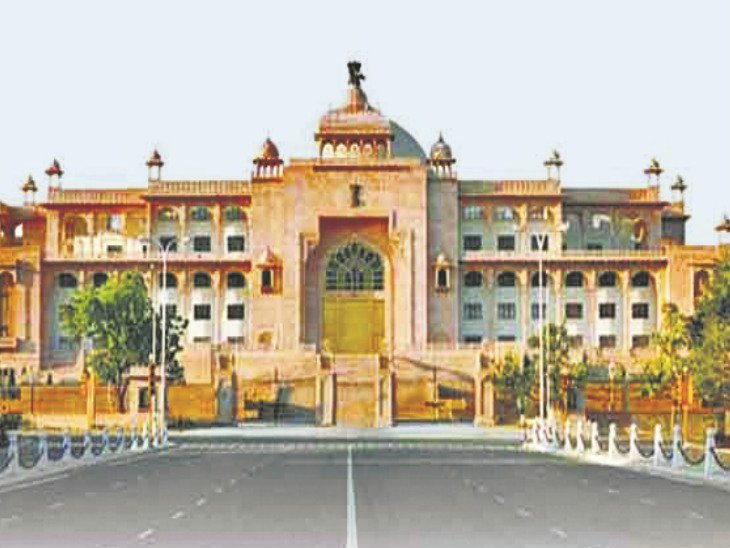
Jaipur: The Rajasthan UCC Bill was introduced in the state Assembly amid a stormy session on Friday, with Congress legislators protesting, raising slogans and eventually walking out of the House. Parliamentary Affairs and Law Minister Jogaram Patel tabled the proposed legislation as the Opposition accused the government of avoiding issues it wanted to raise on the floor of the Assembly.
The Rajasthan UCC Bill, which is expected to undergo debate before being put to a vote, proposes a common legal framework covering marriage, divorce, inheritance, maintenance and live-in relationships. The legislation was introduced on the second day of the Monsoon Session as repeated disruptions overshadowed the proceedings.
The trouble began during Question Hour after Leader of Opposition Tikaram Jully raised allegations that Congress MLAs had been stopped at the Assembly entrance. Jully also sought to raise the alleged assault of activists associated with the CJP who had reportedly visited schools for inspection.
The Speaker declined to permit the matter during Question Hour. Following the decision, Congress members entered the Well of the House, raised slogans against the BJP government and displayed posters targeting the administration.
BJP legislators responded with slogans directed at Congress leader Rahul Gandhi, while both sides exchanged sharp political accusations. The escalating confrontation forced the Speaker to adjourn the House first until noon and subsequently until 1 p.m.
When the Assembly resumed, the protest continued. Despite the uproar, Minister Jogaram Patel proceeded to introduce the Rajasthan UCC Bill.
Congress MLAs later announced a boycott and left the Assembly at around 1:21 p.m. Jully alleged that the Opposition was not being given adequate opportunity to raise matters concerning the public and accused the government of giving priority to its legislative programme over issues raised by elected representatives.
The Speaker had earlier appealed to Congress members to allow the Finance Department’s demands for grants to be taken up. A heated exchange also took place between members of the treasury and Opposition benches over the alleged assault involving CJP activists.
Patel accused the Congress of acting against democratic norms and alleged that the Opposition had failed to bring substantive issues before the House. Government Chief Whip Jogeshwar Garg claimed that Congress legislators had been accompanied by outsiders and what he described as “anti-social elements” when they arrived at the Assembly the previous day, leading to their being stopped at the gate.
After the Congress walkout, Patel alleged that differences within the Opposition party were responsible for the disruption. He claimed the protest was intended to prevent the Leader of the Opposition from gaining political credit and accused Congress of attempting to create a political spectacle while misleading the media.
The government maintained that the Assembly had important legislative and financial business to conduct and said proceedings would continue despite the absence of Congress members.
What the Rajasthan UCC Bill Proposes
According to the government, the proposed legislation is based on the recommendations of an expert committee headed by former Supreme Court judge Justice Ranjana Prakash Desai.
The Bill seeks to establish common rules in several areas of personal law while allowing communities to continue solemnising marriages according to their respective customs and traditions.
Among its key provisions are:
• Mandatory marriage registration: Marriages solemnised after the law comes into force would have to be registered within 60 days.
• Prohibition of polygamy: The proposed law would prohibit polygamous marriages.
• Protection of customary practices: Religious and community-specific traditions for solemnising marriages would continue, subject to the common legal framework governing registration and related matters.
• Exemption for Scheduled Tribes: The proposed provisions would not apply to Scheduled Tribes and other constitutionally protected communities whose customary rights are safeguarded.
• Live-in relationships: The draft proposes registration or written intimation concerning the beginning and termination of live-in relationships, with the stated objective of protecting the rights of those involved.
• Inheritance: Sons and daughters would receive equal inheritance rights. The Bill also establishes an order of succession where a person dies without leaving a will.
The government has presented the legislation as an attempt to establish consistency in personal-law-related matters while retaining constitutionally protected customary rights.
Alongside the UCC legislation, the government has proposed the Rajasthan Trees (Protection) Bill, 2026, aimed at regulating the cutting of trees growing on non-forest land.
The draft legislation identifies 29 species for special protection. These include the khejri, Rajasthan’s state tree, along with rohida, banyan, peepal, lasoda, tendu, mahua, ker and chironji.
Under the proposed law, cutting a protected tree on non-forest land without prior approval from the competent authority would be prohibited. Violators could face imprisonment of up to one year, a fine of up to Rs 1 lakh, or both.
Where permission is granted for removing a protected tree, the person concerned would also be required to plant a prescribed number of trees in the same area.
The state cabinet, chaired by Chief Minister Bhajanlal Sharma, also approved an operations and maintenance policy for rural drinking-water supply schemes.
The policy incorporates 19 major components associated with the Centre’s Jal Jeevan Mission 2.0. Under the proposed arrangement, gram panchayats and village water and sanitation committees would take responsibility for the day-to-day operation and maintenance of rural water-supply infrastructure.
The government said the policy is intended to strengthen local participation and ensure the long-term functioning of rural drinking-water systems.
The cabinet also approved an amendment concerning compassionate appointments for families of soldiers connected with the 1971 India-Pakistan war.
According to the government, 326 Rajasthan soldiers were killed during the war. Another 35 soldiers who suffered serious injuries during the conflict subsequently died while undergoing treatment between January 1 and October 31, 1972.
The amendment extends the relevant cut-off period, making the families of those 35 soldiers eligible for compassionate appointments.
The cabinet approved a two-year relaxation in the required experience for promotions during the 2026-27 financial year for government employees who had not received the relevant promotion benefit during the preceding three years.
It also approved amendments providing notional benefits from June 30, 2016, in relation to reservation in promotions for government employees with disabilities.
Another decision expands the category of eligible dependants for compassionate appointment to include daughters-in-law of deceased government employees. Changes were also approved concerning maternity leave and child-care leave provisions.
In another set of decisions, the Rajasthan government approved the allotment of approximately 306 hectares of industrial land in Jaisalmer district to UltraTech Cement Ltd.
Land was also approved for four renewable-energy projects spread across Bikaner, Jaisalmer and Barmer districts.
The Assembly’s proceedings continued after the Congress walkout, with the government proceeding with its legislative and other scheduled business.