



OBC Creamy Layer income-test policy remains unresolved as a House panel chief says the issue is stuck between two Union ministries amid Supreme Court observations.
By Qalam Times News Network
New Delhi | August 29, 2026
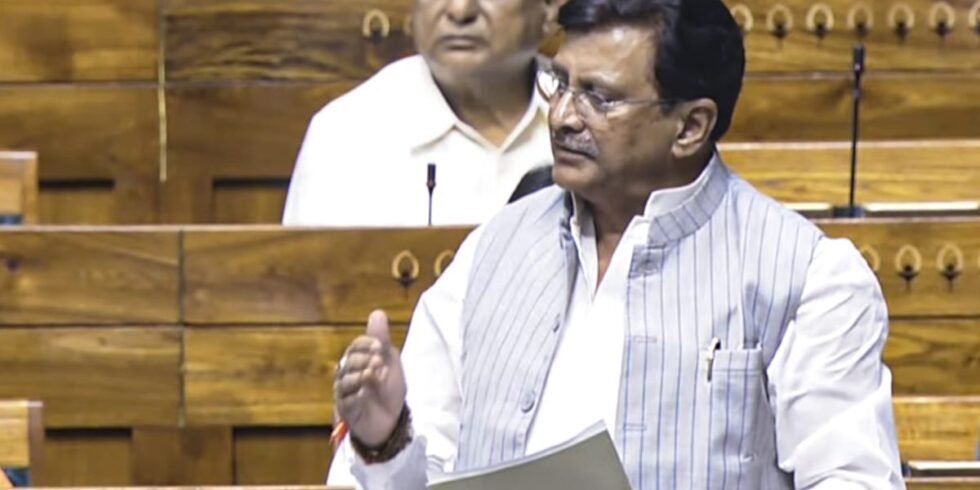
New Delhi: The OBC Creamy Layer income-test issue continues to remain unresolved, with BJP MP Ganesh Singh, chairman of the Parliamentary Committee on the Welfare of Other Backward Classes, saying that the matter appears to be caught between the Ministry of Personnel, Public Grievances and Pensions and the Ministry of Social Justice and Empowerment.
Singh said the OBC Creamy Layer policy relating to the equivalence of posts and the application of the income test should ideally have been prepared by the Ministry of Social Justice and Empowerment. According to a report by The Hindu, he said such a policy could then have been placed before the Union Cabinet for consideration, but this process has not yet taken place.
The issue follows a significant observation by the Supreme Court in its March 11 judgment concerning the criteria used to determine whether an OBC candidate falls within the creamy layer. The court had made it clear that the salary or income of a parent employed by a private company or a public sector undertaking cannot, by itself, be the sole basis for determining creamy-layer status.
The Supreme Court also emphasised that the nature, level and status of the parent’s employment must be considered while applying the exclusion criteria. The Union government has subsequently approached the apex court seeking clarification on the income-test component of the creamy-layer criteria.
OBC : Policy Responsibility Remains Unclear
According to Singh, there appears to be a lack of clarity over which ministry should take the lead in framing the policy required to implement the Supreme Court’s observations.
He said the personnel ministry and the social justice ministry appear to be shifting responsibility between themselves. In his view, the Ministry of Social Justice and Empowerment should have taken the initiative to formulate a framework for determining equivalence between different posts and for applying the income test. Such a framework could then have been submitted to the Cabinet for approval.
The delay has become a matter of concern because the Supreme Court’s observations have implications for OBC applicants whose parents work in government-linked organisations, state public sector undertakings, private companies and other institutions where determining the equivalent status of a post may not be straightforward.
The Union government has already told the Supreme Court that establishing equivalence for all existing state public sector undertakings could itself take as long as two years. The government has further indicated that determining equivalent positions in the private sector could require even more time because of the wide variation in organisational structures and job classifications.
The government’s position has raised questions among OBC representatives and student organisations, who argue that the implementation process should not result in prolonged uncertainty for candidates seeking reservation benefits.
The All India OBC Students Association has strongly criticised what it described as the government’s delay in resolving the matter. The organisation said that, from the perspective of the Prime Minister’s Office and the Department of Personnel and Training, resolving the questions surrounding post equivalence and the income test should not require an extended administrative process.
The association argued that the problem is not a lack of administrative capacity or time, but rather the absence of sufficient political commitment to address the concerns of OBC communities.
It called upon the Union government to stop delaying what it described as justice for OBC candidates and demanded concrete steps to implement the Supreme Court’s ruling.
At the centre of the dispute is the broader question of how the creamy-layer exclusion should operate when a parent’s income is high but the nature and status of the parent’s occupation may not independently justify exclusion from OBC reservation benefits.
The Supreme Court’s observations have therefore created a need for a clear and uniform mechanism that can distinguish between income alone and the status of the post held by a parent.
Until such a framework is formally formulated and approved, uncertainty is likely to continue for OBC candidates, government departments and educational institutions dealing with reservation-related applications.
The controversy also places greater pressure on the concerned ministries to coordinate their approach and establish clear rules that can be applied consistently across government, public-sector and private-sector employment.
For OBC students and job aspirants, the outcome of the government’s discussions and its pending clarification proceedings before the Supreme Court could have significant consequences for the way creamy-layer eligibility is assessed in future.