



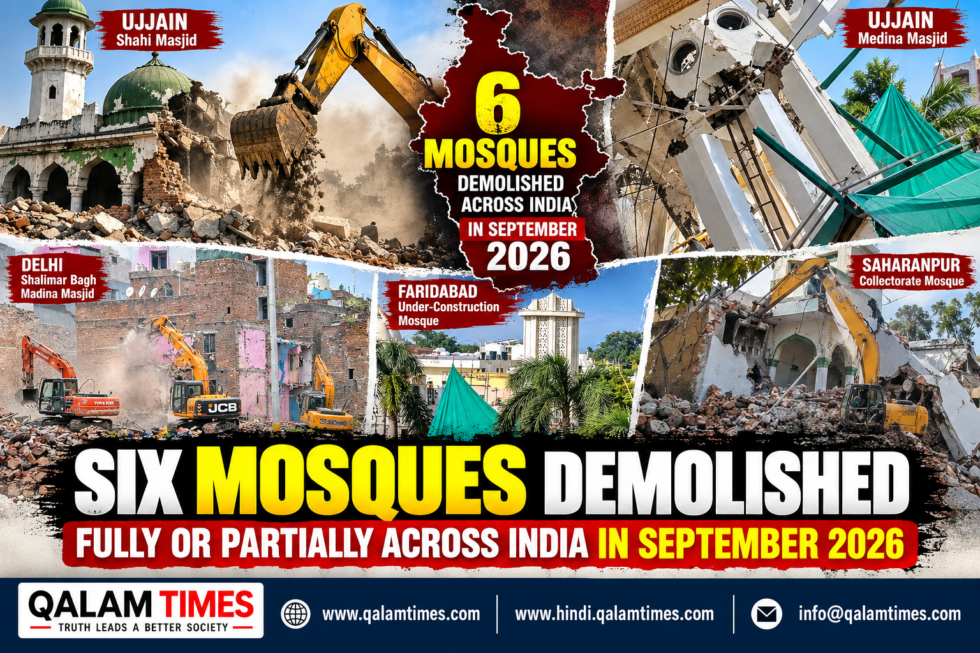
Mosque demolitions in India during September 2026 affected six reported sites, raising questions about road widening, land disputes, legal procedures and heritage protection.
By Qalam Times News Network
Kolkata | October 14, 2026
Mosque demolitions in India became a major subject of concern in September 2026, when at least six mosques were reportedly demolished in full or in part across Madhya Pradesh, Delhi, Haryana and Uttar Pradesh. According to media reports cited in the source material, five of the affected structures were described as having historical significance, with some estimated to be more than a century old.
The reported actions were carried out for various reasons, including alleged encroachment on government land, the absence of approved building plans, road-widening projects and other development-related requirements. Some cases were also associated with legal proceedings and disputes over land ownership. The incidents have prompted questions about administrative procedures, the preservation of historical religious structures and the protection of the legal rights of mosque management committees.
The reported mosque demolitions in India included several incidents in Ujjain, Madhya Pradesh, where road expansion was being undertaken ahead of the 2028 Simhastha Kumbh Mela. Other cases were reported in Delhi’s Shalimar Bagh, Faridabad in Haryana and Saharanpur in Uttar Pradesh. Although authorities cited legal or development-related grounds for their actions, some local residents and mosque representatives disputed aspects of the operations, including claims concerning land ownership, procedural fairness and the extent of the damage.
The following report examines the six cases described in the available media accounts. Allegations and disputed claims are attributed to the relevant parties because they have not all been independently verified.
Ujjain Records Multiple Cases as Road-Widening Work Affects Mosques
Ujjain accounted for several of the reported incidents during September. The city is preparing for the 2028 Simhastha Kumbh Mela, a major Hindu religious gathering, and road-widening projects have affected sections of existing religious structures.
1. Shahi Masjid, Ujjain: Damage to an Approximately 600-Year-Old Structure
Date: September 28, 2026
A portion of Ujjain’s historic Shahi Masjid was affected during road-widening work undertaken ahead of the 2028 Simhastha Kumbh Mela. The mosque is estimated to be approximately 600 years old.
According to the reports cited in the source material, the administration intended to remove the section of the mosque that fell within the proposed road boundary. The mosque management had reportedly agreed to the removal of a portion measuring approximately three feet.
However, the operation took an unexpected turn when a minaret collapsed towards the mosque rather than falling outward, damaging part of the interior. As a result, the work intended to clear the road-facing section also affected the inner portion of the religious structure.
Local residents questioned how the collapse occurred, with some alleging that the incident was not accidental. The administration rejected allegations of a conspiracy and described the damage as an accident.
Tensions reportedly escalated after demolition work began on September 28. Protests developed into clashes between some residents and the police, and tear gas was reportedly used to disperse the crowd. Police also accused protesters of pelting stones.
The incident has raised questions about the planning and execution of demolition operations involving old religious buildings. It has also highlighted the importance of adequate safety measures, technical assessments and clear agreements when authorities undertake work near structures of historical or religious significance.
2. Madina Masjid, Shalimar Bagh, Delhi: Midnight Demolition Operation
Date: September 23, 2026
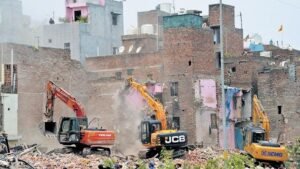
The Municipal Corporation of Delhi (MCD) demolished part of Madina Masjid in Shalimar Bagh during a late-night operation conducted under heavy police security.
Officials reportedly maintained that the mosque obstructed the road-widening project on Max Hospital Road and constituted an unauthorised encroachment. The mosque was described in the source reports as being approximately three decades old.
Media accounts stated that the MCD had issued notices before carrying out the demolition, a detail reportedly acknowledged by the mosque’s imam. Nevertheless, the timing of the operation and the circumstances surrounding it drew objections from local residents and the mosque management.
Social activist Nadeem Khan reportedly said that the Rafiq-e-Millat Trust, which managed the mosque, had challenged the municipal notice in court. According to Khan, a hearing scheduled for September 21 could not proceed because the government lawyer was absent. He alleged that the authorities demolished part of the mosque with a bulldozer the following night.
These claims require independent verification, including examination of the relevant court records and municipal notices. The case nevertheless raises questions about the timing of administrative action, the status of pending legal proceedings and the opportunity available to affected parties to pursue legal remedies before demolition takes place.
The incident also underscores the need for transparency when local authorities enforce road-widening plans that affect established places of worship.
3. Under-Construction Mosque, Faridabad, Haryana: Dispute Over Building Approval
Date: September 22, 2026
The Municipal Corporation of Faridabad (MCF) demolished an under-construction mosque in Ganpati Colony, in the Palla area, using a JCB machine.
Municipal officials said the structure had been built without an approved building plan and was therefore unauthorised. Local Muslim residents opposed the action, arguing that the premises had existed for approximately 15 years.
Residents also alleged that complaints from individuals associated with the Rashtriya Swayamsevak Sangh (RSS) and Bajrang Dal had contributed to the demolition. The available material does not independently establish these allegations.
The operation reportedly led to a confrontation between women protesting the demolition and police and administrative personnel. Eyewitnesses alleged that some women were assaulted and that their clothing was torn during the confrontation. These allegations would require verification through independent accounts, official records and any available video evidence.
The incident raises two distinct issues: whether the building complied with applicable planning regulations and whether the authorities acted lawfully and proportionately while dealing with protesters.
Both questions warrant scrutiny. Enforcement of building regulations should follow established procedures, while allegations of excessive force during protests should be investigated through appropriate accountability mechanisms.
4. Husami Masjid, Ujjain: Road Expansion Affects a Section of the Mosque
Date: September 11, 2026
A section of Husami Masjid in Ujjain was removed during municipal road-widening work linked to preparations for the 2028 Simhastha Kumbh Mela.
According to the reports cited in the source material, approximately 8 to 8.5 feet of the mosque’s road-facing portion fell within the area identified for expansion.
Media accounts stated that the affected section was removed with the consent of the Bohra community and the mosque management, with some members of the community participating in the process.
Unlike cases involving allegations of disputed land ownership or objections to the demolition itself, the available reporting presents this incident as one in which the affected community reportedly consented to the removal of the identified portion.
Nevertheless, the case illustrates the importance of documenting agreements between civic authorities and religious institutions before development work begins. Clear records of the agreed area, the method of removal and the safeguards for the remaining structure can help prevent misunderstandings and reduce the risk of unintended damage.
5. Approximately 150-Year-Old Mosque, Saharanpur, Uttar Pradesh: Dispute Over Government Land
Date: September 5, 2026
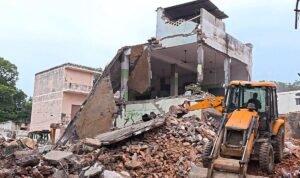
An old mosque located within the Saharanpur Collectorate complex in Uttar Pradesh was demolished by the administration under heavy police security. The structure was estimated to be approximately 150 years old.
Authorities maintained that the mosque had been illegally constructed on government land. The action followed proceedings initiated after a complaint by Vikas Tyagi, described in the source material as a former provincial coordinator of the Bajrang Dal.
According to the available reports, the City Magistrate had ordered the removal of the mosque on July 16, 2026, and imposed a fine of approximately ₹6.41 crore. The mosque management challenged the decision, but its appeal was dismissed by the District Court on September 2. The demolition followed on September 5.
However, the reported sequence of events raises questions about the legal basis and scope of the administrative action. Media reports indicated that the September 2 court order did not expressly direct the immediate demolition of the structure, but upheld the earlier removal or eviction order. The mosque’s mutawalli, or caretaker, reportedly questioned whether an eviction order automatically authorised the destruction of the religious building.
The mosque committee disputed the administration’s claim regarding ownership of the land. It maintained that the property belonged to the Waqf Board and cited documents dating back to 1911 in support of its position that the mosque had existed for more than a century.
The management subsequently approached the Allahabad High Court. According to the source material, on September 11 the High Court stayed recovery of the approximately ₹6.41 crore fine until the next hearing and sought a response from the state government. The next hearing was scheduled for October 12, 2026.
The available information does not establish the final outcome of the ownership dispute or the complete legal status of the demolished structure. Those questions depend on the relevant land records, administrative orders and judicial proceedings.
The case highlights the importance of distinguishing between an order concerning possession or eviction and the legal authority required to demolish a building. It also raises broader questions about the treatment of religious structures on disputed land and the remedies available to their management committees.
6. Medina Masjid, Ujjain: Partial Demolition Near KD Gate
Date: September 1, 2026

The local administration partially demolished a section of Medina Masjid near KD Gate in Ujjain as part of road-widening work associated with preparations for the 2028 Simhastha Kumbh Mela.
The operation reportedly took place in the presence of municipal officials and a substantial police deployment. Media reports estimated the mosque’s age at between 100 and 150 years.
The action formed part of a wider series of operations affecting mosques in Ujjain during the month. The administration’s stated objective was to clear sections of the road affected by existing structures, although the wider implications for historical religious buildings have attracted attention.
Road expansion and other public infrastructure projects can require difficult decisions when existing buildings occupy areas designated for development. Where religious or heritage structures are involved, authorities must also consider the applicable legal framework, the status of the land, the views of affected communities and the possibility of avoiding unnecessary damage.
The Medina Masjid case therefore forms part of a broader discussion about balancing infrastructure requirements with the preservation of established places of worship.
Legal Procedures, Heritage Protection and Administrative Accountability
The six reported cases differ in their circumstances. Some involved road-widening projects, while others centred on allegations of unauthorised construction or disputes over government and Waqf land. In certain instances, the source material describes reported consent from mosque management; in others, local representatives contested the authorities’ position.
These differences matter. The incidents should not be treated as legally identical, and the available accounts do not establish that every demolition was unlawful or that all disputed allegations were substantiated.
At the same time, the cases raise several common questions. Were the relevant notices and orders properly served? Were pending legal proceedings taken into account? Did the authorities clearly identify the portions to be removed? Were appropriate precautions taken to protect the remaining structures? And, where protesters alleged mistreatment, were those allegations investigated?
Historical age is another important consideration. A building’s age alone does not automatically determine its legal status or prevent lawful enforcement action. However, where a structure has religious, architectural or historical significance, its preservation deserves serious consideration before irreversible work is undertaken.
Transparent decision-making, access to legal remedies and clear communication between civic authorities and affected communities can help reduce conflict and protect public confidence in administrative processes.
The six reported mosque demolitions during September 2026 have brought attention to the challenges that arise when infrastructure development, land disputes and religious heritage intersect.
In Ujjain, several cases were associated with road-widening work ahead of the 2028 Simhastha Kumbh Mela. In Delhi and Faridabad, municipal authorities cited road expansion or the absence of approved building plans. In Saharanpur, the central dispute concerned the legal status of the land and the interpretation of administrative and judicial orders.
The circumstances of each case require separate examination, supported by official records, court documents and independently verified reporting. Where authorities have acted within the law, their stated grounds should be assessed on the evidence. Where affected communities have raised credible questions about procedure, ownership or the use of force, those concerns should receive appropriate scrutiny.
Ultimately, development and the preservation of religious and historical heritage need not be treated as mutually exclusive objectives. Careful planning, fair procedures, legal accountability and meaningful consultation can help authorities carry out public projects while minimising avoidable damage and protecting the rights of affected communities.