



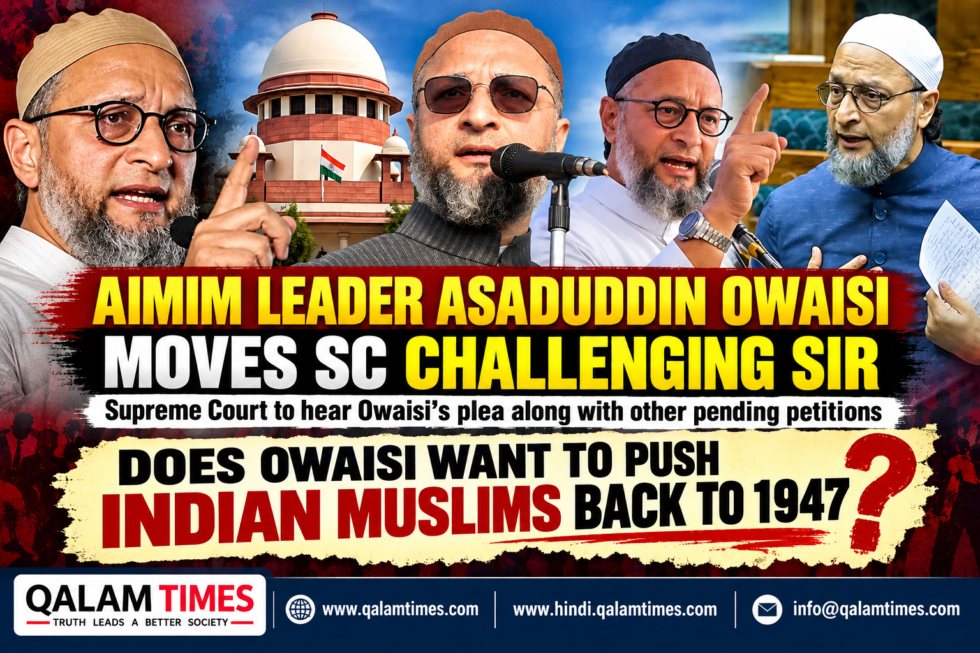
Owaisi’s political strategy faces scrutiny as his Supreme Court plea against SIR raises questions about Muslim leadership, electoral rights and political alliances in India.
By Qalam Times News Network
Kolkata / New Delhi | October 14, 2026
Asaduddin Owaisi’s political strategy has come under renewed scrutiny amid a growing debate over Muslim political representation, electoral rights and the future direction of minority politics in India. The AIMIM chief on Wednesday approached the Supreme Court challenging the manner in which the Special Intensive Revision (SIR) of electoral rolls is being conducted, adding another petition to the legal challenges surrounding the exercise.
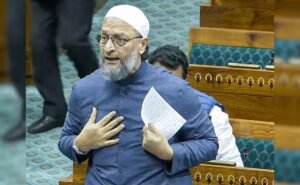
The Supreme Court agreed to consider Owaisi’s plea alongside other pending petitions on the issue. His move comes at a time when the revision of electoral rolls has become a subject of political and legal controversy, with opposition leaders raising concerns about alleged irregularities and the possible exclusion of eligible voters.
Owaisi’s political strategy also raises a broader question about the relationship between electoral representation and the long-term interests of Indian Muslims. While challenging the SIR process through the judiciary is a legitimate democratic course of action, the wider debate concerns how political parties can translate demands for electoral justice into sustained protection of citizens’ constitutional rights.
Supreme Court to Consider Owaisi’s Plea Alongside Other Petitions
Advocate Nizamuddin Pasha, appearing for Owaisi, requested that a bench comprising Chief Justice of India Surya Kant and Justice Joymalya Bagchi list the petition alongside similar matters scheduled to be heard on Thursday. Pasha explained that the plea concerned the manner in which the SIR exercise was being carried out and pointed to the relevant cases identified in the accompanying memorandum.
The Chief Justice-led bench indicated that it would examine the request and consider the petition in the context of the other pending matters. The development places Owaisi among the political leaders seeking judicial scrutiny of the electoral-roll revision process.
Congress leader Rahul Gandhi and ten other prominent opposition leaders have also approached the Supreme Court over alleged malpractices in the SIR exercise and related procedures. Their legal challenges reflect wider opposition concerns about the conduct of electoral-roll revisions and the implications for voters’ rights.
The allegations raised in these proceedings remain matters for judicial consideration. The filing of a petition does not, by itself, establish that irregularities have occurred, and the eventual legal outcome will depend on the arguments and evidence presented before the court.
The controversy has also revived questions about the responsibilities of political parties in safeguarding electoral participation. For communities that fear losing representation through the deletion of eligible voters’ names, access to legal remedies, transparent administrative procedures and effective public awareness are particularly important.
The Bigger Question: Who Can Claim to Represent Indian Muslims?
Owaisi’s legal challenge is one part of a much wider political discussion. His ambitions to expand the All India Majlis-e-Ittehadul Muslimeen (AIMIM) beyond its traditional stronghold in Hyderabad have prompted questions about the kind of political leadership Indian Muslims need and whether a party built around a distinct political identity can develop a broader, sustainable national presence.
In a democratic system, every political party has the right to contest elections, promote its ideology and seek public support. Owaisi’s reported ambitions to field candidates in as many as 100 constituencies in Uttar Pradesh, as discussed in the accompanying political commentary, should be understood within that democratic framework. However, the claim to represent Indian Muslims collectively invites a more demanding assessment of political objectives, organisational capacity and actual public service.
India’s Muslim population is geographically and socially diverse. Many Muslims live in areas where they constitute only a small proportion of the population and face challenges relating to education, employment, economic opportunity, social mobility and political representation. Their concerns cannot necessarily be addressed through the same electoral strategy in every state.
A political organisation seeking national influence must therefore demonstrate that it understands the different circumstances of Muslims in metropolitan centres, smaller towns, rural constituencies and states where the community has limited electoral strength.
The central question is not simply how many seats AIMIM can win. It is whether its political programme can strengthen the democratic participation, constitutional protections and everyday welfare of Muslims across different regions.
Gandhi, Nehru and Maulana Azad: Can History Be Separated from Politics?
A major theme in the accompanying Urdu commentary concerns Owaisi’s reported remarks at a political rally in Azamgarh, where references to the historical experiences of Partition and the political legacies of Mahatma Gandhi, Jawaharlal Nehru and Maulana Abul Kalam Azad reportedly featured in his appeal to Muslim voters.
According to the commentary, Owaisi argued that Indian Muslims needed leaders in the tradition of Maulana Azad rather than depending on Gandhi and Nehru. The political significance of such an argument deserves examination, particularly when historical personalities are invoked to justify a contemporary electoral programme.
Maulana Azad occupies a distinctive place in modern Indian history. A prominent scholar, freedom fighter and advocate of composite nationalism, he became independent India’s first Education Minister and served in Nehru’s Cabinet. His political approach emphasised the importance of Muslims remaining actively involved in India’s national life rather than separating their political future from the country’s broader democratic institutions.
The commentary refers to the 1949 Lucknow conference as an important moment in the discussion of Muslim political choices after Partition. It argues that Azad’s position combined a deep attachment to Islamic cultural heritage with an equally strong commitment to India as his homeland.
Whether one agrees with every aspect of Azad’s political strategy or not, his legacy cannot be fully understood by removing him from the historical and political circumstances in which he worked alongside Gandhi, Nehru and other leaders of the freedom movement.
The same principle applies to Gandhi and Nehru. Both figures remain legitimate subjects of historical criticism. Their political decisions, limitations and controversial positions should be examined critically. However, a balanced assessment must also consider their cooperation with minority leaders, their roles in the national movement and the complexities of the period surrounding Partition.
The Urdu commentary also highlights Gandhi’s efforts to contain communal violence in Calcutta in August 1947, when he stayed in a Muslim household rather than participating in the celebrations taking place elsewhere. It cites this episode as an example of the importance of considering the different dimensions of Gandhi’s political legacy.
The point is not that Gandhi, Nehru or Azad should be beyond criticism. Rather, historical interpretation becomes incomplete when political arguments select only those events that support a predetermined conclusion.
If Maulana Azad’s legacy is invoked as a model for contemporary Muslim leadership, his political philosophy, his relationship with the Congress and his understanding of national belonging must also form part of the discussion.
Does Criticism of Gandhi and Nehru Offer a Political Alternative?
The commentary raises another important question: who benefits politically when the legacy of Gandhi and Nehru is challenged, and what alternative is being proposed?
It draws a comparison between Owaisi’s reported criticism of these leaders and the ideological efforts of the Sangh Parivar to foreground figures such as V.D. Savarkar, Deendayal Upadhyaya and Syama Prasad Mookerjee in its interpretation of Indian political history.
The comparison does not mean that these political traditions are identical. It highlights a broader issue: rejecting historical figures is not, by itself, a substitute for explaining what should replace their political ideas and influence.
For Indian Muslims, criticism of the Congress leadership or the historical choices of the national movement must ultimately lead to a practical discussion of political rights, educational advancement, economic security and democratic participation.
The commentary also refers to the relationship between Gandhi and Maulana Muhammad Ali Jauhar during the Khilafat and Non-Cooperation movements. Their political cooperation illustrates how different ideological positions could sometimes converge around a shared political objective.
Such historical examples demonstrate that political alliances are shaped by circumstances, disagreements and competing priorities. Their success or failure cannot be understood through a single event or an isolated statement.
The challenge for contemporary leaders is to learn from these complexities rather than turn history into a collection of convenient political references.
Building Muslim Leadership Beyond Elections and Family Influence
One of the strongest arguments in the Urdu commentary is that genuine political leadership requires more than electoral victories, public speeches and television appearances. It requires an organisational structure capable of developing new leaders, educating young people, mobilising communities and maintaining contact with ordinary citizens.
The commentary cites the activities of CPI(ML) Liberation in university politics as an example of how ideological training and student organisations can contribute to the development of emerging political figures, even when a party has limited representation in Parliament.
The example points to a distinction between winning elections and building a durable political movement. Electoral representation is important, but it is only one measure of a party’s strength. Its ability to train activists, encourage debate, develop local leadership and remain engaged with social issues also matters.
In this context, AIMIM faces a question about the geographical reach of its organisational model. The Urdu commentary notes the long-standing influence of Owaisi’s family in Hyderabad and asks whether the party has developed a similarly sustainable framework for student politics, grassroots mobilisation and leadership development in Telangana, Andhra Pradesh and other states.
Family-based political influence does not automatically prevent the development of a wider movement. However, a party claiming to represent a diverse national community must demonstrate that leadership opportunities extend beyond a narrow circle and that its political structure can produce credible representatives in different social and regional settings.
The test is whether the organisation can nurture leaders whose public standing rests on competence, accountability and sustained community engagement rather than personal connections alone.
Bihar Elections and Questions About Political Transparency
The accompanying commentary also raises questions about candidate selection and ticket distribution in Bihar, including allegations that substantial sums of money were demanded or paid for electoral tickets.
These allegations have not been established as facts in the material provided and should not be treated as proven misconduct without independent verification. Nevertheless, the broader issue of transparency in candidate selection is relevant to any political party.
If financial resources become a decisive factor in securing nominations, parties risk weakening the role of grassroots workers, ideological commitment and public service. Such a system could also discourage capable candidates who lack substantial personal wealth.
The quality of political representation should be judged not merely by the number of elected representatives but by their performance, accessibility, legislative participation and commitment to public concerns.
For a party seeking to establish itself as a national voice for a marginalised community, transparent candidate selection and internal accountability are especially important. They help establish whether the organisation is building a broad-based political movement or primarily consolidating the influence of a limited group.
Constitutional Struggles Must Go Beyond Political Rhetoric
The debate over Muslim political leadership also extends to citizenship, civil liberties, legal assistance and electoral rights.
The Urdu commentary questions whether political speeches highlighting the cases of Muslim youths arrested under the Citizenship Amendment Act-related protests or other serious allegations are accompanied by adequate practical support. It asks what role political organisations play in legal representation, pursuing cases and assisting families facing prolonged legal difficulties.
These questions require case-specific evidence before conclusions can be drawn about any individual leader or party. However, the distinction between public statements and practical intervention remains an important standard for evaluating political leadership.
The same applies to the Special Intensive Revision of electoral rolls. If eligible voters’ names are wrongly deleted, affected citizens need accessible procedures for checking electoral records, filing claims and objections, obtaining legal assistance where necessary and seeking timely administrative remedies.
Owaisi’s petition before the Supreme Court is a concrete legal development. Its ultimate significance will depend on the issues raised, the court’s examination and any resulting directions. More broadly, political parties seeking to defend voting rights must demonstrate how they assist affected citizens beyond public campaigning.
The Urdu commentary also makes a claim concerning the deletion of approximately 22 lakh Muslim names from electoral rolls in West Bengal and questions whether Owaisi personally intervened to help affected voters. This figure and the community-specific attribution require independent verification and should not be treated as established solely on the basis of the commentary.
The underlying question remains relevant: what practical measures are political parties taking to protect eligible voters, regardless of their religion, from wrongful exclusion?
Effective leadership requires a combination of legal action, administrative engagement, public education and sustained work with affected communities.
Why Are Other Parties Reluctant to Ally With Owaisi?
Another question raised by the commentary concerns AIMIM’s relationships with other political parties. Why do some parties hesitate to enter into electoral alliances with Owaisi, despite the possibility of cooperation on particular political or constitutional issues?
Several explanations are possible, including differences in political ideology, concerns about electoral consequences, competing claims to represent particular voter groups and disagreements over campaign strategy. The relative importance of these factors varies by state and election, and the material provided does not establish a single explanation.
The commentary contrasts this reluctance with the Congress party’s alliance with the Indian Union Muslim League in Kerala, arguing that the comparison deserves examination.
However, alliances are shaped by state-specific political histories, organisational arrangements, electoral calculations and policy agreements. The existence of one successful partnership does not automatically mean that another alliance will be politically feasible.
The important question is whether differences between parties can be managed through negotiation and a shared commitment to constitutional democracy.
In a diverse country such as India, no single political organisation can realistically expect to secure a national majority solely by mobilising one religious community. Building wider coalitions may therefore be essential to translating minority concerns into legislative influence and policy outcomes.
At the same time, alliances should not require any community to abandon its identity or remain silent about discrimination. The objective should be to combine the defence of specific rights with cooperation on broader democratic and social concerns.
What Political Path Should Indian Muslims Choose?
The debate ultimately concerns the kind of political future Indian Muslims want to build. Should their political engagement revolve primarily around prominent leaders, emotionally charged speeches and electoral mobilisation, or should it also include long-term investment in education, employment, legal support, social justice and democratic institutions?
These approaches are not necessarily mutually exclusive. Public campaigning and electoral mobilisation can draw attention to neglected issues, while organised grassroots work can turn that attention into practical improvements.
The challenge is to ensure that political visibility produces measurable benefits. A leader’s claim to represent a community should be assessed against clear standards: the protection of constitutional rights, the development of new leadership, organisational transparency, legislative effectiveness and the ability to work with other democratic forces.
For Muslims living in areas where they form a small share of the population, these questions are particularly important. Their political security may depend not only on community-based representation but also on building relationships with other disadvantaged groups and democratic organisations.
Such cooperation need not diminish Muslim identity or cultural autonomy. Instead, it can help connect the defence of minority rights with wider demands for equality, accountable government and social justice.
Owaisi, like any other political leader, has the right to criticise Gandhi, Nehru, Congress leaders or rival political organisations. The more significant question is whether his political programme offers a convincing and sustainable alternative for addressing the diverse needs of Indian Muslims.
His party’s performance should therefore be evaluated through its policies, organisational development, legislative record, legal interventions and practical engagement with communities across the country.
Owaisi’s petition against the SIR process has brought another dimension to the debate over electoral rights and minority representation. The Supreme Court’s consideration of his plea will form part of the continuing legal examination of the revision exercise.
Beyond the immediate court proceedings, however, the questions raised by the accompanying political commentary deserve wider discussion. How should Indian Muslims assess competing claims to leadership? What lessons should contemporary politics draw from the legacies of Gandhi, Nehru and Maulana Azad? Can a party with a strong regional base build an inclusive national organisation? And how can political mobilisation be translated into effective protection of constitutional rights?
These questions cannot be answered simply by supporting or rejecting a particular leader. They require careful examination of political history, electoral realities and organisational performance.
Indian Muslims need political leadership that understands their varied circumstances, defends their rights through democratic and constitutional means, encourages new leaders and remains accountable to the people it claims to represent.
Ultimately, political leadership is not established by the volume of a speech or the strength of a slogan. It is built through sustained public service, transparent organisation, effective representation and the ability to turn democratic demands into meaningful outcomes.
For Owaisi and AIMIM, as for every political party claiming to represent a wider community, that is the standard against which their political strategy must be judged.