




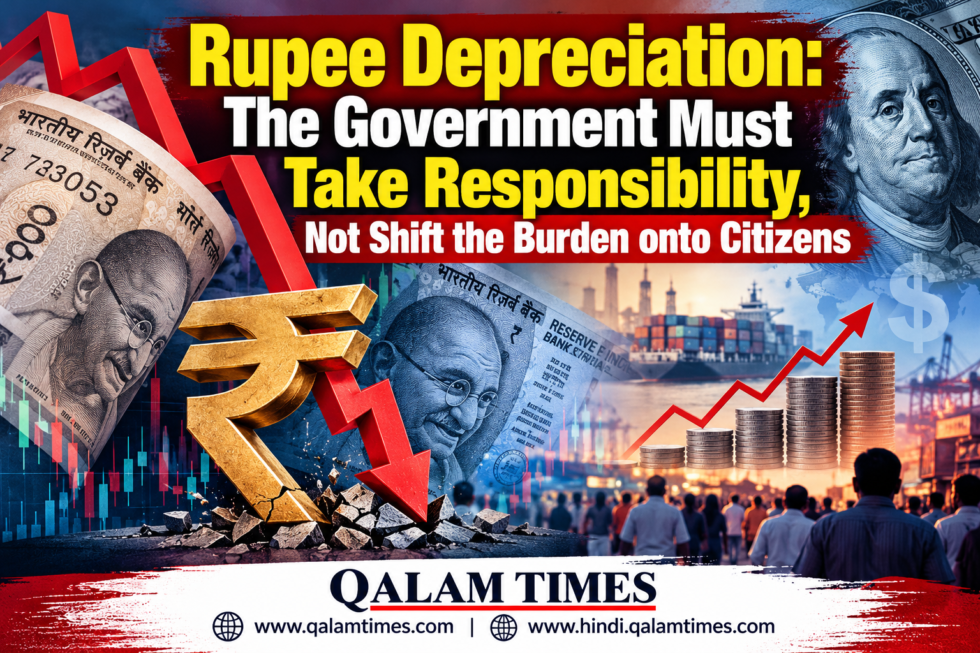
Rupee Depreciation raises concerns over inflation, imports and India’s economic outlook. Why the government must strengthen exports, investment and economic stability.
Qalam Times News Network
New Delhi | October 10, 2026
Rupee Depreciation has emerged as a serious concern for India’s economic outlook, raising questions about the country’s external trade position, investment climate and the government’s economic priorities. The weakening of the Indian currency against the US dollar is not merely a movement on the foreign exchange market. It can affect import costs, household budgets, business confidence and the purchasing power of ordinary citizens.
The speed of the rupee’s decline has added to these concerns. According to the figures cited in the original commentary, the dollar was trading at around ₹89 in December before approaching ₹97 in the first week of the current month. If that trend continues, the prospect of the exchange rate moving towards ₹100 per dollar will become an even greater source of public anxiety. The central question in the debate over Rupee Depreciation is not simply how far the currency may fall, but what the government and the Reserve Bank of India (RBI) are doing to address the underlying economic pressures.
A Weak Currency, Rising Costs and Questions Over Economic Policy
The Indian rupee’s performance also invites comparison with other Asian currencies. The original commentary argues that several major Asian economies, including China, Japan, South Korea, Singapore and Malaysia, have seen their currencies recover, while the Bangladeshi taka has remained comparatively stable. It cites an approximate annual depreciation of 5 per cent for the rupee against around 1.5 per cent for the taka at the beginning of the 2026 financial year.
Such comparisons need to be assessed in context. India and Bangladesh differ significantly in economic size, industrial structure, trade composition and foreign exchange requirements. Nevertheless, the comparison raises a legitimate question: does the size of an economy automatically translate into a strong currency? Clearly, it does not. Currency performance also reflects export competitiveness, the balance of trade, capital flows, investor confidence, inflation, monetary policy and global financial conditions.
A large economy can still face persistent pressure on its currency if imports substantially exceed exports, foreign investors withdraw funds, or demand for foreign exchange rises faster than its supply. Conversely, a smaller economy may achieve greater currency stability through effective monetary management and favourable external conditions. Economic strength cannot be measured by headline growth figures or political claims alone; it must also be judged by the economy’s ability to earn foreign exchange, sustain productive investment and manage external vulnerabilities.
The Cost of a Falling Rupee Reaches Every Household
The effects of currency depreciation extend well beyond financial markets. When the rupee loses value against the dollar, imports priced in dollars generally become more expensive, unless offset by changes in international prices, taxes or other costs. India imports substantial quantities of crude oil, machinery, electronic components, industrial chemicals and other essential inputs. A weaker rupee can increase the domestic cost of these goods and place additional pressure on businesses and consumers.
Higher import costs can feed into transport, manufacturing and service expenses. Companies facing more expensive raw materials may pass some of the burden on to customers. This can contribute to inflation and leave households with less money for education, healthcare, savings and discretionary spending.
Students planning to study abroad may find tuition fees and living expenses more expensive in rupee terms. Families paying for medical treatment overseas can face a larger financial burden. Businesses dependent on imported technology or equipment may postpone expansion, while smaller enterprises may struggle to absorb higher costs. The consequences can spread across production, employment, trade and household welfare.
A weaker currency is not harmful in every circumstance. It can make Indian goods and services cheaper for overseas buyers and increase the rupee value of export earnings. Certain export-oriented industries and tourism businesses may therefore benefit. However, these gains are neither automatic nor uniform. Exporters that depend heavily on imported components may also face rising costs, while the benefits of a cheaper currency can be limited if overseas demand is weak or domestic production cannot respond.
For this reason, currency depreciation should not automatically be celebrated as an advantage for exports. Its overall effect depends on the structure of the economy, the scale of import dependence, the responsiveness of exporters and the duration of the decline.
RBI Faces the Challenge of Balancing Stability and Reserves
The Reserve Bank of India has tools to address excessive volatility in the foreign exchange market. It can intervene by buying or selling foreign currency, manage domestic liquidity and use monetary policy to maintain price stability. However, intervention involves difficult choices.
Selling dollars can help meet demand for foreign currency and moderate sharp movements in the rupee. Yet prolonged or excessive intervention can reduce foreign exchange reserves, which are important for meeting external payment obligations and providing confidence during periods of market stress. On the other hand, leaving the currency entirely to short-term market pressures may allow disorderly movements to intensify.
The objective should therefore not be to defend one particular exchange rate at any cost. Exchange rates respond to domestic and international conditions, and the RBI cannot permanently override those forces without potential consequences. Its challenge is to limit excessive volatility, preserve adequate reserves and maintain financial stability while allowing the currency to adjust to economic realities.
The government also has a responsibility to address the structural factors that influence currency performance. Monetary intervention alone cannot compensate indefinitely for weak export competitiveness, high import dependence or insufficient domestic investment.
Why Should Citizens Bear the Burden of Economic Adjustment?
The debate over the rupee’s decline has become particularly important because of calls for citizens to reduce certain foreign exchange expenses. Prime Minister Narendra Modi has urged people to exercise restraint over foreign travel and gold purchases, among other measures intended to conserve foreign exchange.
Encouraging prudent spending may have a role in managing external pressures. Gold imports and overseas travel can contribute to demand for foreign currency. However, asking citizens to cut back cannot substitute for a comprehensive economic strategy. Nor should ordinary people be made to feel responsible for every consequence of a weakening currency.
Foreign travel is not always a luxury. It may be necessary for medical treatment, higher education, professional responsibilities or family circumstances. Gold purchases also have cultural and financial significance for many households. Policies aimed at reducing foreign exchange outflows must recognise these differences rather than treating every expense as unnecessary consumption.
The government’s primary responsibility is to create conditions in which the economy earns more foreign exchange, produces more competitively and provides greater opportunities for investment and employment. Citizens can make informed spending choices, but they cannot independently resolve structural weaknesses in trade, industrial capacity or capital flows.
Rupee Depreciation : A Stronger Economy Requires More Than Slogans

A durable response to rupee depreciation requires a broad and sustained economic programme. India needs to strengthen its manufacturing base, improve export competitiveness, encourage investment in productive sectors and reduce avoidable dependence on imported goods. Greater support for research, technological development and innovation can help Indian businesses move towards higher-value products and services.
Employment-generating investment is equally important. A stronger industrial ecosystem can expand domestic production, improve incomes and help Indian firms compete in international markets. Export growth must be supported by reliable infrastructure, efficient logistics, predictable regulations and access to modern technology. At the same time, policies should encourage domestic alternatives where they are economically viable, without creating inefficiencies through indiscriminate import restrictions.
Maintaining investor confidence is another essential task. Domestic and foreign investors look for policy stability, transparent regulation, sustainable public finances and credible long-term economic planning. Sudden uncertainty can discourage investment, while consistent policies and a supportive business environment can help attract capital that contributes to production and employment.
Reducing the trade deficit also deserves attention. A trade deficit is not automatically evidence of economic failure, particularly when imports support investment and future production. But persistent external imbalances can increase a country’s dependence on foreign capital and expose its currency to shifts in global sentiment. The goal should be to improve the quality and competitiveness of exports, encourage productive investment and manage external risks rather than pursue numerical targets without considering their wider consequences.
Rupee Depreciation : Accountability Must Begin with the Government

The fall of the rupee is influenced by several forces, including global dollar strength, international oil prices, geopolitical uncertainty, capital movements and domestic economic conditions. It would be simplistic to attribute every change in the exchange rate to a single government decision. Equally, it would be wrong to treat currency depreciation as a matter for the market alone and absolve policymakers of responsibility for the country’s economic resilience.
The government must explain how its policies will strengthen exports, support manufacturing, create jobs, attract stable investment and manage dependence on imported energy and other essential goods. The RBI must continue to pursue monetary and financial stability within its mandate. Together, the government and the central bank need a coherent approach that addresses immediate volatility without losing sight of long-term structural reforms.
A currency’s value is not the sole measure of a nation’s economic health. Nevertheless, a sustained decline can reveal vulnerabilities that deserve serious attention. Public confidence cannot be restored through slogans or appeals for personal sacrifice alone. It requires credible policies, measurable progress and transparent accountability.
The responsibility for building a resilient economy rests primarily with the institutions that shape economic policy. Citizens may contribute through their choices, but they should not be expected to carry the burden of adjustment indefinitely. If the government wants India to withstand global financial pressures, it must focus on strengthening the foundations of the economy rather than shifting the responsibility onto the public.
The message is clear: economic challenges demand responsible governance, not merely restraint from citizens.