



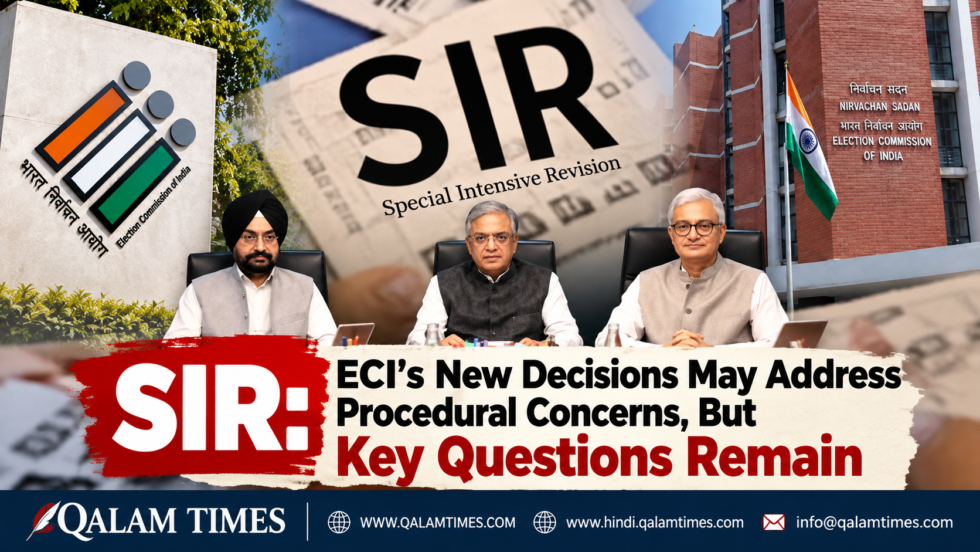
SIR review by ECI brings new measures on unmapped voters, Form 6, ECINet, hearings and voter inclusion, but major transparency questions remain.
Qalam Times News Network
New Delhi | September 26, 2026
SIR has once again become the centre of a growing institutional and political debate after the Election Commission of India held its first full meeting with all three Election Commissioners present amid controversy over the Special Intensive Revision of electoral rolls. The Commission announced several measures concerning unmapped voters, logical discrepancies, Form 6, ECINet, hearings and the treatment of vulnerable voters. Yet, while these decisions address some immediate procedural difficulties, they do not automatically settle the larger questions that have emerged around transparency, decentralisation and the protection of eligible voters.
The Commission said that all final decisions relating to the SIR exercise were taken unanimously and described differences within the institution as part of internal deliberations. This clarification came against the backdrop of a report published by The Indian Express on September 23, which had raised questions about the functioning and internal decision-making of the Commission. Rather than allowing the controversy to remain confined to competing versions of events, the latest decisions make it important to examine what has actually changed—and what remains unresolved.
SIR : From unmapped voters to ECINet: the real test will be implementation
One of the most consequential decisions concerns voters who received notices because of unmapped records or logical discrepancies during SIR. Under the new arrangement, such voters will not necessarily have to appear personally before the Electoral Registration Officer (ERO) or Assistant Electoral Registration Officer (AERO).
Instead, Booth Level Officers (BLOs) will visit the homes of the concerned voters, collect relevant documents and upload them to ECINet. The ERO can then take a decision on the basis of the available material. Personal hearings will reportedly be required only in exceptional circumstances, while online hearings are to be strengthened.
On paper, this is a significant attempt to reduce the administrative burden on voters. For elderly people, daily-wage workers, migrants, people with disabilities and those who cannot easily travel to government offices, a doorstep mechanism could make the process considerably more accessible.
But the effectiveness of this arrangement will depend on how consistently BLOs are able to reach affected households, what documents they accept, how those documents are assessed and whether voters receive adequate information about the status of their applications.
There is another important question: who bears the burden when documentation is difficult to obtain? Electoral registration is not merely a technical exercise. A person who lacks formal paperwork should not automatically be treated as someone whose electoral eligibility is doubtful. The administrative system therefore needs safeguards against both wrongful inclusion and wrongful exclusion.
The Commission has also said that voters may authorise an adult family member to participate in an online hearing on their behalf. That may provide practical relief, but the process must remain transparent enough for the concerned voter to understand what evidence was considered and why a particular decision was reached.
Form 6: clarification, but not the end of the controversy
The Commission has clarified that during SIR, Form 6 will continue with the declaration required under the Supreme Court’s directions, while outside the SIR period the Form 6 prescribed under the Registration of Electors Rules, 1960 will apply.
This distinction is important because Form 6 is the principal mechanism through which eligible citizens seek inclusion in electoral rolls.
The controversy, however, concerns the additional declaration associated with the SIR process. Critics, including opposition parties, have argued that additional documentation requirements can create difficulties particularly for young and first-time voters who may have no connection with older electoral records.
The larger issue is therefore not simply whether Form 6 exists. It is whether the process attached to it is sufficiently simple, legally transparent and accessible to every eligible citizen.
The Election Commission has stated that people whose names could not be included during or after SIR can apply to the concerned ERO through the continuous updating mechanism. It has also directed Chief Electoral Officers, District Election Officers and EROs to conduct special drives for young and first-time voters.
That assurance is significant. But assurances need to be translated into measurable administrative outcomes.
ECINet review: transparency must go beyond a technical audit
The decision to conduct an independent review of ECINet is another major development.
The Commission has proposed a committee headed by a Senior Deputy Election Commissioner, with an independent expert from an IIT or IIIT. The committee is expected to examine whether the systems and processes used in ECINet conform to the applicable laws and rules.
This is potentially important because electoral technology is not simply an IT issue. When software affects the addition, deletion or processing of voter records, technological design can have direct consequences for democratic participation.
The central question is therefore broader than whether the software functions correctly. It is also about who has authority over the process, how decisions are recorded, what audit trails exist, and how an affected voter can challenge an adverse decision.
The debate over centralisation versus decentralisation is particularly relevant here. If functions that were previously handled locally are increasingly mediated through a centralised technological system, there must be clear accountability at every level.
An independent review should therefore ideally examine not only technical performance but also governance, access controls, auditability, data integrity, decision-making authority and mechanisms for correcting errors.
The Commission has also instructed district authorities to establish adequate help desks and special camps for vulnerable groups, including people living in night shelters, labourers, poor citizens and homeless people.
This is an important recognition of a basic reality: electoral administration cannot assume that every voter has a permanent address, easy internet access, digital literacy or the ability to visit an election office during working hours.
However, the announcement also raises a practical question. What happens to eligible voters who may already have been left out during an earlier stage of the revision process?
The answer cannot simply be another application form. There needs to be an effective mechanism for identifying excluded eligible voters, assisting them with documentation where legally permissible, processing their claims promptly and ensuring that they are not permanently disadvantaged because they missed an earlier administrative stage.
The Commission’s reference to Goa, where BLOs were instructed to visit voters who had been left out and 81 of 97 identified voters reportedly submitted Form 6, offers one example of how targeted intervention can work. But one state-level example cannot substitute for a systematic national mechanism.
The Commission has also extended the relevant timelines in Delhi and Maharashtra.
In Delhi, the deadline for claims and objections has been extended to October 30, 2026, while the deadline for disposal of notices, claims and objections has been extended to November 30.
In Maharashtra, claims and objections can reportedly be submitted until October 12, with the disposal process extending until November 10.
Extensions can provide valuable additional time to voters and election officials. But their usefulness will ultimately depend on whether people are adequately informed about the new deadlines and whether local offices have sufficient capacity to process applications within the extended period.
Internal functioning and the question of institutional transparency
The Commission has also announced that meeting agendas will be circulated to relevant members in advance and that minutes of meetings will be issued. It has additionally directed that Annual Performance Appraisal Reports be completed within the prescribed timeframe and that foreign travel by officials require prior approval.
These may appear to be administrative matters, but institutional procedures matter when public confidence in an independent constitutional body is under scrutiny.
The Commission’s decision to formalise advance circulation of agendas and publication of minutes is therefore noteworthy. It responds, at least procedurally, to concerns about how internal meetings and decision-making were being organised.
The issue is not whether every internal discussion should become public. Constitutional institutions need room for confidential deliberation. But there is a legitimate distinction between protecting internal deliberation and maintaining institutional opacity.
A transparent record of decisions, applicable rules and accountability mechanisms can strengthen public confidence without compromising legitimate internal processes.
The larger question: can SIR combine accuracy with accessibility?
The Election Commission’s stated objective is to maintain accurate electoral rolls. That objective is fundamental to credible elections. At the same time, accuracy cannot be measured solely by the removal of questionable entries.
An electoral roll is credible only when it protects against wrongful inclusion and wrongful exclusion.
That distinction becomes particularly important in a large and socially diverse democracy such as India. Migrant workers, young voters, tenants, homeless citizens, people without easily traceable family records and citizens who move between states can face very different documentation realities.
The challenge for the Election Commission is therefore to create a process in which verification is rigorous without becoming unnecessarily burdensome.
The latest decisions appear to recognise some of these difficulties. Doorstep assistance for certain notice cases, online hearings, help desks, extended deadlines and continued access to Form 6 are all mechanisms that could reduce barriers.
But the credibility of these measures will ultimately depend on implementation.
The Commission must ensure that every affected voter knows why a notice was issued, what evidence is required, where to submit it, how the decision will be made and what remedy is available if the claim is rejected.
The same principle should apply to ECINet. A technological system used in electoral administration should be understandable in terms of accountability even if its underlying technical architecture is complex.
What happens next will matter more than what was announced
The September 26 meeting has produced several procedural decisions, but the broader debate surrounding SIR is far from over.
The next stage should be judged through verifiable outcomes: how many voters receive notices, how many are assisted by BLOs, how many claims are accepted or rejected, how many excluded voters are subsequently restored, how quickly appeals are handled and what the independent ECINet review ultimately recommends.
For the Election Commission, this is ultimately a question of institutional credibility. For political parties, it is a matter of public scrutiny. And for citizens, it is much more fundamental: whether an eligible Indian citizen can remain on, or be restored to, the electoral roll through a process that is lawful, accessible and transparent.
The Commission has now announced a set of corrective and procedural measures. The real test begins when those decisions reach the ground.
SIR is no longer merely an electoral-roll exercise. It has become a test of how effectively India’s election administration can balance verification, technology, transparency and the fundamental right of eligible citizens to participate in the electoral process.