



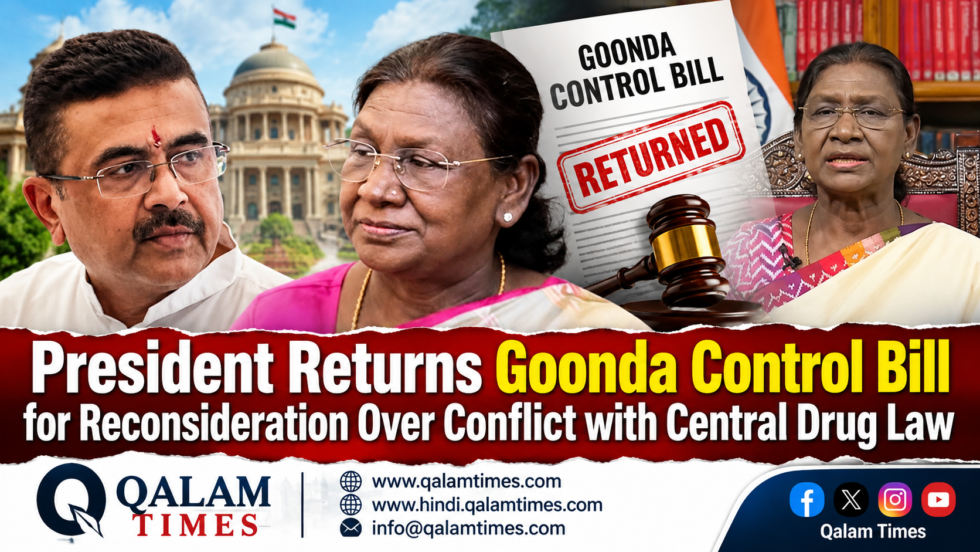
Goonda Control Bill returned by President Droupadi Murmu for reconsideration after Centre flags conflict with NDPS and PIT-NDPS laws.
Qalam Times News Network
Kolkata | September 25, 2026
The Goonda Control Bill passed by the West Bengal Assembly has suffered a major legal setback after President Droupadi Murmu declined to give her assent and returned the legislation to the state government for reconsideration. The move followed objections raised by the Union Home Ministry over provisions relating to drug offences, which were found to overlap with the existing central legal framework governing narcotics-related crimes and preventive detention.

The Goonda Control Bill, formally titled the West Bengal Public Safety and Control of Anti-Social Activities Bill, 2026, seeks to create a legal mechanism to deal with individuals accused of persistent anti-social or violent activities. However, the Centre has raised concerns that including offences punishable under the Narcotic Drugs and Psychotropic Substances Act, 1985 (NDPS Act) could create a parallel preventive-detention framework alongside the existing central law.
Centre Flags Conflict with Existing Narcotics Legislation on Goonda Control Bill
According to the objections communicated to the state, a provision in the proposed legislation seeks to classify as a “goonda” a person who commits, attempts to commit, abets, or provides financial or other assistance in connection with an offence punishable under the NDPS Act.
The Union government has reportedly pointed out that the proposed preventive-detention provisions would overlap with the Prevention of Illicit Traffic in Narcotic Drugs and Psychotropic Substances Act, 1988 (PIT-NDPS Act). The central legislation already provides a specific statutory mechanism for preventive detention in cases involving illicit trafficking in narcotic drugs and psychotropic substances.
The concern is therefore not simply about the punishment of drug-related offences but about the creation of two potentially overlapping legal mechanisms dealing with the same category of conduct.
The Centre has reportedly advised the state to remove the drug-related reference from Clause 2(D)(3)(B) of the proposed legislation to avoid a conflict between the state legislation and the existing central law.
The constitutional issue revolves around Article 254 of the Constitution, which deals with inconsistency between laws made by Parliament and laws enacted by state legislatures on matters falling within the Concurrent List.
The President’s decision has put the West Bengal government in a position where it must reconsider the legislation before attempting to secure presidential assent again.
A state government official, as quoted in reports on the matter, described the development as a temporary setback because the administration had intended to bring the legislation into operation quickly. The official, however, indicated that the government could make the necessary changes, place the revised legislation before the Assembly again and subsequently send it back for presidential consideration.
The development has also revived the political controversy surrounding the legislation.
Trinamool Congress MP Kalyan Banerjee criticised the proposed law and claimed that his party had questioned its legal basis from the beginning. Taking a political swipe at the state government, he said that it was fortunate that the President had not approved the legislation, adding that otherwise the Chief Minister could have faced consequences under the proposed law.
West Bengal Congress president Shubhankar Sarkar also welcomed the President’s decision. He questioned the necessity of introducing another law when existing criminal laws already provide mechanisms for punishing offenders. He alleged that the legislation was intended to suppress political dissent rather than simply address criminal activity.
CPI(M) leader Sujan Chakraborty similarly attacked the government, arguing that the controversy demonstrated the problems surrounding the legislation. He accused the BJP-led state administration of following the approach of previous governments and claimed that attempts to introduce such legislation had repeatedly encountered legal obstacles.
The allegations made by opposition leaders represent their political assessment of the legislation and have been strongly disputed by the ruling side.
What the Proposed Law Seeks to Do
The legislation was passed by the West Bengal Assembly on June 29, 2026, under the title West Bengal Public Safety and Control of Anti-Social Activities Bill, 2026.
Among other provisions, the proposed law defines certain forms of anti-social activity and identifies categories of persons who may be treated as “goondas”. It also provides for the removal or exclusion of an individual from a specified area, city or district for a period of up to one year, subject to an order by an authorised senior official such as a district magistrate, police commissioner or an officer of DIG rank.
The legislation was presented by the government as a measure intended to strengthen public safety and enable the authorities to take preventive action against individuals considered a threat to public order.
Opposition parties, however, had raised concerns from the outset that the preventive provisions could potentially be used against political opponents and dissenting voices.
The Chief Minister had earlier assured critics that the preventive powers provided under the legislation would not be used for political revenge.
Confusion Over Whether the Law Had Already Come Into Force
The controversy has been further complicated by conflicting statements over the legal status of the legislation.
Government sources had earlier claimed that the Governor had given his assent and that the legislation had come into force on July 13. There were also reports that the proposed law had been invoked in connection with arrests following disturbances in Kolkata during protests demanding the resignation of Union Education Minister Dharmendra Pradhan.
However, during proceedings before the Calcutta High Court in August, the state government reportedly informed the court that the legislation had not actually been brought into force, as presidential assent was still required.
The distinction became legally significant because a Bill passed by a state legislature does not automatically become an enforceable law in circumstances where presidential assent is constitutionally required.
High Court Had Earlier Dismissed PILs
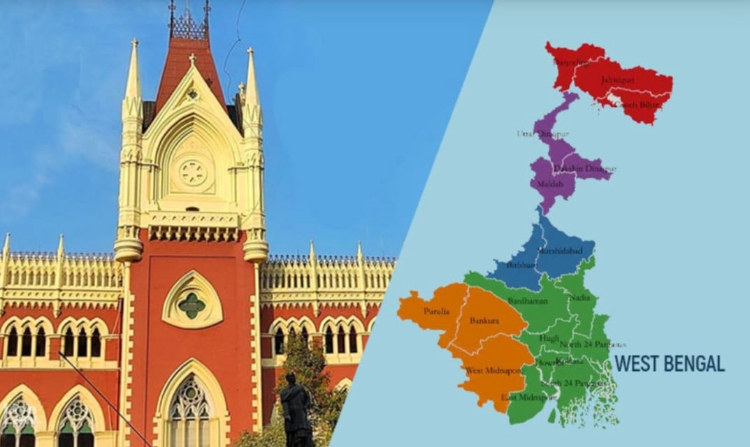
The legislation had also faced judicial scrutiny. Three public interest litigations challenging its validity were dismissed by a Calcutta High Court Division Bench on August 6.
The bench, comprising Justice Tapobrata Chakraborty and Justice Parthasarathi Chattopadhyay, reportedly held that the challenges could not be sustained at that stage because the legislation had not received presidential assent and therefore had not attained the status of a fully operative law.
The latest decision to return the Bill for reconsideration now puts the next step in the hands of the state government and the West Bengal Assembly.
For the government, the immediate task will be to determine whether the disputed drug-related provision should be removed or modified and whether other provisions require legal revision before the Bill is brought back before the legislature.
For the opposition, the episode has provided fresh grounds to question the necessity, scope and constitutional implications of the proposed preventive legislation.
The final shape of the Goonda Control Bill will therefore depend on how the West Bengal government responds to the Centre’s objections and whether the revised legislation can avoid conflict with existing central laws.