




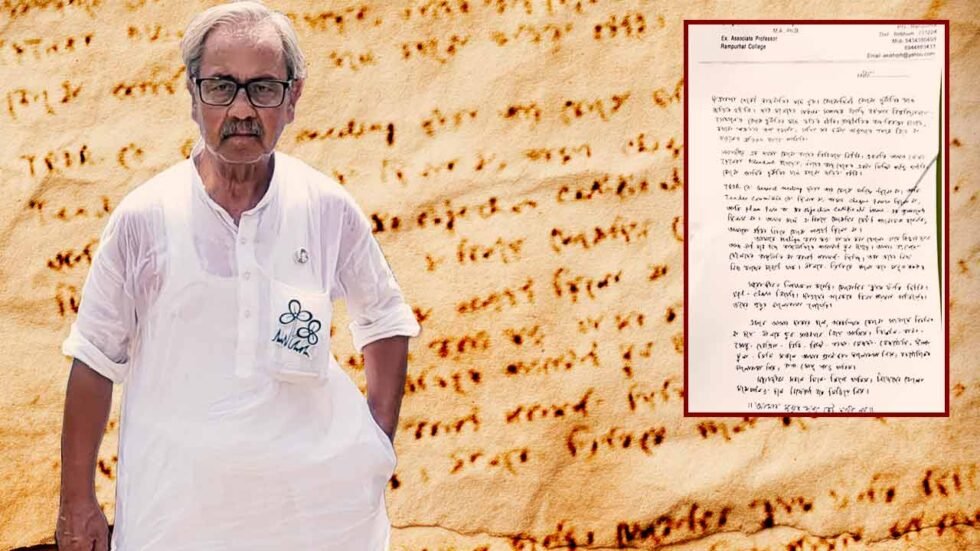
Ashis Banerjee Death raises questions over a 233-word note, alleged political pressure, the final hours before his death and the ongoing forensic investigation.
Qalam Times News Network
Kolkata, August 17, 2026
RAMPURHAT, BIRBHUM: The Ashis Banerjee Death has raised a series of questions after the former minister, former Deputy Speaker of the West Bengal Assembly and veteran Trinamool Congress leader was found hanging inside the party office at his family residence in Rampurhat, Birbhum, on Sunday morning.
The Ashis Banerjee Death came as a shock to his family, political colleagues and people across Birbhum because relatives said there had been no obvious indication that the veteran politician was facing an extreme personal or emotional crisis. According to family members, he had appeared normal even on Saturday night and had spent time talking with his younger brother before having dinner and going to bed.
Ashis Banerjee Death: A Note Mentioning Corruption and Alleged Attempts to Defame Him
The circumstances surrounding the Ashis Banerjee Death became more complicated after investigators found a 233-word handwritten note near his body. The note, written on his personal letterhead, reportedly refers several times to allegations of corruption and to what he described as attempts to malign his reputation.
At the beginning of the note, the writer reportedly stated that he had been associated with politics since his student days but had never been involved in corruption. Towards the end, the note reportedly said that nobody should be held responsible for his death. In another part, the writer referred to efforts allegedly made to tarnish his image.
Police have not yet publicly established whether the document was written by Banerjee or whether it should legally be treated as a suicide note. His family members have identified the handwriting as his, but investigators are expected to rely on forensic examination before reaching a final conclusion.
According to family members, Banerjee had a long-standing habit of waking early. On Sunday, he reportedly got up in the morning, washed and offered prayers. There are religious pictures inside the party office located on the ground floor of the family home, and he went there after waking up.
His wife reportedly became concerned when he did not return for some time. At around 6:30 a.m., she alerted their nephew, Abhishek Banerjee, who is a lawyer and had been closely involved in looking after the veteran politician’s work in recent times.
Abhishek went downstairs and found the office door locked from inside. He called out several times and knocked on the door. When he looked through a gap, he reportedly saw his uncle inside and immediately alerted the police.
Police reached the house shortly before 7 a.m. The door was broken open, following which investigators entered the office. A video recording was reportedly made as part of the investigation.
Inside the room, Banerjee was found hanging from a green nylon rope. He was wearing a white kurta-pyjama. A large photograph of West Bengal Chief Minister Mamata Banerjee was visible on the wall behind him, along with other framed photographs.
Two plastic chairs were reportedly found close to the body. Investigators also recovered the handwritten letter from a nearby table.
The discovery sent shockwaves through Rampurhat. Family members broke down as news of the death spread rapidly across Birbhum. Political leaders from different parties began arriving at the residence, with many describing the death as difficult to believe.
One of the most significant questions concerns the hours between Saturday night and Sunday morning.
Banerjee’s younger brother Prashanta Banerjee reportedly said that the two brothers had spent considerable time together on Saturday night, talking as they often did. Banerjee then went to have dinner, and according to the family, everything appeared normal. He later went to his bedroom and closed the door himself.
The family says nobody noticed any unusual behaviour or anything that suggested he was preparing to take such a drastic step.
Banerjee lived in a large joint family home. His son reportedly lives in Kolkata with his wife because of professional commitments. His wife, brother, sister-in-law and nephew were staying at the family residence.
Neighbours also said they had not noticed any major change in his behaviour.
On August 15, Independence Day, Banerjee had participated in a flag-hoisting programme in the locality and reportedly remained at his office for much of the day. A local resident told people around him that he had spoken with Banerjee on Saturday evening and that the former minister appeared completely normal.
Election Defeat Was a Setback, But Family Saw No Major Change
Banerjee had served as an MLA five times and had held ministerial responsibilities for a considerable period. His defeat in the recent Assembly election was undoubtedly a political setback, and family members acknowledged that he had been disappointed.
However, they said they did not see signs that the electoral defeat had pushed him into an extreme state of distress. His manner remained calm and, according to relatives, he continued with his normal routine.
That has made the sudden death even more difficult for those close to him to understand.
Suicide or Something Else? Investigation Yet to Establish Final Cause
Questions over whether Banerjee died by suicide or whether another possibility needs to be examined have also emerged.
Senior political figures have urged investigators not to reach conclusions merely because a handwritten note was found at the scene. One minister, Agnimitra Pal, publicly questioned whether the possibility of homicide had been completely ruled out and said the circumstances surrounding the death needed to be examined carefully.
The handwriting on the recovered letter will be an important part of the investigation. Police are also expected to examine Banerjee’s mobile phones, communications, recent contacts and other digital evidence to establish what happened during the crucial hours before his death.
The contents of the letter have also intensified speculation about whether he had been subjected to political pressure, allegations or attempts at blackmail.
The death triggered reactions across the political spectrum. Leaders who had ideological and political differences with Banerjee also described him as a decent, educated and straightforward person.
Mamata Banerjee expressed grief over the death and spoke to members of the bereaved family. Her reaction focused on what she described as the possible role of political hostility and alleged humiliation in the circumstances preceding his death.
Trinamool Congress leader Kunal Ghosh also demanded that anyone found responsible for allegedly provoking Banerjee should face action. He referred to a video circulating on social media in which a young man is allegedly seen speaking aggressively to Banerjee inside a vehicle. Ghosh claimed that the man was associated with the BJP and called for an investigation into whether the incident amounted to provocation.
Other Trinamool leaders, however, focused on the wider problem of political hostility and what they described as personal attacks and social-media abuse.
Several unanswered questions now form the central part of the investigation:
- What happened between midnight and approximately 6 a.m. on Sunday?
- Did Banerjee receive any phone calls, messages or visitors during those hours?
- Was the handwritten letter genuinely written by him?
- Why did the letter contain detailed references to corruption allegations and attempts to malign him?
- Did anyone threaten, pressure or allegedly blackmail him?
- What does his mobile phone and digital communication reveal about his final hours?
- Did any political dispute or confrontation immediately precede his death?
- Can the video circulated on social media provide any useful lead?
- Does the forensic evidence completely rule out third-party involvement?
- What was the precise sequence of events inside the party office?
The preliminary post-mortem findings reportedly described the death as an antemortem, non-continuous hanging, indicating that the hanging occurred while the person was alive. The forensic examination is expected to establish whether the injuries and other evidence are consistent with the circumstances found at the scene.
If the forensic evidence ultimately confirms that hanging was the direct cause of death, the investigation will still have to determine whether it was suicide, whether anyone encouraged or pressured him to take such a step, and what circumstances led to the decision.
At present, the evidence points investigators towards the possibility of suicide, but several questions remain unanswered.
The 233-word note, the events of the final night, the condition of the locked room, Banerjee’s digital communications and allegations of political pressure will therefore remain central to the investigation.
For a veteran politician who, according to colleagues across political lines, had maintained a reputation for personal integrity, the circumstances surrounding his death have created a mystery that only a thorough and impartial investigation can resolve.



TRDA Probe: CM Suvendu Adhikari Says Investigation Will Continue After Asish Banerjee’s Death - Qalam Times