




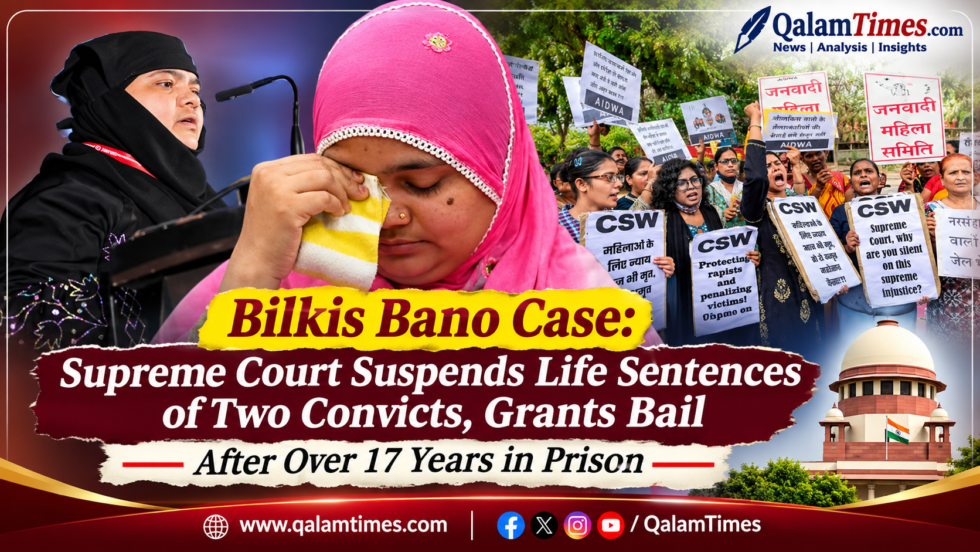
Bilkis Bano Case: Supreme Court suspends life sentences of two convicts and grants bail after over 17 years in prison in the 2002 Gujarat gang rape and murder case.
Qalam Times News Network
New Delhi, November 16, 2026
The Bilkis Bano Case has taken another significant turn after the Supreme Court of India suspended the life imprisonment sentences of two men convicted of gang-raping Bilkis Bano and murdering seven members of her family during the 2002 communal violence in Gujarat. The court has granted the two convicts bail, taking into consideration their prolonged incarceration and the severe physical disability of one of them.

A Bench comprising Justice M.M. Sundresh and Justice Prasanna B. Varale passed the order on October 28, 2026, while hearing appeals challenging the Bombay High Court’s May 2017 judgment, which had upheld their convictions and life sentences. The order was made public on November 16, bringing the Bilkis Bano Case back into the national spotlight and raising fresh questions about the legal proceedings in one of India’s most closely followed criminal cases. The two men, Bipinchand Kanaiyalal Joshi and Pradip Ramanlal Modhiya, are among the 11 convicts whose premature release by the Gujarat government in August 2022 was overturned by the Supreme Court in January 2024.
Bilkis Bano Case : Supreme Court Cites 17 Years of Imprisonment and Disability
During the hearing, senior advocate Siddharth Luthra, representing the two appellants, informed the court that his clients had already spent more than 17 years in prison. He also submitted that one of the convicts had not been named in the original First Information Report (FIR) and was allegedly implicated in the case nearly three years after the incident. The court was further informed that one of the appellants was suffering from a severe physical disability. Opposing the bail applications, Additional Solicitor General Raja Thakre argued that both the trial court and the Bombay High Court had carefully examined the available evidence before convicting the accused. He emphasised the seriousness of the offences and opposed granting relief to the appellants. After considering the submissions from both sides, the Bench observed that the period already spent in custody, the disability of one appellant and the legal and factual questions raised in the pending appeals warranted consideration. The Supreme Court subsequently ordered the suspension of their life sentences and granted them bail subject to conditions to be determined by the concerned trial court. The Bench observed that the appeals would be listed for hearing in due course. Importantly, the latest order does not overturn the convictions. The two men remain convicted, while their appeals against the judgments and sentences are pending before the Supreme Court.
The 2002 Gujarat Violence: The Attack That Shook the Nation
The case originates from the communal violence that swept across Gujarat in 2002. Bilkis Bano, who was five months pregnant at the time, was fleeing her village of Randhikpur in Dahod district along with members of her family and other Muslims when a mob attacked the group. During the assault, Bilkis Bano was gang-raped. Seven members of her family were murdered, including her three-year-old daughter. The attack became one of the most widely documented cases arising from the 2002 Gujarat violence and drew national and international attention to the struggle for justice faced by survivors of communal and sexual violence.
Supreme Court Transfers Investigation and Trial
Initially, the Gujarat Police investigated the case. However, concerns over the fairness of the investigation and the possibility of interference led to further judicial intervention. In December 2003, the Supreme Court directed the Central Bureau of Investigation (CBI) to take over the investigation. Bilkis Bano subsequently approached the Supreme Court, expressing concerns about threats and the possibility of an impartial trial in Gujarat. In response, the apex court transferred the trial to Maharashtra.
In 2008, a special court convicted 11 men of gang rape and murder and sentenced them to life imprisonment.
The convictions were subsequently upheld by the Bombay High Court in May 2017, bringing a major legal milestone in Bilkis Bano’s long struggle for justice.
Supreme Court Orders Compensation for Bilkis Bano

In 2019, the Supreme Court directed the Gujarat government to pay Bilkis Bano compensation of Rs 50 lakh. The court also ordered the authorities to provide her with a government job and accommodation of her choice.
The ruling was widely regarded as an important development in recognising the rights of survivors of sexual violence and ensuring state accountability.
Controversial Remission in 2022 and Supreme Court Verdict in 2024
The case returned to national attention on August 15, 2022, when the Gujarat government granted remission to all 11 convicted men, allowing them to walk free after spending years in prison.
Their release triggered widespread criticism and public outrage. The controversy intensified after the convicts were reportedly welcomed outside Godhra sub-jail by relatives and members of right-wing Hindu organisations, with some offering sweets and publicly honouring them.
Bilkis Bano challenged the remission decision before the Supreme Court, arguing against the release of the men convicted of the crimes committed against her and her family.
On January 8, 2024, the Supreme Court quashed the remission orders, ruling that the Gujarat government was not the appropriate authority to grant the relief. Since the trial had been transferred to Maharashtra, the remission decision fell within the jurisdiction of the Maharashtra government.
The apex court also held that the Gujarat government had acted beyond its authority in granting the remission.
Following the judgment, all 11 convicts were directed to surrender and return to prison.
Fresh Legal Development Raises Questions About the Pending Appeals
The latest Supreme Court decision has once again brought the Bilkis Bano Case into focus. While the two convicts have received temporary relief through suspension of their sentences and bail, the underlying convictions have not been set aside.
The court’s decision is based on the circumstances presented before it, including the period of incarceration, the medical condition of one appellant and the questions of fact and law that remain to be examined.
The remaining nine convicts are not covered by this particular bail order, and their legal position is not changed by the latest decision.
The Supreme Court is expected to examine the appeals in due course. The final outcome will depend on the court’s assessment of the legal arguments and evidence presented by the parties.
For Bilkis Bano, whose pursuit of justice has continued for more than two decades, the latest development marks another chapter in a long and difficult legal battle.
The case continues to raise important questions about criminal accountability, survivors’ rights, judicial oversight and the administration of justice in cases involving communal violence and sexual crimes.