



Jamiat Protest in Kolkata over alleged SIR voter deletions and mosque loudspeaker removals gets Calcutta High Court permission with conditions.
By Qalam Times News Network
Kolkata, August 13, 2026
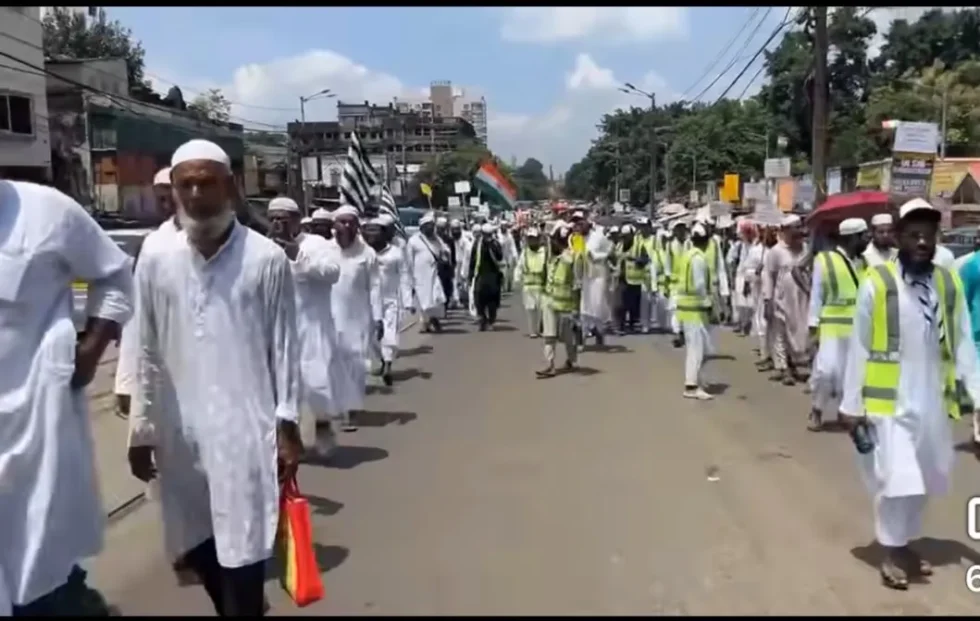
Jamiat Protest in Kolkata brought the debate over voter-list revisions and the removal of mosque loudspeakers into the public spotlight on Tuesday, after the Calcutta High Court permitted the West Bengal unit of Jamiat-e-Ulema to hold a procession despite an earlier refusal by Kolkata Police.
The Jamiat Protest was organised against what the organisation described as the alleged disproportionate deletion of around 27 lakh names during the Special Intensive Revision (SIR) of electoral rolls, as well as the removal of loudspeakers from mosques in different parts of West Bengal.
The procession was permitted to travel from Rajabazar to Moulali between 11:30 a.m. and 1 p.m. on Tuesday. However, the High Court restricted participation to 750 people and imposed several conditions on the organisers.
Court Questions Timing of Police Decision on Jamiat Protest
Jamiat-e-Ulema had originally sought permission for around 2,000 participants to march from Rajabazar to Esplanade on August 11. The organisation approached the High Court after Kolkata Police rejected its application at around 8:30 p.m. on August 7.
Justice Saugata Bhattacharyya questioned why the police decision had been communicated so late, particularly on a Friday evening, leaving the organisers with little time to seek judicial intervention. The court observed that such late decisions had repeatedly resulted in weekend hearings concerning public meetings and processions.
Police officials cited concerns over traffic management, pointing to the proposed route’s inclusion of some of Kolkata’s busiest commercial and traffic corridors.
The State also referred during the hearing to an earlier incident of alleged violence involving a Jamiat-e-Ulema procession. However, the court noted that this reason had not appeared in the original police communication rejecting permission.
The court further observed that the right to peaceful protest is protected under Article 19 of the Constitution. It also questioned whether holding a procession on a weekday could, by itself, constitute sufficient grounds for denying permission.
Protest Over SIR and Mosque Loudspeakers
The organisation’s principal concerns include the alleged deletion of around 27 lakh voters’ names during the SIR exercise and the removal of loudspeakers used for the azan at mosques.
Maulana Siddiqullah Chowdhury, president of the West Bengal unit of Jamiat-e-Ulema, led the procession and criticised what he described as selective action over loudspeakers. He also accused the RSS of turning the issue into a political controversy.
The allegations surrounding voter deletions remain politically contentious, with the SIR process itself subject to legal and political debate. The Jamiat has demanded greater transparency and accountability over the electoral-roll revision process.
While allowing the procession, the High Court imposed a number of restrictions to balance the organisers’ right to protest with public order and traffic considerations.
The court limited the number of participants to 750. Ten volunteers were also directed to submit their contact details to Kolkata Police by Monday night.
The organisers were prohibited from using loudspeakers during the procession and were permitted to use only hand-held microphones. They were also instructed to ensure that one side of the road remained open for traffic.
The conditions were aimed at preventing disruption while allowing the organisation to express its concerns through a peaceful public demonstration.
The loudspeaker issue has added another dimension to the dispute. Several mosques in West Bengal reportedly removed loudspeakers used for the azan following verbal instructions from local police stations.
According to Waqf Board records cited in the report, West Bengal has around 62,000 mosques, although the actual number may be higher because many small village mosques may not be officially recorded.
The issue has generated debate over the regulation of loudspeakers at religious places, freedom of religious practice and the manner in which administrative instructions are communicated and implemented.
The Kolkata procession has therefore brought together two separate but politically sensitive issues—electoral-roll revision and the regulation of mosque loudspeakers—making the demonstration a significant development in West Bengal’s current political discourse.