



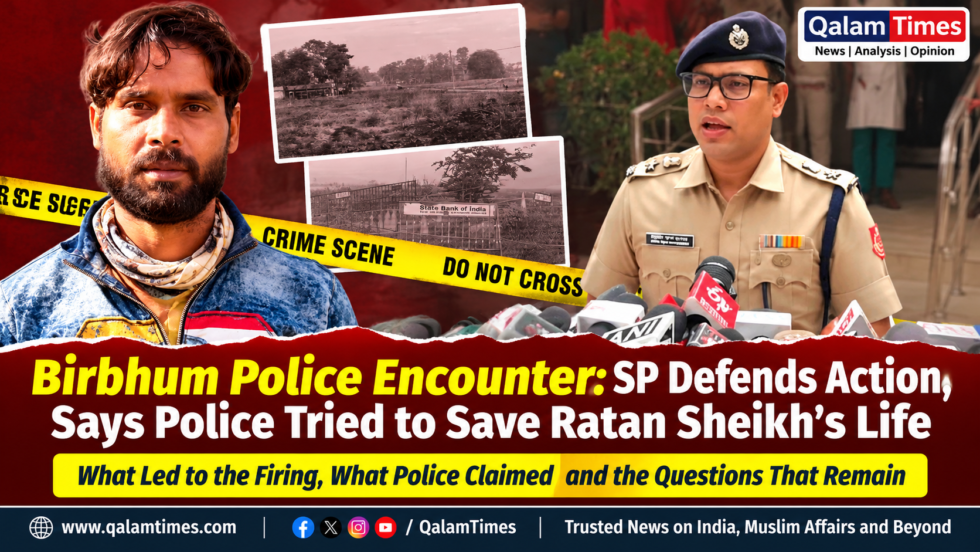
Birbhum Police Encounter: SP Vidit Raj Bhundesh explains Ratan Sheikh’s fatal shooting, police claims, unanswered questions and political reactions in West Bengal.
Qalam Times News Network
Birbhum, 17 November 2026
Birbhum Police Encounter has become a subject of political debate and public scrutiny after Ratan Sheikh, accused of shooting a police constable, was killed during an alleged exchange of fire in Nanoor, Birbhum, on Sunday. On Monday, the district police administration presented its account of the incident, maintaining that officers had opened fire in self-defence after the accused allegedly shot at their team during an operation to recover the firearm.
Birbhum Superintendent of Police Vidit Raj Bhundesh addressed the media in a press conference lasting approximately 13 minutes. He provided details of Ratan Sheikh’s arrest, the subsequent search for the weapon and the circumstances that reportedly led to the fatal shooting. However, despite the police explanation, several questions concerning the operation, the use of force and the circumstances surrounding Ratan’s death remain unanswered.
Police Version: Accused Allegedly Opened Fire During Weapon Recovery Operation
According to the police, the incident originated on Friday evening when a police team went to apprehend Ratan Sheikh in connection with a criminal case in Santiniketan. During the operation, Ratan allegedly fired at constable Biswajit Das, leaving him seriously injured. The constable is currently receiving treatment at SSKM Hospital in Kolkata under the supervision of a panel of doctors.
Police said Ratan was subsequently arrested and taken to a brickfield in Uchkaran village, under Nanoor police station, where investigators believed the firearm used in the attack had been concealed.
Explaining what happened at the location, SP Bhundesh stated that Ratan initially appeared to be searching for the weapon. He allegedly moved around the area before sitting down and retrieving a firearm hidden inside a bush.
According to the police account, Ratan suddenly fired at the officers, with the bullet striking the police vehicle used by the team.
The SP maintained that the officers responded with gunfire in self-defence, invoking their legal right to protect themselves and secure the arrested individual. He further alleged that Ratan attempted to fire another shot, following which he sustained injuries in the police retaliation.
Police Claim Every Effort Was Made to Save Ratan’s Life
A significant part of the police briefing focused on the medical assistance allegedly provided to Ratan after he was shot. SP Bhundesh said the injured man was immediately transported to the nearest available medical facility so that he could receive treatment without delay. The police team took him to Nanoor Block Primary Health Centre (BPHC), where the doctor on duty examined him and declared him dead.
The police chief emphasised that the priority after the shooting was to ensure that the injured accused received medical attention as quickly as possible.
He also confirmed that the police had registered a case and initiated the necessary procedures in accordance with guidelines laid down by the National Human Rights Commission (NHRC) and the Supreme Court for incidents involving police firing and alleged encounters.
However, the police explanation has not put an end to the controversy. Questions remain about the precise sequence of events, the number of rounds fired and the manner in which the operation was conducted.
Questions Over Number of Bullets and Videography
During the press conference, journalists questioned the SP about the number of bullets fired at Ratan and the identity of the police officer or officers responsible for the shooting.
Bhundesh did not provide an exact figure. He stated that more than one round had reportedly been fired from each side and that the actual number would become clear during the investigation.
Another important issue concerned the videography of the search operation. Police sources indicated that such operations are required to be videographed under the applicable procedures.
When questioned about whether the operation had been recorded, the SP responded that the officers were preparing to begin videography when Ratan allegedly opened fire.
This explanation has left further questions about the availability of independent visual evidence documenting the events leading up to the shooting.
Political Reactions: Opposition Questions Police Conduct
The incident has triggered a political debate in West Bengal, with opposition leaders questioning the circumstances surrounding the killing.
CPM Central Committee member Sujan Chakraborty criticised the police explanation, arguing that the administration appeared reluctant to describe the incident directly as an encounter.
Referring to previous remarks attributed to Chief Minister Mamata Banerjee about arresting criminals in the morning and eliminating them by evening, Chakraborty alleged that the political leadership had created an atmosphere in which such actions were being encouraged.
He also questioned why the police were emphasising their efforts to save Ratan after shooting him, instead of providing a comprehensive explanation of the circumstances that led to his death.
According to Chakraborty, the situation raises concerns about the rule of law and the accountability of law enforcement agencies.
The BJP, meanwhile, defended the police action. Senior party leaders, including Union Minister of State Sukanta Majumdar and Bengal panchayat minister Dilip Ghosh, supported the police, arguing that individuals who attack law enforcement personnel should face the consequences of their actions.
The political divide has once again brought the issue of police encounters, the use of firearms and institutional accountability into the centre of public discussion in the state.
Birbhum Police Describe Events Before the Fatal Operation
According to the police, Ratan had recently been released on bail from Bolpur Correctional Home on Friday. Investigators alleged that a group of criminal associates received him after his release and organised a gathering during which plans for another criminal activity were discussed.
Acting on intelligence inputs, a police team reportedly moved to apprehend him. It was during this operation that constable Biswajit Das was allegedly shot.
Following Ratan’s arrest, the police also detained two other accused persons from Bolpur and Nanoor as part of the investigation.
The police have yet to provide a complete public account of all the evidence collected in connection with the case.
Family Members Express Grief and Question Police Action
Ratan Sheikh’s death has also drawn emotional reactions from members of his family.
His sister-in-law, Champa Biwi, said the family had expected the police to arrest him and send him back to prison rather than shoot him dead.
She acknowledged the police allegation that Ratan had fired at officers but maintained that he could have been apprehended and prosecuted through the legal system.
His son, Badshah Sheikh, adopted a different position. He reportedly said that he had little to say about his father’s death, explaining that Ratan had abandoned him and his mother approximately seven years earlier.
The contrasting reactions within the family reflect the complicated personal circumstances surrounding the deceased.
Birbhum Police Encounter Raises Wider Questions About Accountability
The killing of Ratan Sheikh has raised broader questions about the limits of police authority, the protection of arrested individuals and the importance of transparent investigations when firearms are used by law enforcement personnel.
While the police maintain that their officers acted in self-defence after coming under fire, the complete sequence of events will need to be established through an impartial investigation and the examination of available evidence.
The questions surrounding the number of bullets fired, the absence of videography at the crucial stage, the medical response and the circumstances of the shooting remain important aspects of the case.
For now, the police version and the political reactions present sharply different perspectives on the incident. The findings of the investigation will be crucial in determining what happened at the brickfield in Uchkaran village and whether all established legal and procedural safeguards were followed.
The case has also renewed public attention on police encounters in West Bengal, particularly the need to ensure that the law is upheld even when individuals face serious criminal allegations.