



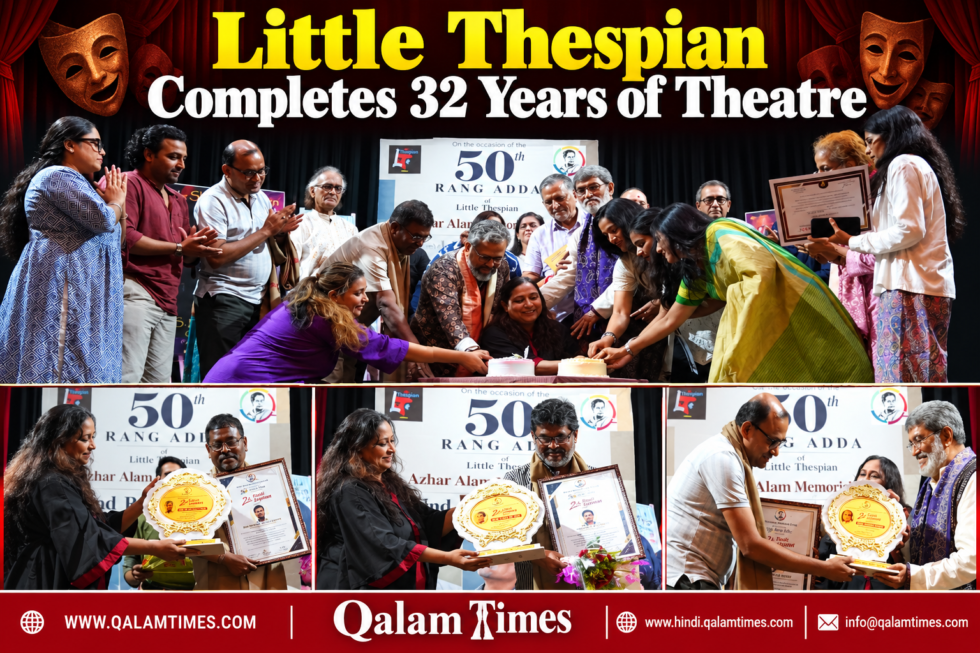
Little Thespian completes 32 years of theatre, celebrating its foundation day with Chehre at Academy of Fine Arts and presenting the second Rang Samman.
Qalam Times News Network
Kolkata | September 23, 2026
Little Thespian, one of India’s notable theatre organisations, has completed 32 years of its journey in theatre, marking more than three decades of performances, experimentation, translation, training and engagement with audiences beyond conventional theatre spaces. The organisation celebrated its foundation day on September 20, 2026, with a staging of Chehre at the Academy of Fine Arts in Kolkata, followed by the presentation of the second Rang Samman by the Azhar Alam Memorial Trust.
The journey of Little Thespian began with an unexpected meeting between Uma Jhunjhunwala and S. M. Azhar Alam during the cultural activities of Calcutta University on September 20, 1994. What started as a meeting between two theatre enthusiasts gradually developed into an organisation with a presence across India’s theatre circuit. Over the years, the group has deliberately taken theatre beyond traditional auditoriums, presenting socially relevant productions in cities, smaller towns and open courtyards in an effort to make theatre more accessible to wider sections of society.
A Three-Decade Theatre Journey Rooted in Experimentation, Literature and Community Engagement
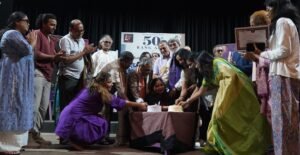
Over its 32-year journey, Little Thespian has developed an extensive repertoire. Its body of work includes 35 full-length productions, more than 50 stories presented under Katha Collage, 10 one-act plays through Bal Rangmanch, and over 100 performance recitations under Qissa-Khawani.
Among its productions are Chehre, Patthar, Daftar, Andhere Mein, Chaak, Bheegi Aurtein, Parchhaiyaan, Visarjan, Endgame, Roohein, Balkan Ki Aurtein, Dhokha, Kabira Khada Bazaar Mein, Gainda and Hayavadan, among others.
The organisation has also regularly participated in national theatre festivals across India, including the Bharat Rang Mahotsav, organised by the National School of Drama. Its own National Theatre Festival, Jashn-E-Azhar, has become an important part of its theatre activities.
Another significant contribution has been its work in theatre literature. Little Thespian publishes Rang Rasa, described by the organisation as India’s first Urdu theatre magazine. Founded by S. M. Azhar Alam in 2010, the publication is now issued biannually in Hindi and English under the editorship of his daughter, Gunjan Azhar.
Translation and adaptation have remained central to the group’s artistic work. Little Thespian has brought the writings of authors including Rabindranath Tagore, Saadat Hasan Manto, Krishna Chander, Bhisham Sahni, Eugène Ionesco, Samuel Beckett and Tennessee Williams to Hindi-Urdu theatre audiences.
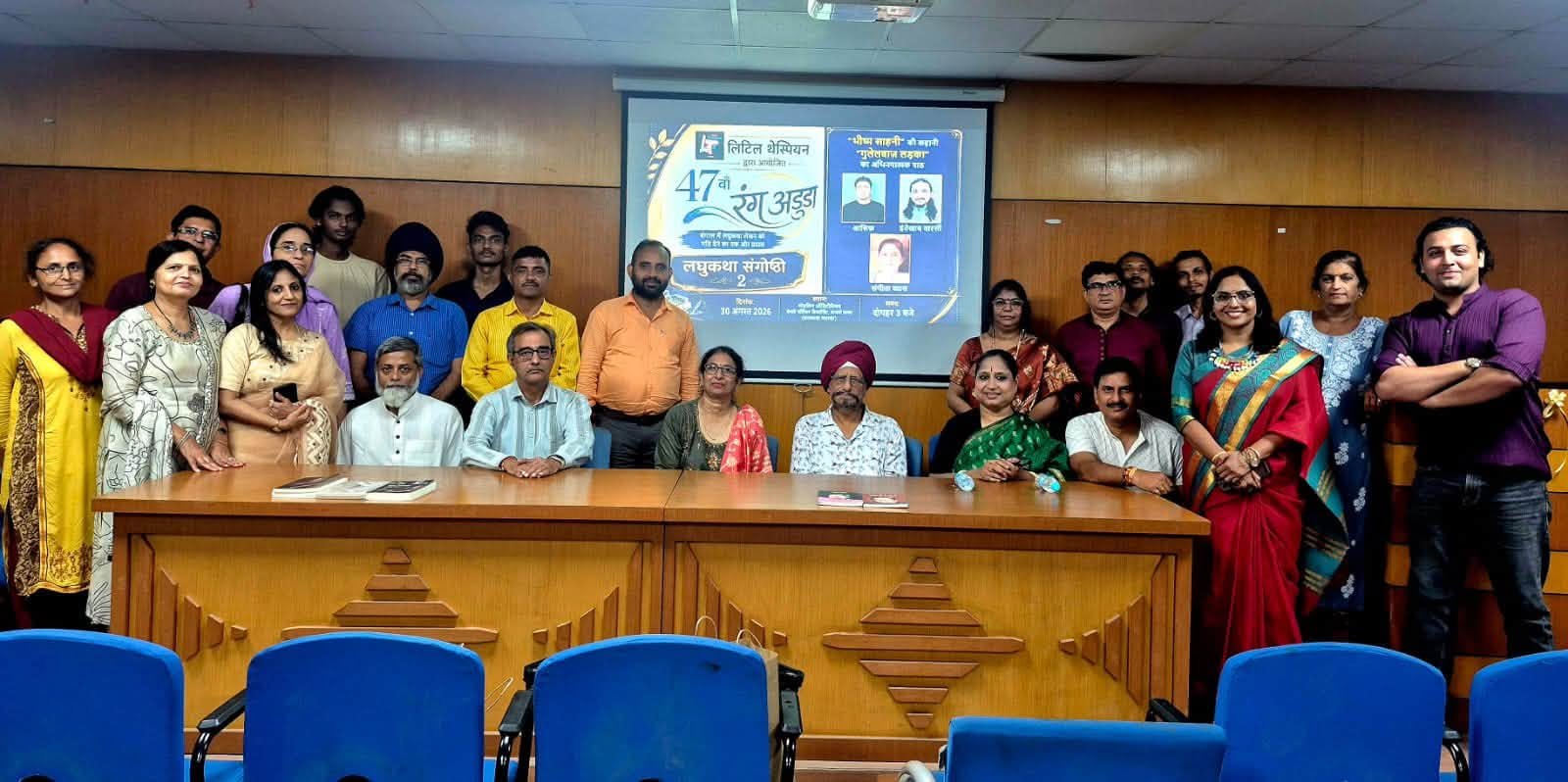
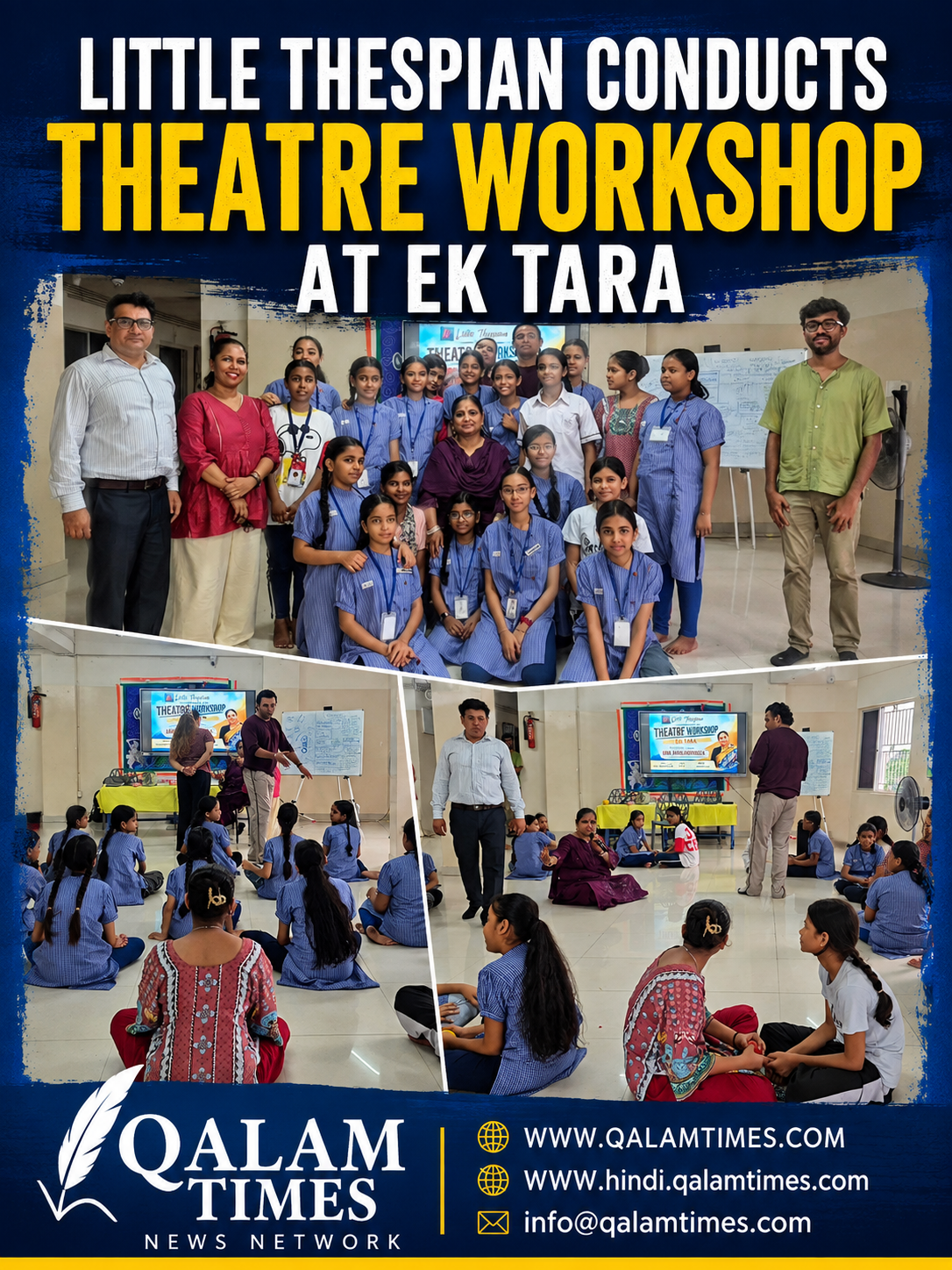
The organisation has also developed educational and dialogue-based initiatives. Its workshops on the dramatic presentation of poems and stories have so far completed 21 sessions, while its monthly Rang Adda dialogues have provided a platform for students, scholars and experienced theatre practitioners to discuss theatre and related subjects.
In collaboration with the National School of Drama, New Delhi, Little Thespian conducted a 30-day production-oriented workshop between December 2025 and January 2026. Since 2022, its youth-oriented programmes, Rang Samwad and the Drama Competition, have also sought to encourage emerging theatre practitioners. Its Children’s Theatre wing focuses on productions created by children and intended for young audiences.
‘Chehre’ Brings Generational Trauma to the Stage
The foundation day programme featured Chehre, an adaptation by S. M. Azhar Alam of Tony Devaney Morinelli’s The Sins of the Mother. The one-act psychological drama examines the complicated ways in which trauma can pass from one generation to another within a family.
Set inside a Muslim household and centred on three generations of women, the play follows Amina, an ageing alcoholic mother, and gradually exposes the emotional wounds that have shaped her relationships with her daughters, Ishrat and Razia. Through Nasima’s recollections, the narrative explores how abuse and unresolved pain can become part of a family’s inherited emotional landscape.
Amina emerges as both someone shaped by suffering and someone who inflicts suffering on others. Her own difficult relationship with Amma becomes part of the pattern that subsequently affects her daughters. The production therefore raises a difficult question about whether people can escape the patterns of behaviour created by those who hurt them.
The cast included Uma Jhunjhunwala as Amina, Annie Das as Ishrat, Gunjan Azhar as Razia, Nupur Bhoutika as Nasima and Sangeetha Vyas as Amma.
Jhunjhunwala’s portrayal of Amina brought together the character’s volatility, vulnerability and emotional complexity. Das and Azhar presented contrasting responses to the same traumatic family environment, while Bhoutika’s Nasima provided another perspective on the family’s past. Vyas’s portrayal of Amma added another layer to the memories that continue to influence the characters.
The production’s technical elements also contributed significantly to its atmosphere. Joydeep Roy handled the lighting design, while Murari Raychoudhury worked on the music design, helping the production move between present-day confrontations and memories of the past.
Second Rang Samman Honours Three Unsung Theatre Professionals
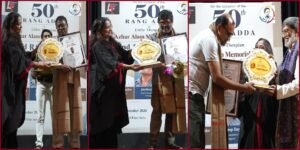
Following the performance, the Azhar Alam Memorial Trust presented the second Rang Samman to three theatre professionals in recognition of their longstanding contributions and largely behind-the-scenes work in the theatre fraternity.
The awardees were Madan Gopal Halder, a skilled theatre set maker; Joydeep Roy, light executive and designer; and Anindya Nandy, a professional Dolby-enlisted sound engineer associated with theatre and film.
Madan Gopal Halder has spent 48 years working in theatre set construction. Known for converting a director’s or designer’s creative concept into a physical stage environment, he has reportedly constructed sets for more than 15,000 plays and supplied sets for over 25,000 productions. His work has taken him across West Bengal and to theatre productions beyond the state.
Joydeep Roy began his professional career in 1992. He worked for three years with renowned stage lighting designer Tapas Sen and subsequently spent more than 15 years working with Sen’s son, Joy Sen. Roy has served as light executive and designer for more than 250 theatre productions.
Anindya Nandy has worked in theatre and film music and sound for 26 years. His professional experience includes Dolby-enlisted sound engineering, theatre music operation, field recording, auditorium development, and the installation of sound and lighting projection systems.
The Rang Samman therefore placed particular emphasis on the professionals whose contributions often remain away from the spotlight: the craftsmen who construct the physical world of a play, the lighting designers who shape its visual mood, and the sound professionals who contribute to its atmosphere and emotional impact.
The theatre organisation’s history remains closely associated with its founder, S. M. Azhar Alam, who received the West Bengal Natak Akademi Award and several state-level honours for his work as a playwright and director. His play Namak Ki Gudiya received recognition for Best Playwright, while Question Mark earned him recognition for Best Director. He was also honoured with the Nemichandra Jain Natya Lekh Puraskar for Roohein.
Following his legacy, the Azhar Alam Memorial Trust was established on December 20, 2021. The Trust presents the Azhar Alam Memorial Award, provides fellowships for research scholars and organises an annual research article writing competition.
With its continuing performances, publications, workshops, youth programmes and theatre festivals, Little Thespian’s 32-year journey reflects a sustained engagement with theatre as both an artistic form and a means of dialogue with society.