



Lust Stories 3 review: Explore Netflix’s four-part anthology, its stories of desire, marriage, intimacy, ambition and fantasy, with performances by Konkona Sen Sharma, Radhika Apte, Aditi Rao Hydari and others.
Qalam Times News Network
Mumbai | September 19, 2026
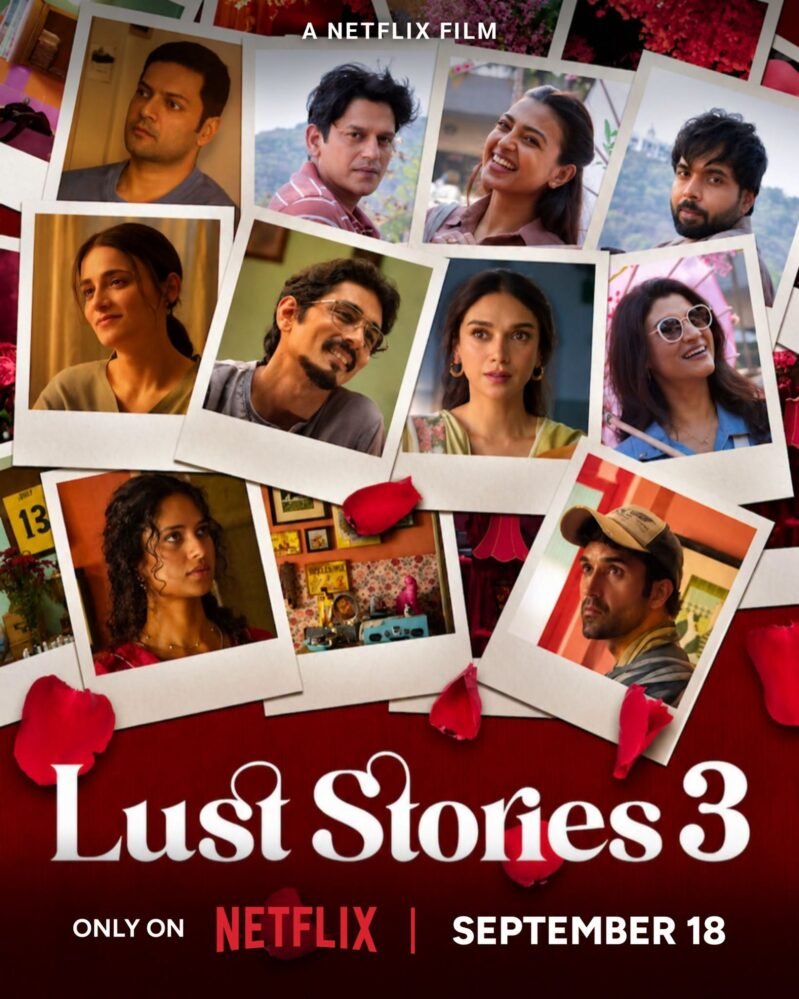
Lust Stories 3 returns to Netflix with four filmmakers offering sharply different perspectives on desire, intimacy and the complicated emotional lives of modern relationships. Directed by Vikramaditya Motwane, Kiran Rao, Shakun Batra and Vishal Bhardwaj, the anthology moves between comedy, relationship drama, crime-infused romance and period fantasy. While the four segments vary considerably in depth and impact, the film remains an engaging examination of desires that people often conceal, suppress or struggle to understand.

For decades, mainstream Hindi cinema was reluctant to discuss sexual desire openly. Romance was usually considered a safer language, while physical intimacy was often suggested through symbolism rather than addressed directly. Lust Stories 3 continues the franchise’s attempt to place desire within ordinary human experience, treating it not simply as a source of attraction but also as something connected to loneliness, marriage, ambition, imagination and personal freedom.
Lust Stories 3: Four Stories, Four Distinct Takes on Desire
The anthology opens with Vikramaditya Motwane’s story, which uses humour to examine the frustrations that can develop inside seemingly ordinary marriages. Konkona Sen Sharma and Radhika Apte play Shonali and Padma, two friends whose marital lives have left them questioning whether the excitement and sense of being desired they once experienced can be recovered.
Their husbands, played by Abhishek Banerjee and Vijay Varma, become part of an unusual weekend that gradually turns into an experiment in rediscovering intimacy. What initially appears to be a comic situation develops into something more revealing as both women confront their individual attitudes towards desire.
Shonali is considerably more adventurous and willing to challenge conventional expectations, while Padma remains cautious. Her hesitation is not merely embarrassment; it reflects the pressure placed on married women to behave according to a particular social idea of respectability.
Konkona Sen Sharma appears to relish the opportunity to play a character who is unusually outspoken and uninhibited. Radhika Apte, meanwhile, is given a more layered emotional role. Padma’s uncertainty allows the film to explore the gap between what a person wants privately and what she believes she is supposed to want publicly.
The humour works because the characters are not entirely detached from reality. Beneath the comedy is a more serious observation about marriage: introducing something new into an established relationship cannot automatically repair deeper emotional problems. An attempt to reignite physical attraction may instead expose the parts of a relationship that have been neglected for years.
Kiran Rao’s segment changes the mood completely. Her story centres on Karan, played by Gurfateh Pirzada, a pizza delivery worker whose meeting with Lisa, portrayed by Sana Thampi, quickly develops into an attraction. The story is presented with a glossy, energetic visual style that initially suggests a straightforward romantic narrative.
It soon becomes clear, however, that Karan’s life contains a criminal dimension, while his twin brother Arjun becomes increasingly important to the deception surrounding him. Lisa is also not written as a passive romantic figure. As the story develops, her attraction to Karan begins to give her greater agency within the situation.
Rao appears more interested in pace and entertainment than in examining her characters at considerable psychological depth. As a result, this segment can feel lighter than the others. Yet its central idea remains interesting: desire does not always originate in emotional intimacy. Sometimes attraction becomes entangled with ambition, opportunity and the desire to change one’s circumstances.
Shakun Batra’s contribution is more introspective and focuses on a marriage that has already begun to collapse. Ali Fazal and Radhikka Madan play Varun and Sainee, a couple who have decided to end their marriage but continue to maintain a physical relationship.
Their separation creates an unusual contradiction. Emotionally, they are moving apart, yet physically they remain connected. Intimacy becomes one of the few areas in which they can still communicate, even as disagreements over the rest of their lives become increasingly difficult to resolve.
Batra has repeatedly explored the tensions hidden beneath apparently stable domestic relationships, and this story continues that interest. Here, physical attraction survives even after affection, trust and companionship have been damaged.
Fazal and Madan give the segment much of its emotional strength. Neither character is reduced to a simple villain. Each has grievances that make sense from their own point of view, allowing the conflict to remain relatively balanced.
Their continued physical relationship also functions as a form of temporary escape. It offers relief from emotional pain without addressing the reasons their marriage has failed. The problem is not the attraction itself but the fact that it allows both characters to postpone difficult conversations about their future.
The final segment, directed by Vishal Bhardwaj, adopts a much more theatrical approach. Set in 1980s Hyderabad, the story follows Saira, played by Aditi Rao Hydari, a literature teacher whose imagination begins moving beyond the boundaries of her conventional married life.
Her husband Badru, played by Siddharth, is not presented as an uncaring or completely unsuitable partner. Their marriage has affection, but Saira increasingly feels that routine intimacy does not satisfy the imaginative world developing inside her.
Her interest in romantic and erotic literature encourages her to begin writing her own stories. Through writing, she discovers a way to explore thoughts and desires that she has never felt comfortable expressing openly.
Bhardwaj surrounds the story with period detail, heightened performances, colourful dialogue and a strong theatrical sensibility. The result is the most extravagant of the four segments, but that exaggeration is central to the film’s design rather than an accidental feature.
Aditi Rao Hydari gives one of the anthology’s most memorable performances. She combines sensuality with vulnerability and comedy, particularly when Saira’s private imagination begins to collide with the carefully controlled identity she presents to those around her.
Siddharth brings warmth and comic simplicity to Badru, while Gajraj Rao adds several humorous moments as Saira’s eccentric father-in-law.
What distinguishes this story is its treatment of female desire. Saira is not simply looking for more physical intimacy from her husband. She wants excitement, imagination and the freedom to define her own desires instead of accepting a version imposed by social convention.
Taken together, the four stories demonstrate how differently desire can operate within human relationships. In one story, it becomes a way of confronting marital boredom. In another, it becomes intertwined with ambition and deception. Elsewhere, it provides temporary comfort after the collapse of a marriage. Bhardwaj’s segment presents it as an expression of imagination and personal freedom.
Not every segment reaches the same emotional or dramatic depth, and some ideas are explained more explicitly than necessary. Nevertheless, the anthology benefits from the contrast between its filmmakers and performers.
Rather than presenting desire as a single, uncomplicated emotion, Lust Stories 3 connects it with marriage, loneliness, self-expression, social expectations and personal ambition. That wider approach gives the anthology more substance than its provocative title might initially suggest.
For Netflix viewers interested in contemporary Hindi cinema and relationship-driven storytelling, the film offers four distinct interpretations of a subject that Indian mainstream cinema has traditionally approached with caution.