



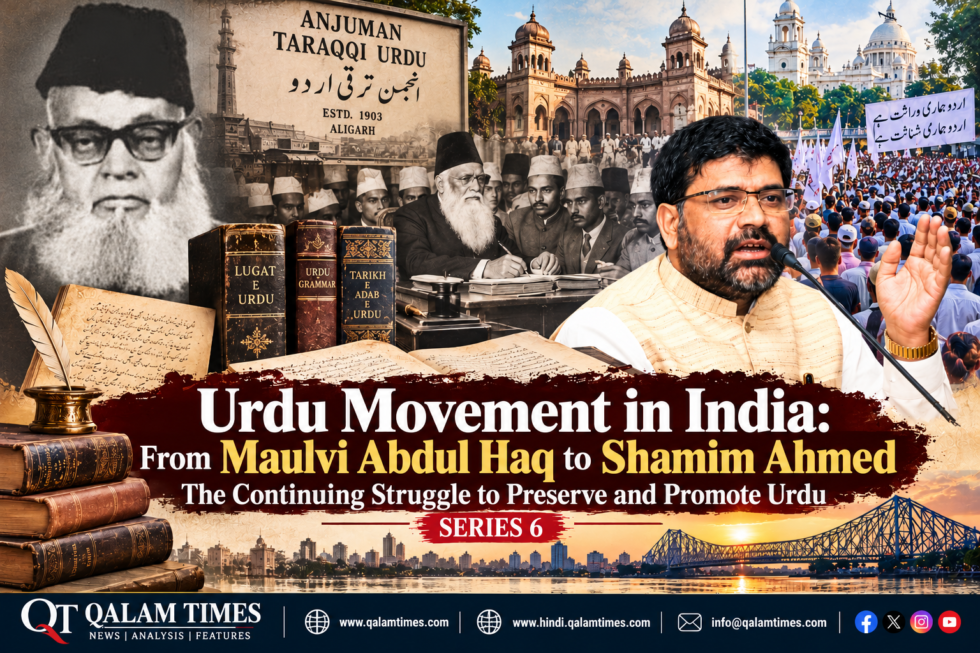
Explore Maulvi Abdul Haq’s contribution to the Urdu movement, the legacy of Anjuman Taraqqi Urdu, and Shamim Ahmed’s continuing efforts for Urdu in West Bengal.
From Anjuman Taraqqi Urdu to the Contemporary Urdu Movement in Bengal: A Historical Journey of Language, Scholarship, Cultural Identity and Public Advocacy
Qalam Times News Network
Kolkata | October 25, 2026
The Urdu Movement in India represents a long and multifaceted history of intellectual endeavour, literary development, educational reform and public advocacy. Across different periods, writers, scholars, teachers, journalists and social activists have worked to preserve Urdu’s literary heritage while strengthening its ability to respond to changing educational, cultural and institutional needs. The movement has never been confined to a single organisation, geographical region or historical moment. Rather, it has taken different forms according to the circumstances of the people who supported it, from nineteenth-century initiatives for modern education and the development of Urdu scholarship to later campaigns concerning language recognition, educational opportunities and the place of Urdu in public life. Every generation has inherited a different set of challenges, and each has contributed to the language’s history through its own methods, priorities and institutions.
In the previous instalment of this series, Qalam Times examined Sir Syed Ahmad Khan and his role in the nineteenth-century debate over Urdu, education and linguistic identity. This sixth instalment moves forward to another major figure in Urdu history: Maulvi Abdul Haq, widely remembered as Baba-e-Urdu. While Sir Syed’s contribution was closely associated with educational reform, intellectual awakening and the promotion of modern knowledge, Abdul Haq devoted much of his life to developing Urdu’s scholarly resources, strengthening literary institutions and encouraging organised work for the language. His association with Anjuman Taraqqi Urdu made him an important figure in the institutional history of Urdu. More than a century later, the contemporary Urdu movement associated with Shamim Ahmed in West Bengal presents another chapter in the continuing effort to secure public attention for Urdu and its place in India’s multilingual society.
Placing Maulvi Abdul Haq and Shamim Ahmed within the same historical discussion does not mean that they belonged to the same organisation or pursued identical programmes. They worked in different periods, under different political conditions and through different methods. Abdul Haq’s principal contribution was rooted in scholarship, publications, language development and institution-building, whereas the contemporary movement associated with Shamim Ahmed has drawn attention to public advocacy, linguistic recognition and the concerns of Urdu-speaking communities in Bengal. The meaningful connection between them lies in the broader history of efforts to sustain Urdu as a language of knowledge, cultural expression and public participation. By examining these distinct contributions together, this article seeks to demonstrate how the Urdu movement has evolved over time while retaining its concern for the language’s continuing relevance.
Maulvi Abdul Haq: The Scholar Who Dedicated His Life to Urdu
Maulvi Abdul Haq, born in 1870 and remembered until his death in 1961, occupies an important position in the history of Urdu language development and scholarship. His reputation as Baba-e-Urdu reflects the lasting respect he earned through decades of work on the language’s vocabulary, grammar, literature, research and publication. He belonged to a period in which the position of Indian languages was being shaped by changing educational institutions, colonial administrative practices and debates about modern knowledge. Urdu possessed a substantial literary tradition, but its continued development also required organised scholarly attention, systematic documentation and resources that could support new forms of learning. Abdul Haq recognised that the future of a language could not depend entirely on the achievements of earlier poets and writers; it also required sustained efforts to preserve existing works, improve linguistic resources and create opportunities for future scholarship.
His intellectual outlook developed within a wider environment of educational reform and debate about the future of Indian society. Having studied at Aligarh, Abdul Haq encountered an educational atmosphere shaped by the discussions and reformist concerns associated with Sir Syed Ahmad Khan and his contemporaries. He subsequently became involved in educational, translation and scholarly activities, including work in Hyderabad, where Urdu played an important role in intellectual and cultural life. These experiences helped shape his commitment to the language as a medium of scholarship rather than merely an inheritance to be admired. His work encompassed the practical tasks that allow a language to remain productive across generations: collecting and examining linguistic material, preparing scholarly publications, supporting literary research and helping establish institutions through which knowledge could be preserved and circulated.
Abdul Haq’s importance therefore extends beyond the symbolic title by which he is widely known. His legacy demonstrates the value of sustained intellectual labour in the development of a language. Urdu needed dictionaries that could record and explain its vocabulary, grammatical resources that could support accurate writing, scholarly editions that could preserve literary texts and institutions capable of encouraging new research. These tasks required patience, specialised knowledge and long-term commitment rather than occasional public campaigns. Abdul Haq’s career became closely associated with precisely this kind of work. His contribution also offers a useful perspective on the broader Urdu movement: language advocacy can take many forms, and the development of scholarly resources may be just as important to a language’s future as public demands for recognition or administrative support.
Anjuman Taraqqi Urdu: Organising the Work of Language Development
One of the most significant institutions associated with Maulvi Abdul Haq was Anjuman Taraqqi Urdu, an organisation devoted to the advancement of Urdu through scholarship, publications and organised literary activity. The organisation emerged in 1903 within the wider educational environment associated with the All-India Muslim Educational Conference. Its early history involved several prominent intellectual figures, including Allama Shibli Nomani and Professor Thomas Walker Arnold. Abdul Haq later became one of its central figures and took on a major responsibility for developing its work. His association with the organisation helped establish his reputation as an advocate who understood that a language required more than individual literary talent: it needed institutions capable of bringing scholars together, preserving texts, producing publications and supporting a sustained programme of intellectual development.
Under Abdul Haq’s stewardship, Anjuman Taraqqi Urdu became closely associated with efforts to strengthen the scholarly foundations of Urdu. Its work contributed to the wider environment in which dictionaries, literary studies, research publications and linguistic resources could be developed and circulated. Such activities were essential at a time when questions about education and language were closely connected with access to knowledge and the changing requirements of public life. By organising scholarly activity, the Anjuman helped create opportunities for Urdu to be used in serious intellectual work and encouraged the view that the language could continue to grow through research, translation and publication. This institutional approach represented a significant dimension of the Urdu movement because it focused not only on defending the language’s existing position but also on improving the resources needed for its future development.
The experience of Anjuman Taraqqi Urdu also illustrates the challenges involved in sustaining a language organisation over a long period. Institutions must recruit committed scholars, preserve documents, maintain publishing programmes and adapt to changing political and educational circumstances. Their effectiveness depends on the participation of people who are willing to undertake detailed work that may not always attract immediate public attention. The history associated with Abdul Haq reminds us that a language movement requires both public commitment and an intellectual infrastructure capable of supporting that commitment. Public awareness can draw attention to the importance of a language, but dictionaries, research, books, archives and educational resources help ensure that it remains usable, teachable and capable of communicating new ideas.
Urdu Beyond Poetry: Scholarship, Translation and Modern Knowledge
Urdu has a rich literary heritage, including poetry, fiction, prose, journalism and criticism. Yet the long-term development of any language also depends on its capacity to express ideas across a wide range of disciplines. A language used only within a limited literary sphere may struggle to meet the changing needs of education and research, whereas a language supported by dictionaries, technical vocabulary, textbooks and scholarly publications can continue to serve a broader intellectual community. Maulvi Abdul Haq understood the importance of this wider function. His work on Urdu’s linguistic resources formed part of an effort to strengthen the language’s ability to communicate knowledge clearly and accurately, while his association with educational and translation activities connected him with the broader question of how modern subjects could be studied through Indian languages.
The translation of scientific, historical and philosophical works into Urdu was particularly important to this intellectual programme. Translation requires more than replacing words from one language with their equivalents in another; it demands a clear understanding of concepts, the development of appropriate terminology and careful attention to the needs of readers. Where technical vocabulary is inconsistent or unfamiliar, translators must help establish language that communicates complex ideas without sacrificing accuracy. The educational and translation initiatives associated with Hyderabad, including the work of Dar-ul-Tarjuma and the development of Urdu within higher education, formed part of this broader history. Abdul Haq’s association with Osmania University connected him with an educational environment in which Urdu had a significant role. These activities illustrate why the advancement of a language involves cooperation among scholars, teachers, translators, publishers and institutions.
The relevance of this historical experience extends beyond the period in which Abdul Haq worked. Contemporary language development also requires updated textbooks, terminology, research publications, digital resources and opportunities for students to engage with knowledge through the languages they understand. The specific requirements of modern education are different from those of the early twentieth century, but the underlying challenge remains familiar: how can a language maintain its intellectual usefulness while responding to new forms of knowledge and communication? Abdul Haq’s work provides a historical example of sustained engagement with this question. It also reminds Urdu advocates that the language’s future depends not only on the preservation of its past but also on the continuing production of scholarship, educational material and new writing.
From Sir Syed Ahmad Khan to Maulvi Abdul Haq: A Historical Connection
The relationship between Sir Syed Ahmad Khan and Maulvi Abdul Haq can be understood through the wider history of educational reform and Urdu’s intellectual development. Sir Syed, who lived from 1817 to 1898, promoted modern education, scientific learning and the translation of contemporary knowledge. His initiatives were shaped by the social and political circumstances of nineteenth-century British India, when educational reform became an important subject of debate among Indian intellectuals. The Scientific Society and the educational movement associated with Aligarh reflected his belief that modern knowledge should become more accessible and that language could play an important role in communicating new ideas. Urdu formed part of this intellectual programme, although Sir Syed’s broader objectives extended well beyond language advocacy alone.
Abdul Haq belonged to a later generation and pursued his own scholarly and institutional programme. His work with Anjuman Taraqqi Urdu, his linguistic research and his commitment to publications helped strengthen the resources through which Urdu could continue to serve as a language of learning and literary activity. The two figures should not be treated as if they carried out identical work or operated through the same institutions. Sir Syed’s initiatives were closely associated with educational reform and social change, while Abdul Haq became particularly associated with scholarship and the systematic development of Urdu. Nevertheless, both demonstrate that a language’s future depends on intellectual investment, institutional support and opportunities for people to use it in education and public communication.
This historical connection provides a useful starting point for understanding later Urdu movements across India. The concerns that emerged in nineteenth-century debates did not remain confined to Aligarh or northern India; questions about education, literary development, linguistic recognition and public participation appeared in different forms across many regions. However, each region developed its own history, shaped by local linguistic conditions, political circumstances and the priorities of its advocates. West Bengal offers a particularly important example of this regional diversity. Its Urdu history includes literary and journalistic traditions as well as modern public campaigns, and it should be studied through its own institutions, documents and participants rather than simply treated as an extension of developments elsewhere.
West Bengal: Urdu’s Regional Heritage and the Need for Documentation
West Bengal occupies a distinct place in the wider history of Urdu in India. Kolkata has long been associated with publishing, journalism, literary gatherings and cultural exchange, creating an environment in which several languages have interacted and developed. Urdu has formed part of this linguistic landscape through writers, teachers, readers, newspapers, cultural organisations and educational initiatives. Its history in Bengal cannot be adequately explained by focusing only on national personalities or institutions located in other regions. The state’s own social and linguistic circumstances have influenced the ways Urdu has been taught, published, discussed and represented in public life. Understanding this history requires attention to local developments and the individuals who worked within them.
The challenges and priorities of Urdu advocates in West Bengal have differed from those encountered in nineteenth-century northern India or early twentieth-century Hyderabad. Questions about the language’s educational opportunities, public recognition and institutional presence have emerged within the state’s particular linguistic environment and administrative framework. Bengali occupies a central place in West Bengal’s public and cultural life, while Urdu-speaking communities have their own educational, literary and cultural concerns. The relationship between these realities must be examined through reliable evidence and careful historical analysis rather than simplified into a contest between languages. A more complete history should recognise the region’s multilingual character and examine how different communities have sought opportunities to preserve their linguistic heritage while participating in wider civic life.
Regional documentation is essential to this process. Newspaper reports, organisational records, photographs, public statements, pamphlets, correspondence and oral histories can help researchers reconstruct how Urdu-related concerns developed in West Bengal. Such material can also establish the dates of important events, identify the organisations involved and distinguish documented achievements from later recollections. The history of a movement is not made up solely of its most visible leaders; it also includes the contributions of teachers, volunteers, writers, organisers and local participants whose work may otherwise go unrecorded. This is why the contemporary Urdu movement associated with Shamim Ahmed deserves to be examined within Bengal’s own historical context, with attention to its particular demands, methods and documented milestones.
Shamim Ahmed and the Contemporary Urdu Movement in Bengal
In the contemporary phase of the Urdu movement in West Bengal, Shamim Ahmed has been associated with efforts to raise public awareness about Urdu and draw attention to its position in the state. As described in Qalam Times’ earlier coverage, the campaign has included public programmes, awareness initiatives, peaceful protests and demands concerning linguistic recognition and the place of Urdu in public life. These activities emerged in the political and constitutional circumstances of independent India, which differ considerably from the colonial conditions in which Sir Syed Ahmad Khan and Maulvi Abdul Haq worked. The contemporary movement must therefore be understood through the specific needs of Urdu-speaking communities in West Bengal and the legal and administrative framework governing language policy in the state.
One of the notable events associated with the campaign was a 36-hour sit-in in Kolkata in June 2008. The slogan “No Urdu, No Vote” also became part of its political messaging, reflecting an effort to make Urdu-related concerns more visible in public debate. These events form part of the movement’s documented public history and deserve careful examination through contemporary reporting, photographs and other records. Public demonstrations can serve as a means of communicating concerns to authorities and the wider public, but their historical significance must be assessed alongside the demands made, the responses received and any subsequent institutional developments. Responsible reporting should distinguish the movement’s stated objectives from independently verified outcomes and should not assume that every demand was implemented simply because it received public attention.
The West Bengal Official Language (Amendment) Act, 2012, was an important legislative development concerning the use of Urdu and certain other languages under specified conditions. The exact scope of the law, the areas and circumstances in which its provisions apply, and the extent of its implementation must be established through the statutory text and relevant government records. This distinction between legal recognition and practical implementation is important to the history of language movements because legislation does not, by itself, answer every question concerning education, administration or public access. For Qalam Times, documenting the campaign associated with Shamim Ahmed therefore involves more than recording demonstrations or slogans. It also requires examining the legal framework, the public debate surrounding language rights and the experiences of the communities affected by policy decisions.
From Maulvi Abdul Haq to Shamim Ahmed: Different Eras, Shared Historical Questions
At first glance, Maulvi Abdul Haq and Shamim Ahmed appear to belong to entirely different worlds. Abdul Haq’s work developed in the late colonial period and was strongly associated with scholarship, publications, language development and institution-building. Shamim Ahmed’s contemporary campaign emerged in independent India and has involved public advocacy concerning Urdu’s position in West Bengal. The methods used by the two figures cannot be equated, and their immediate objectives were shaped by different circumstances. Yet placing their work within a broad historical account of Urdu allows us to examine several questions that have repeatedly emerged in discussions about the language: how can Urdu be preserved and developed, what kinds of institutions are needed to support it, and how can its place in public life be strengthened?
Preserving and Developing the Language
Abdul Haq’s contribution was rooted in the intellectual development of Urdu. His work on language resources, scholarship and publication helped support the continued use of Urdu in literary and academic contexts. His approach demonstrates that the preservation of a language involves active work: existing texts must be studied and documented, vocabulary must be recorded, new research must be encouraged and publications must remain available to readers. In the contemporary Bengal context, public advocacy associated with Shamim Ahmed has drawn attention to Urdu’s recognition and presence in public life. These efforts are different in character, but both can be examined as part of a wider history in which Urdu advocates have responded to the needs of their own times.
The history of Anjuman Taraqqi Urdu illustrates the role of organised scholarship in developing a language. Institutions can bring people together, preserve material, publish research and provide continuity beyond the lifetime of individual contributors. The contemporary movement in Bengal raises a different set of institutional questions, including how language-related demands are communicated to authorities and how legal provisions and administrative arrangements affect communities. Public participation, scholarly work and institutional development should not be regarded as competing approaches; they address different aspects of a language’s needs. A movement may require researchers to preserve its history, educators to support learning, organisations to coordinate work and public advocates to communicate concerns. The relative importance of these roles changes with circumstances, but each can contribute to a fuller understanding of language development.
Historical Memory and the Responsibility of Journalism
The preservation of Urdu’s history requires accurate records and a willingness to examine regional experiences in detail. Abdul Haq’s legacy demonstrates the importance of documentation and scholarship, while the contemporary movement associated with Shamim Ahmed provides an opportunity to record the activities and concerns of Urdu advocates in West Bengal. Historical journalism should preserve names, dates, speeches, public documents and photographs while carefully distinguishing established facts from claims that still require verification. It should also avoid suggesting direct organisational links between individuals or movements unless documentary evidence supports such conclusions. By maintaining these standards, Qalam Times can contribute to a more reliable record of Urdu’s history and ensure that future researchers have access to material that might otherwise be lost.
The connection between Abdul Haq and Shamim Ahmed is therefore thematic and historical, not a claim of direct organisational succession. There is no basis in this article to assert that Shamim Ahmed’s movement is a continuation of Anjuman Taraqqi Urdu or that the two figures were connected through a common organisation. Rather, their work illustrates different ways in which Urdu has been supported and advocated across changing historical circumstances. This distinction makes the comparison more meaningful because it allows the particular contribution of each figure to be examined without erasing the differences between their periods, institutions and methods.
Why the History of Urdu Needs a Regional Perspective
A complete history of the Urdu movement cannot be written through a small number of prominent personalities alone. Nationally recognised figures and major institutions are important, but the wider story also includes regional organisations, local publications, educational initiatives and campaigns that emerged in response to specific circumstances. The work associated with Sir Syed Ahmad Khan highlights educational reform and modern knowledge; Abdul Haq’s career demonstrates the importance of scholarly resources and organised language development; and the contemporary movement in West Bengal draws attention to public advocacy and the particular concerns of Urdu-speaking communities in the state. These are different chapters in a broad history, and each deserves to be understood on its own terms.
Bihar and West Bengal provide useful examples of why regional history matters. The Bihar Urdu movement associated with Ghulam Sarwar involved journalism, political advocacy and demands for official recognition. The movement associated with Shamim Ahmed in Bengal developed within a different regional context and included public mobilisation and efforts to make Urdu-related concerns visible. The two movements should not be treated as identical, nor should their histories be merged without evidence. Instead, comparison can help identify recurring questions while preserving the specific circumstances of each region. The same approach applies to Abdul Haq’s scholarly activities: his contribution can inform a wider discussion of Urdu’s development without suggesting that every later campaign followed his programme directly.
For historians, journalists and language organisations, this approach creates an important responsibility to preserve evidence and make it accessible. Contemporary newspaper reports, government notifications, organisational documents, publications and oral histories can provide the basis for a more detailed account of how Urdu movements developed in different parts of India. Such documentation should record not only major events but also the context in which they occurred, the demands made by participants and the responses that followed. It should also recognise uncertainty where records are incomplete. A credible history does not need to present every movement as uniformly successful; it needs to explain what people attempted, why they acted, what evidence survives and how their efforts fit into the wider historical landscape.
The history of Urdu in India is a continuing story of intellectual work, cultural expression, institutional development and public advocacy. Maulvi Abdul Haq occupies a prominent place in this history because he devoted his life to strengthening Urdu’s scholarly foundations and supporting organised work for the language. Through his association with Anjuman Taraqqi Urdu, his linguistic research and his contribution to publications and educational initiatives, he demonstrated that the development of a language requires sustained effort across generations. His legacy also provides a meaningful historical connection with the educational and intellectual concerns that had shaped the work of Sir Syed Ahmad Khan in the nineteenth century.
The contemporary Urdu movement associated with Shamim Ahmed in West Bengal belongs to a different historical period and responds to a different set of circumstances. Its public programmes, protests and language-related demands should be examined through the political, constitutional and regional context of independent India. Yet the history of this campaign also highlights the importance of recording the efforts of contemporary advocates and preserving Bengal’s distinctive experience of Urdu. By documenting these developments alongside the work of earlier scholars and institutions, Qalam Times can help present a broader account of the many ways in which Urdu has been supported and promoted.
The connection between Maulvi Abdul Haq and Shamim Ahmed is not one of direct organisational succession, but of historical themes that continue to matter: the preservation of language, the development of intellectual resources, the importance of institutions and the need to keep linguistic concerns visible in public life. Their contributions arose under different conditions and through different methods, yet each offers an opportunity to understand a particular aspect of Urdu’s history. From scholarly research and organised publication to contemporary public advocacy, the story of Urdu demonstrates that a language remains alive through the continued participation of people who study it, teach it, write in it, preserve its history and engage with the institutions that shape its future.
For Qalam Times, this series is also a commitment to documenting regional histories that might otherwise receive limited attention. The Urdu movement in India cannot be understood fully without recognising the contributions of scholars, writers, educators and activists working across different states and historical periods. Series 6 therefore brings together the institutional legacy associated with Maulvi Abdul Haq and the contemporary Urdu movement in Bengal associated with Shamim Ahmed—not to suggest that they pursued the same programme, but to examine how distinct efforts have contributed to the wider history of Urdu. The task of preserving this history continues through research, responsible journalism and the careful recording of the people and institutions that have shaped the language’s journey.
From Maulvi Abdul Haq’s scholarly mission to Shamim Ahmed’s contemporary advocacy in Bengal, the history of Urdu remains a story of commitment, adaptation and the continuing search for a meaningful place for the language in India’s intellectual and public life.