



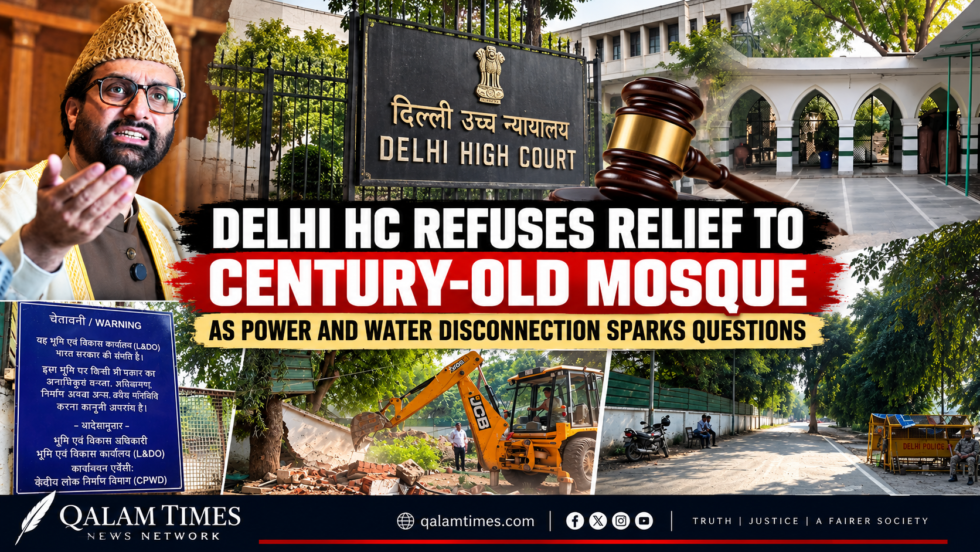
Race Course Mosque in Delhi faces uncertainty after the High Court rejects an imam’s plea to restore electricity and water, raising questions about the future of the historic Waqf-notified property.
Qalam Times News Network
New Delhi, October 24, 2026
The historic Race Course Mosque in the national capital has been drawn into a legal dispute after the Delhi High Court refused to order the restoration of its electricity and water connections, which were disconnected on October 7. The court dismissed a petition filed by the mosque’s imam, Mohd Haroon, observing that questions concerning his legal rights over the premises and the applicability of an earlier judgment required consideration beyond the scope of the proceedings.

The decision, delivered by Justice Saurabh Banerjee on October 15, has brought renewed attention to the position of the century-old religious structure, its legal status and the ongoing developments surrounding the land on which it stands. The Race Course Mosque is located within the Race Course Club complex, spread across approximately 53 acres near the Prime Minister’s official residence at 7, Lok Kalyan Marg.
The mosque is a Waqf-notified property and was recognised as a Grade II heritage structure in 2009. Its utility connections were disconnected amid demolition activities in the surrounding area, where disputes over land possession and the eviction of residents have already resulted in prolonged legal proceedings.
A Historic Mosque in the Middle of a Land Dispute
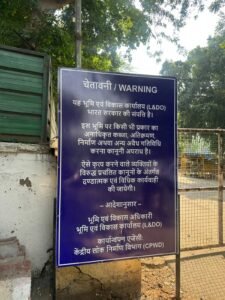
The mosque and its adjoining graveyard are documented in official administrative records. According to a Delhi Administration Gazette notification dated September 8, 1977, the property appears under entry number 18 and covers two bighas of land, including the mosque and the graveyard. Situated behind Safdarjung Tomb, the religious site lies within an area that has become the focus of proceedings concerning the Race Course Club property and neighbouring settlements. The Centre has cited national security considerations in connection with taking possession of the area. However, government sources were reported as saying that no eviction notice had been issued to the mosque itself. The question of the mosque’s future has nevertheless attracted attention because its electricity and water supplies were cut off while demolition work continued nearby. The distinction between the wider land-possession dispute and the legal status of the mosque remains important. Although the surrounding area has been affected by eviction proceedings, the court’s October 15 decision concerned the imam’s request for restoration of utility services and the legal questions raised by his petition.
Mohd Haroon, the mosque’s imam, approached the Delhi High Court on October 12 after the electricity and water connections were disconnected on October 7. Haroon lives in a hujra, or small living quarter, on the mosque premises.
Before the petition was filed, the Delhi Waqf Board had approached the New Delhi Municipal Council (NDMC) seeking the restoration of the essential services. In a letter dated October 8, the Board asked the NDMC’s executive engineer to restore the connections. It reportedly maintained that the services had been disconnected without prior notice or an apparent valid reason, despite the payment of outstanding dues. The Board also stated that the mosque had maintained a lawful electricity connection since 1976. Its intervention highlighted the long-standing use of the premises and the dispute over the circumstances in which the utility services were discontinued. The request, however, did not result in the immediate restoration of electricity and water. Haroon subsequently moved the High Court, seeking judicial intervention to have the services restored.
NDMC Cites Safety Concerns Amid Demolition Work
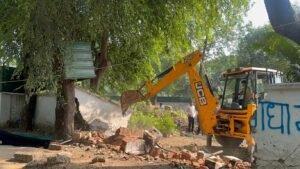
The NDMC opposed the plea when the matter came before the High Court on October 15. The civic body argued that demolition work was still underway in the area, including the removal of jhuggi structures, and that restoring electricity during the ongoing operations could pose a risk to public safety. The NDMC also raised a procedural objection, pointing out that the Land and Development Office (L&DO), which is overseeing the demolition process and is expected to take possession of the land, had not been made a party to Haroon’s petition.
During the proceedings, the NDMC’s counsel also referred to an earlier Delhi High Court judgment dated August 25. Although the mosque was not a party to the litigation concerning the Race Course Club and the eviction of slum dwellers, the civic body’s counsel told the court orally that the mosque premises were covered by that judgment. The earlier ruling had cleared the way for the eviction of approximately 700 slum dwellers living near the Prime Minister’s residence. The displaced residents have since reportedly been rehabilitated in Savda Ghevra, nearly 50 kilometres away. The reference to the August 25 judgment became relevant because the court was asked to consider whether the mosque premises fell within or outside the scope of the earlier ruling. Justice Saurabh Banerjee dismissed Haroon’s petition after considering the legal questions concerning his claim to the premises. The court noted that the Delhi Waqf Board, which it described as the “original occupant” of the premises, had not itself challenged the disconnection of electricity. It also observed that Haroon had been appointed as an imam by the Board and that his appointment did not, by itself, establish an independent legal right to the property. On this basis, the court declined to accept his claim that the disconnection amounted to a violation of his fundamental rights in the circumstances presented before it. The order also identified what it described as “serious disputed question of facts”. These included whether Haroon possessed any right, title or interest in the premises and whether the mosque fell outside the scope of the August 25 judgment. The court stated that these issues went beyond what it could adjudicate in the writ petition before it and dismissed the plea.
The ruling means that Haroon did not obtain the requested order for the restoration of electricity and water through this petition. It should not, however, be interpreted as a final judicial determination of every issue concerning the mosque’s historical status, the property records or the applicability of the earlier judgment.
Delhi Waqf Board’s Role Comes Under Scrutiny
The case has also drawn attention to the administrative position of the Delhi Waqf Board, which had sought the restoration of the utility services but did not independently challenge their disconnection in the proceedings initiated by Haroon. The elected body’s tenure ended in August 2023, and the Board has not been reconstituted since, according to the reported account. Officials appointed by the Lieutenant Governor assumed charge in January 2024 and have continued to administer its affairs in the absence of a reconstituted elected body. The Board’s intervention through its letter to the NDMC demonstrated that it had raised objections to the disconnection. Nevertheless, the court specifically noted that it had not itself challenged the action before the court in the proceedings under consideration. This has raised questions about the representation of Waqf-notified religious properties in disputes involving civic authorities, land possession and essential services. The case also illustrates the distinction between the rights of an institution associated with a property and those of an individual appointed to serve there. The precise legal responsibilities of the Board, the status of the premises and the rights of the parties remain matters that must be assessed according to the applicable law and the relevant court proceedings. The Race Course Mosque’s recognition as a Grade II heritage structure in 2009 and its inclusion in the 1977 Gazette notification form important parts of its historical and administrative background. The property’s Waqf notification is another significant element in the dispute. However, these records must be considered separately from the immediate legal question addressed by the High Court: whether the imam was entitled to the relief sought through his petition and whether the disputed questions could be decided in those proceedings.
The refusal to restore the utility connections has left the immediate request for relief unresolved in Haroon’s favour. Meanwhile, the NDMC has maintained that the continuing demolition work presents public safety concerns, while the Waqf Board had previously argued that the services were disconnected without proper notice or an apparent valid reason. The dispute therefore brings several issues into focus: the status of a historic religious site, the rights of its occupants, the responsibilities of the authorities managing the surrounding land, and the consequences of redevelopment and demolition activities. For now, the High Court has declined to direct the restoration of electricity and water through Haroon’s petition. The broader questions surrounding the premises and the application of the August 25 judgment remain distinct from that decision and would require consideration through the appropriate legal process.