



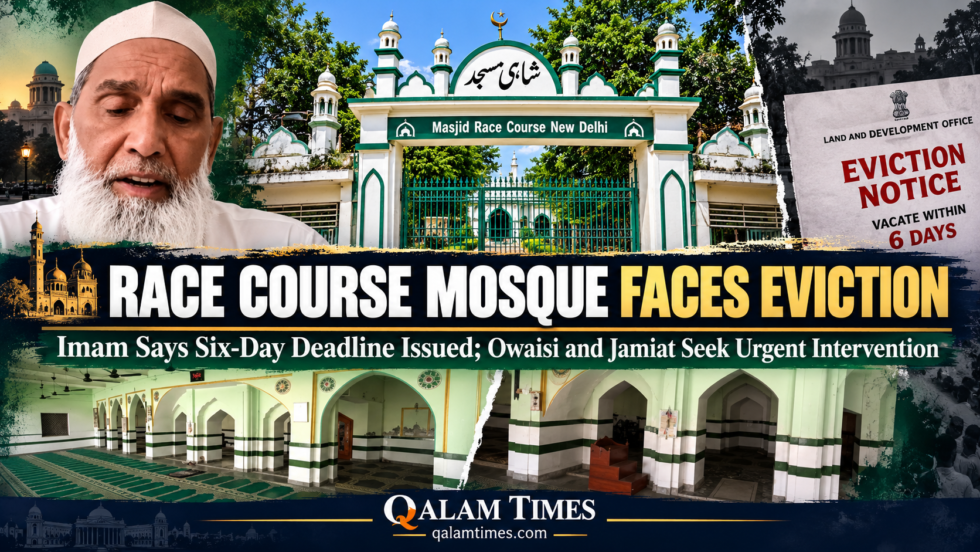
Race Course Mosque Eviction sparks concern as Imam Mohammed Harun alleges a six-day deadline, while Asaduddin Owaisi and Jamiat Ulama-i-Hind seek urgent government intervention.
Qalam Times News Network
New Delhi, 20 October 2026
The Race Course Mosque eviction dispute has intensified after the mosque’s imam, Mohammed Harun, alleged that authorities had directed him to vacate the premises within six days, raising concerns about the future of a historic place of worship near the official residence of Prime Minister Narendra Modi. The development has prompted appeals for urgent intervention from AIMIM chief Asaduddin Owaisi and Jamiat Ulama-i-Hind, while the imam says the disconnection of water and electricity has made daily religious activities increasingly difficult.
According to the reports provided to Qalam Times News Network, the Land and Development Office (L&DO) issued an eviction notice on Monday, October 19, declaring the premises unauthorised and directing that they be vacated within the stipulated period. The dispute centres on the mosque’s occupation of government land, its claimed status as a registered Waqf property and its inclusion in heritage records associated with the New Delhi Municipal Council (NDMC).
The Race Course Mosque eviction controversy has also drawn attention to the responsibilities of the relevant public authorities and the Delhi Waqf Board, with critics questioning whether sufficient steps were taken to protect the property and pursue available legal remedies. The mosque’s electricity and water supplies were reportedly disconnected on October 7. The imam has further alleged that the entrances were closed and access routes obstructed, making it difficult for worshippers to reach the premises and offer namaz.
Historic Status and Waqf Protection at the Centre of the Dispute
The mosque is reportedly included in the NDMC’s heritage records. Jamiat Ulama-i-Hind has stated that the property appears at serial number 22 in the NDMC heritage list and serial number 18 in the Delhi Gazette of 1977.
The organisation has argued that these records support the need to preserve the mosque’s historical and religious significance while the dispute is examined by the competent authorities.

Owaisi has also maintained that the mosque was recognised as a gazetted Waqf property in 1977 and should receive the protections applicable under the relevant legal framework. In a post on X, he referred to the concept of “waqf by user” and argued that the provisions of the Waqf Amendment Act should be considered in determining the property’s status.
However, the legal implications of the heritage listings, the property’s Waqf status and the L&DO’s claim over the land require examination of the underlying official records and applicable law. Inclusion in a heritage list and recognition as a Waqf property may raise distinct legal questions, and neither should be treated as conclusively resolving the dispute without examining the relevant documents.
All India Majlis-e-Ittehadul Muslimeen (AIMIM) president and Hyderabad MP Asaduddin Owaisi has urged Union Minority Affairs Minister Kiren Rijiju to intervene urgently.
Owaisi questioned the apparent lack of effective action by the Delhi Waqf Board, alleging that it had not adequately challenged the eviction or demolition-related action despite the property’s claimed Waqf status.
He also pointed to the absence of a constituted Delhi Waqf Board since 2023, arguing that the situation made intervention by the Union ministry particularly important. At the same time, he questioned why the board’s chief executive officer had not taken effective steps to address the matter.
Owaisi’s intervention has brought the dispute into the wider political debate over the protection of religious endowments, the responsibilities of Waqf authorities and the legal safeguards available to historic places of worship.
The immediate question, however, remains whether the authorities and the relevant institutions can resolve the competing claims before any irreversible action is taken against the property.
Jamiat Ulama-i-Hind Submits Memorandum to the Union Minister

Jamiat Ulama-i-Hind has separately approached Rijiju, seeking urgent measures to protect the Race Course Mosque and the adjoining graveyard located behind Safdarjung Tomb. A delegation led by the organisation’s general secretary, Maulana Muhammad Hakimuddin Qasmi, submitted a memorandum on behalf of its president, Maulana Mahmood Asad Madani. The memorandum referred to the mosque’s inclusion in the NDMC heritage list and the 1977 Delhi Gazette. It called for a detailed report from the authorities concerned and urged them to preserve the property’s religious, historical and legal status. The organisation also sought information from the Delhi Waqf Board and the NDMC, arguing that no demolition-related steps should be taken until the dispute had been examined and resolved through the appropriate legal process. According to the supplied report, Rijiju heard the delegation’s concerns and assured its representatives that he would make every possible effort to address the matter.
The minister’s reported response has raised expectations among those seeking intervention, although the precise nature of any official action or decision would need to be confirmed through subsequent government communications.
Imam Mohammed Harun Says Repeated Appeals Went Unanswered
Mohammed Harun, who says he has been associated with the mosque for nearly 40 years, has described the situation as deeply distressing. In a video statement circulated on social media, the imam alleged that he had repeatedly approached the Delhi Waqf Board over approximately six months but had received no effective assistance. According to Harun, the board’s response was limited largely to writing to the NDMC about the disconnection of electricity and water. He alleged that his requests for stronger legal intervention were not acted upon. “Even drinking water has come to an end,” he said, describing the practical difficulties created by the loss of essential services and the reported obstruction of access to the mosque. Harun further claimed that he had urged the board to approach the court and had sought permission to pursue legal action himself. He alleged that neither step was taken.
The imam maintained that the mosque had a recognised heritage status and referred to a survey conducted in 2021, which he said had not classified the property as unauthorised or as an encroachment. That assertion has not been independently verified from the survey documents supplied with the reports. Appealing to supporters and members of the public, Harun said he had exhausted his efforts to secure assistance and was distressed by what he viewed as the Waqf Board’s failure to stand by the mosque. His account has placed the human consequences of the dispute at the centre of the controversy, particularly the difficulty of maintaining access to a place of worship when essential utilities have reportedly been disconnected.
Amanatullah Khan Raises Concerns Over Possible Demolition
Aam Aadmi Party leader Amanatullah Khan, a former chairman of the Delhi Waqf Board, has also expressed concern about the reported action against the mosque.Khan said the mosque predated Independence and was included in the NDMC’s heritage list. He indicated that he intended to visit the site personally to assess the situation.
His intervention adds another political voice to the calls for clarification over the property’s status and the steps being taken by the authorities. The dispute now involves several related but distinct issues: the government’s claim concerning the land, the mosque’s asserted Waqf status, its inclusion in heritage records, the reported disconnection of essential services and the legal options available to the parties. A clear account of the relevant documents and the decisions taken by the competent authorities will be necessary to establish the property’s legal position.
The six-day deadline reported by the imam has made the matter urgent. Jamiat Ulama-i-Hind has called for restraint until the legal questions are settled, while Owaisi and other political figures have demanded intervention from the relevant authorities.
The next steps will depend on the official eviction notice, the legal basis cited by the L&DO, the status of any proceedings before a court and the response of the Waqf authorities and the Union Minority Affairs Ministry.
The government authorities’ position on the mosque’s land status and the basis for the reported eviction action also needs to be clearly documented. Equally important is whether any legal protection or interim relief applies to the premises.
For the mosque’s imam and worshippers, the immediate concerns include access to the site, the restoration of essential services and clarity over whether they will be permitted to continue using the premises while the dispute is examined.
The case has become a test of how competing claims involving government land, religious endowments and heritage recognition are handled under the law. A transparent examination of the records, along with timely communication from the responsible authorities, would help establish the facts and clarify the available remedies.