



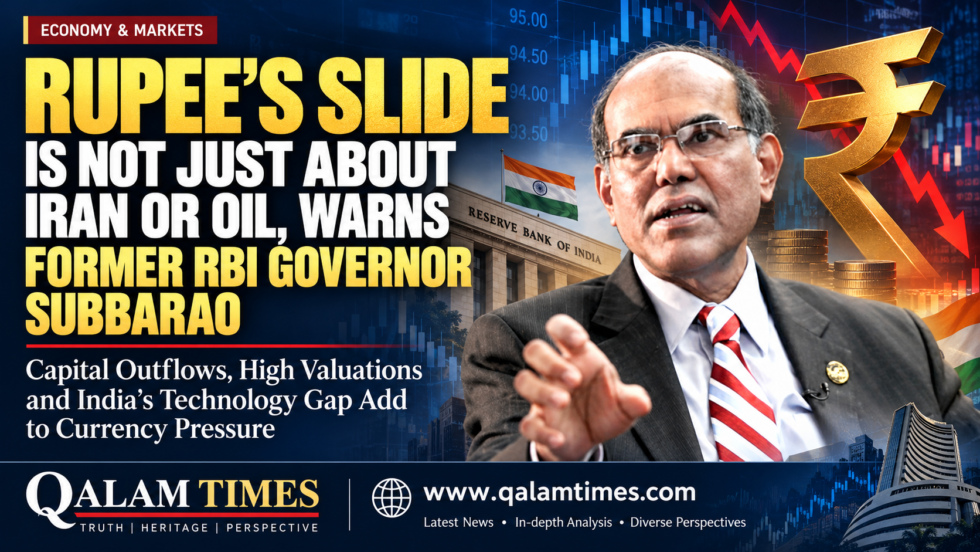
Rupee Depreciation reflects more than the Iran conflict and rising oil prices, says former RBI Governor D Subbarao, citing capital outflows, high valuations and India’s technology gap.
Qalam Times News Network
Kolkata, 19 October 2026
Former RBI Chief Highlights Structural Weaknesses Behind the Rupee’s Decline
Rupee Depreciation cannot be explained solely by geopolitical tensions involving Iran or the recent rise in international crude oil prices, former Reserve Bank of India (RBI) Governor D Subbarao has cautioned. In an interview with PTI, Subbarao argued that treating the currency’s weakness as a temporary consequence of the current international crisis could lead to an incomplete understanding of India’s economic challenges.

According to Subbarao, Rupee Depreciation has been influenced by persistent capital outflows over several years, reflecting a combination of domestic weaknesses and changing global investment preferences. Although higher oil prices put additional pressure on India’s external finances, he believes that the underlying reasons for the currency’s performance require closer examination, particularly the attractiveness of Indian financial assets to international investors. His remarks come amid pressure on the rupee, declining domestic equity markets and fluctuations in crude oil prices. The Indian currency settled at a provisional level of ₹94.92 against the US dollar on Monday, October 19, losing three paise during the session, according to the supplied report. Subbarao’s central argument is that India’s economic growth, while comparatively strong, is not sufficient on its own to guarantee sustained foreign investment or a stronger currency. Improving productivity, export competitiveness and technological capabilities will be essential if India wants to strengthen investor confidence over the long term.
Why Foreign Investors Are Becoming More Cautious About Indian Assets
One of the concerns identified by Subbarao is the valuation of Indian equities. Domestic households have increasingly invested in shares and mutual funds, helping support the stock market and expanding participation in financial assets. However, strong domestic investment has also contributed to elevated market valuations. For foreign portfolio investors, who compare potential returns across countries and asset classes, relatively expensive Indian stocks may offer less attractive opportunities than competing markets. Subbarao observed that international investors are increasingly assessing where their money can generate the strongest returns. If Indian assets are priced at a premium while the expected gains appear limited, investors may choose to move capital elsewhere. uch decisions can put pressure on the rupee because foreign investors selling Indian assets and converting the proceeds into other currencies increase demand for foreign exchange. The scale and direction of these flows depend on several factors, including market expectations, interest-rate differences, risk appetite and the relative performance of competing economies. The former RBI Governor’s assessment suggests that restoring confidence in Indian assets will require more than temporary measures to support the exchange rate. India must also strengthen the economic fundamentals that influence long-term investment decisions.
The Global Technology Race Is Redirecting Investment
Subbarao also pointed to a major shift in international capital allocation. Investors are increasingly directing money towards economies, companies and industries associated with technological leadership. The expansion of artificial intelligence has been a significant factor, particularly through investment in large US technology companies. Other sectors attracting attention include semiconductors, biotechnology, advanced manufacturing and renewable-energy technologies. Countries and markets such as the United States, Taiwan and China have attracted capital because of their positions in different parts of these technology-driven industries. Subbarao’s point is that international investors are no longer looking exclusively at economic growth rates. They are also evaluating which countries possess the research capabilities, industrial ecosystems, skilled workforces and technological advantages needed to generate future profits. India remains one of the world’s fastest-growing major economies, but its presence in several advanced technology sectors is still relatively limited. This gap can affect the country’s ability to attract investment at a time when global capital is increasingly concentrating on emerging technologies. For India, the challenge is therefore to convert its growth potential into greater technological competitiveness. Investment in research and development, advanced manufacturing, semiconductor capabilities and innovation could help broaden the range of opportunities available to domestic and foreign investors.
Stronger Exports and Productivity Are Essential for Currency Rupee Stability
Subbarao emphasised that India needs to make its assets more attractive by improving productivity, strengthening export competitiveness and reducing unnecessary transaction costs and policy uncertainty. These improvements matter because a country’s external position depends not only on the movement of financial capital but also on its ability to earn foreign exchange through exports and other international receipts. India imports substantial quantities of crude oil and other energy products. When global oil prices rise, the country generally faces a higher import bill, increasing demand for dollars. Unless this pressure is offset by stronger export earnings or other foreign-exchange inflows, the external balance can deteriorate. A more competitive export sector can help reduce this vulnerability over time. Greater manufacturing capacity, more productive businesses and a broader range of exportable goods and services can strengthen India’s ability to earn foreign exchange. Subbarao’s broader message is that policymakers must pay attention to both the current account, which records trade in goods and services and other current transactions, and the capital account in its broader external-sector context, which reflects financial flows and investment. A currency can face pressure even when economic growth remains strong if capital outflows persist and the external financing position becomes more difficult to manage.
RBI’s Rate Hike: Balancing Inflation Against Economic Growth
Subbarao also supported the RBI’s reported 25-basis-point interest-rate increase, describing it as a measured response to the risk that inflation could become entrenched. The central bank’s decisions involve competing priorities. Price stability is its primary monetary-policy objective, but policymakers must also consider economic growth and financial stability. The difficulty, according to Subbarao, is that much of the current inflationary pressure originates from supply-side disruptions, including higher oil prices and unfavourable monsoon conditions. Interest-rate increases cannot produce additional crude oil or improve rainfall. They can, however, moderate demand and help prevent an initial rise in prices from spreading throughout the economy. If households and businesses begin expecting inflation to remain high, they may adjust wages, prices and spending decisions accordingly. Such behaviour can make inflation more persistent, even after the original supply shock begins to ease. Subbarao warned that the RBI cannot simply assume inflation will decline without intervention. At the same time, he acknowledged that higher borrowing costs can discourage investment, raise financing expenses and slow economic activity. In his assessment, a 25-basis-point increase was justified as a cautious step against the risk of persistent inflation. However, he stressed that monetary tightening cannot resolve supply-side inflation or correct the structural factors behind the rupee’s weakness. The central bank therefore faces a difficult choice: tightening policy too early may weaken growth, while delaying action could allow inflationary expectations to become more firmly established. Subbarao also highlighted the relationship between Indian and US interest rates. Although the exchange rate is not explicitly stated as the primary objective of the Monetary Policy Committee (MPC), it remains an important consideration when assessing financial conditions. International investors compare the returns available in different countries, taking account of interest rates, exchange-rate risks and expected market performance. When the difference between Indian and US interest rates narrows, some investors may find Indian assets less attractive, depending on their expectations and the risks involved. Subbarao noted that the interest-rate differential between India and the United States had fallen to a historically low level at the time of his comments. He suggested that this could have been one of the considerations behind the RBI’s decision to raise rates.
However, interest-rate differences are only one part of the picture. Investors also consider the economic outlook, currency expectations, political and policy risks, and the availability of investment opportunities in other markets. A higher Indian interest rate cannot, by itself, guarantee capital inflows or prevent depreciation if investors remain concerned about valuations, growth prospects or external vulnerabilities. Subbarao also discussed the Reserve Bank’s Foreign Currency Non-Resident (FCNR) deposit scheme as a possible instrument for easing pressure on the rupee. He said such a scheme could be justified as an emergency measure when market sentiment becomes destabilised. Nevertheless, the amount of money raised through the scheme would not, on its own, establish whether the intervention had been successful. When the rupee comes under sustained pressure, the RBI may sell dollars from its foreign-exchange reserves to moderate excessive volatility. If reserves fall significantly, however, markets may become concerned about the country’s ability to manage further pressure on the currency.
These concerns can influence private-sector behaviour. Importers may seek to secure their future dollar requirements earlier than planned, while exporters may delay converting their dollar earnings into rupees if they expect the domestic currency to weaken further.
Such actions can intensify demand for dollars and add to exchange-rate pressure. FCNR inflows may help interrupt this cycle by bringing additional foreign currency into the banking system and supporting market confidence. Subbarao nevertheless cautioned that foreign-exchange reserves and the country’s underlying external strength are not the same thing. FCNR deposits create liabilities that must eventually be repaid. Depending on the terms of the scheme, including any exchange-rate protection or guarantee, the funds can carry a significant cost. This distinguishes borrowed or deposit-based foreign-currency resources from foreign exchange earned through exports. Although both can strengthen the immediate availability of foreign currency, they have different implications for future repayment obligations. Subbarao described the scheme as a form of insurance. The key question, he argued, is whether the immediate benefit of improving reserves and stabilising market expectations justifies the cost of obtaining those funds. In other words, FCNR inflows may provide temporary relief, but they cannot substitute for stronger exports, sustainable investment flows and reduced dependence on imported energy.
What India’s Policymakers Need to Address Next
Subbarao’s comments underline the need to distinguish between short-term currency pressures and longer-term economic weaknesses. Geopolitical tensions and rising oil prices can create immediate challenges for the rupee. However, the currency’s sustained performance also depends on the strength of domestic investment opportunities, the competitiveness of Indian exports, the direction of international capital flows and confidence in economic policy. A lasting improvement would require a combination of measures: stronger productivity, greater participation in advanced technologies, more competitive exports, predictable policies and a more resilient external position.
For the RBI, the challenge is to contain inflation without unnecessarily weakening growth, while managing the financial risks associated with currency volatility and international capital movements. For the government and industry, the broader task is to ensure that India’s growth translates into attractive investment returns, stronger technological capabilities and a greater capacity to earn foreign exchange.
The central lesson from Subbarao’s assessment is clear: India’s economic growth remains an important advantage, but growth alone cannot shield the rupee from persistent capital outflows or changing global investment priorities. Sustainable currency stability will depend on strengthening the economic foundations that encourage investors to stay, invest and participate in India’s long-term development.