





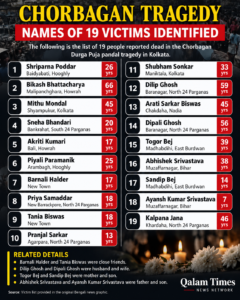
The Chorbagan Stampede in Kolkata claimed 19 lives and left 25 injured during Durga Puja celebrations, devastating 16 families and raising serious questions about crowd management and public safety.
Qalam Times News Network
Kolkata, October 18, 2026
Chorbagan Stampede Turns a Night of Celebration into a Family Tragedy
The Chorbagan Stampede during Kolkata’s Durga Puja celebrations has turned a festive evening into a devastating tragedy, claiming 19 lives and leaving 25 people injured, according to the reported toll. Behind these figures lie heartbreaking stories of parents who lost their children, couples who never returned home together, and friends whose plans for a joyful evening ended in tragedy. Sixteen families have been plunged into grief following the disaster at the Chorbagan Durga Puja pandal.
The Chorbagan Stampede occurred on Saptami evening, when heavy rain and severe traffic congestion affected parts of north and central Kolkata. According to eyewitness accounts, a large number of visitors tried to enter the pandal to escape the rain. The resulting rush and pushing created dangerous conditions inside the venue, where people reportedly fell along a circular passage. The crowd surge quickly turned fatal, leaving several people unable to escape.
Seventeen of the deceased were reportedly residents of West Bengal, while the remaining two were a father and son who had travelled from Bihar to celebrate Durga Puja in Kolkata. Abhishek Srivastava had arrived with his family, including his wife, Nibha, and their son, Ayansh. The family had come to enjoy the city’s famous festive celebrations. However, both Abhishek and Ayansh died in the incident. Relatives travelled from Bihar after receiving news of the disaster. Nibha was reportedly informed about her son’s death, while the family had not yet told her that she had also lost her husband. She was subsequently sent back to her home in Bihar. The family expressed anguish over what they believed was a failure to take adequate preventive measures. They questioned why stronger safety arrangements had not been implemented before the crowd became uncontrollable.
Two Teenage Friends Who Never Returned Home
Among the victims were Tania Biswas and Barnali Halder, both 17, from the Gouranganagar area of New Town. The two teenagers were close friends who regularly celebrated festivals together and had planned their Durga Puja outing in advance. They had decided to wear sarees for the occasion and travelled to Kolkata to visit the pandals. Their plans ended in tragedy at Chorbagan, where both girls reportedly died in the crowd surge. Their deaths have left their families and neighbourhood devastated. What was meant to be an evening of friendship, photographs and festive memories has instead become an unbearable loss.
Shriparna Poddar, 27, worked as a nurse at Tata Medical Centre and lived in Baidyabati, Hooghly. She had left home for work on Saturday morning and later joined friends for pandal-hopping in Kolkata. Her family learnt of the tragedy through one of her friends and rushed to Kolkata Medical College and Hospital. By the time they arrived, Shriparna had died. Neighbours remembered her as a lively and compassionate young woman who was always ready to help anyone in need. Her parents, who had only one child, were left devastated by the loss.
Families Lose Their Sole Breadwinners

Shubham Sonkar, 33, from Bagmari in Kolkata, had gone out to see the Durga Puja pandals with his parents and sister. He never returned home. Shubham worked for a private company and was reportedly the primary financial support for his family. His father, Ramji Sonkar, is retired, while his brother Sujan is preparing for competitive examinations and his sister Nayana gives private tuition. His death has left the family grieving not only for a loved one but also facing uncertainty about its financial future. Priya Samaddar, a 19-year-old student from Leninagar in New Barrackpore, was another victim. She studied in the arts stream at APC College and had gone to Kolkata with friends to enjoy the festival. Her father, Shyamal Samaddar, a tailor by profession, struggled to come to terms with the loss of his daughter. The family had been looking forward to the celebrations, never imagining that the evening would end in such a devastating manner.
A Young Boy Separated from His Parents

Thirteen-year-old Pranjal Sarkar had travelled from Agarpara to see the Durga Puja pandals with his parents. During the crush, he became separated from them and was reportedly unable to get back on his feet after falling. His family members later described the painful experience of identifying his body among the deceased. The account has further intensified concerns about the risks faced by children and vulnerable visitors in densely packed festival crowds. The loss has been especially difficult for his mother, who is struggling to accept that her child is gone.
Togor Bej, 18, and her 14-year-old son, Sandip Bej, had travelled to Kolkata with relatives after visiting her parental home in Balia village, Hooghly. They had planned to return to their home in Birpur, East Burdwan, on Sunday. Neither made it back. Togor’s sister-in-law, 25-year-old Piyali Paramanik, also died in the incident. Togor’s daughter, Agamani Bej, sustained injuries and was receiving hospital treatment, according to the report. The news reached Birpur on Saturday night, leaving the village in shock. A family visit intended to create happy festive memories instead resulted in multiple deaths and a young girl requiring medical care.
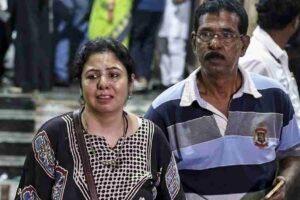
Dilip Ghosh, 62, and his wife, Dipali Ghosh, 56, residents of NK Chatterjee Road in Baranagar, had gone to Chorbagan together on Saptami evening. Their relatives received a telephone call at around 9:30 pm informing them that the couple had been taken to hospital. Initially, they learnt of Dilip’s death. Further enquiries revealed that Dipali had also died. The couple’s simultaneous deaths have left their extended family mourning the loss of two loved ones who had set out together to celebrate the festival.
Other Victims and Heartbreaking Accounts
Arati Sarkar Biswas, from Natunpara in Chakdaha, Nadia, also died while visiting Kolkata’s Durga Puja pandals. Her husband, Ram Sarkar, reportedly witnessed her collapse under the pressure of the crowd. He recalled that visitors were suddenly instructed to leave, triggering a rush as people attempted to move out simultaneously. Arati fell and could not get back up. Her husband later expressed deep anguish at being unable to save her. Other reported victims included Mithu Mondal of Shyampukur, Akriti Kumari of Bali, Bikash Bhattacharya of Howrah and Sneha Bhandari of Bankrahat. The stories of the deceased reveal the wide reach of the disaster: students, healthcare workers, young parents, elderly couples and visitors who had travelled from outside Kolkata were all among those affected.
Eyewitnesses Describe Bloodied Victims and Chaos at the Pandal
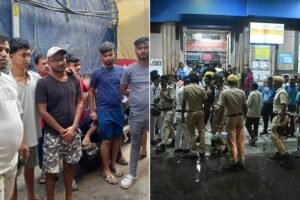
Eyewitnesses described scenes of panic, with injured people struggling to escape and personal belongings scattered across the road. Some victims reportedly had bleeding injuries, while others had torn clothing. Shoes, bags and water bottles lay abandoned as visitors tried to reach safety. One witness said that conditions became suffocating after part of the pandal reportedly collapsed, leaving people desperately searching for a way out. Another described seeing unconscious visitors and said that assistance was being provided to some victims while the situation remained chaotic. Questions have also been raised about the presence of police personnel inside the crowded area and the time taken to bring the situation under control. These accounts underline the importance of clear exit routes, adequate emergency personnel and effective crowd-flow management at major public gatherings.
Safety Measures Announced After the Disaster
The tragedy has renewed scrutiny of crowd-management arrangements at Kolkata’s major Durga Puja pandals. According to the report, the state government announced changes intended to reduce congestion, including ending VIP passes at major pandals and requiring visitors to use a common queue. The report also stated that a Bijoya Sammilani programme scheduled for October 26 would be scaled down. Organisers were expected to gather to pay tribute to the deceased and provide financial assistance to injured people. These measures come amid mounting grief and questions about whether the disaster could have been prevented through better planning, adequate crowd control and more effective emergency preparedness. The Chorbagan Stampede is a painful reminder of how quickly a public celebration can become a catastrophe when large crowds, severe weather and inadequate movement control combine. For the families who lost loved ones, official announcements and financial assistance cannot undo the loss. The tragedy has also highlighted the need for stronger safety protocols at crowded religious and cultural events. Clearly marked exits, controlled entry, trained crowd-management teams, emergency medical support and rapid communication can make a critical difference when conditions deteriorate. For 16 families, Durga Puja will forever be associated with grief rather than celebration. Their stories deserve to be remembered, and the questions raised by the disaster deserve serious answers.