



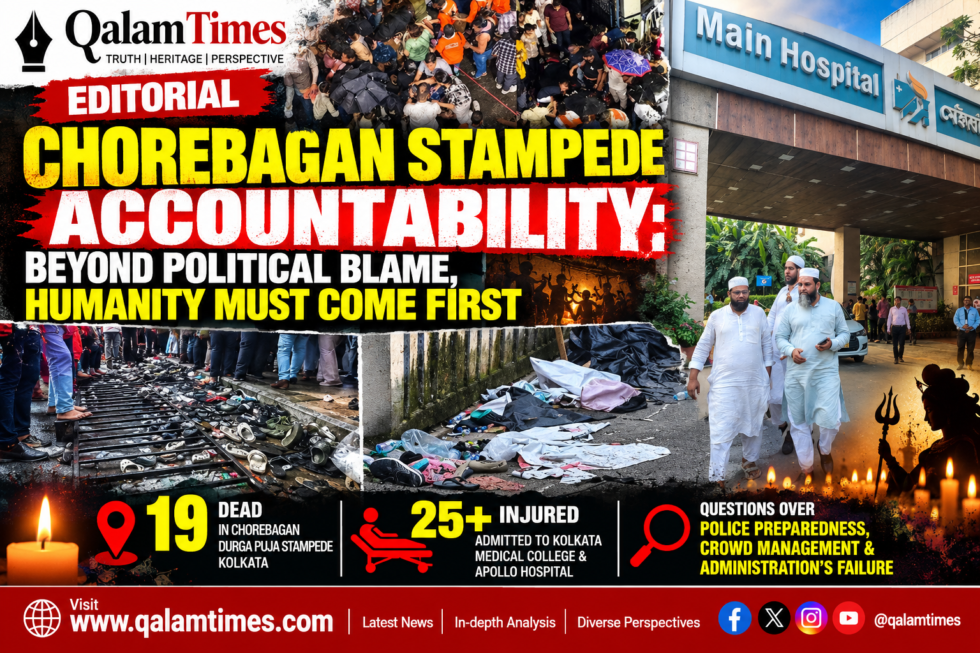
Chorebagan Stampede Accountability demands an impartial investigation, justice for victims, support for injured families and stronger public safety measures after the tragic Kolkata Durga Puja pandal incident.
— Dr. Mohammad Farooque
Qalam Times News Network
A Tragedy That Demands Justice, Compassion and Administrative Responsibility
Chorebagan Stampede Accountability must be more than a political demand following the tragic loss of lives at a Durga Puja pandal in Kolkata. The reported deaths of 19 people and injuries to several others have left families grieving and raised serious questions about crowd management, emergency preparedness and the responsibility of those entrusted with public safety. At such a moment, the first duty of every institution and political organisation is to stand with the victims, provide assistance to the injured and help establish the truth.
The tragedy has also prompted a response from civil society organisations. A joint delegation comprising representatives of Jamaat-e-Islami Hind, West Bengal; the Association for Protection of Civil Rights (APCR), West Bengal; and Jamiat Ulama-i-Hind, Kolkata, reportedly visited Kolkata Medical College and Apollo Hospital to enquire about the injured and offer support to their families. This humanitarian initiative brings an important dimension to the discussion: Chorebagan Stampede Accountability must include not only an investigation into the circumstances of the disaster but also practical solidarity with those whose lives have been shattered by it.
According to the statement supplied by the delegation, its members included Shadab Masum, secretary of Jamaat-e-Islami Hind, West Bengal; Umar Waees, secretary of APCR, West Bengal; Maulana Ashraf Ali Qasemi, secretary of Jamiat Ulama-i-Hind, Kolkata; and Javed and Umar Ali Momin. The delegation expressed grief over the incident, sought information about the condition and treatment of the injured, spoke with family members and assured them of possible assistance. Although the hospital authorities reportedly could not facilitate direct meetings with the injured in the absence of the concerned superintendent, the representatives discussed medical concerns with hospital officials and extended their support to the families. The delegation also stated that a group of young volunteers was ready to donate blood and provide other assistance if required. Such a commitment deserves recognition because, in the aftermath of a public tragedy, timely help can make a meaningful difference to those struggling with uncertainty and loss.
Humanity Must Stand Above Political Rivalry
The Chorebagan incident has become the subject of intense political debate. Opposition leaders have questioned the preparedness of the administration, the conduct of the police and the involvement of politically connected individuals in the organisation of the puja. Questions have also been raised about the responsibilities of temporary security personnel and the arrangements made to control the crowd. These issues require serious examination. However, the suffering of victims must not become secondary to a contest between political parties. The question raised by Trinamool Congress MP Abhishek Banerjee about whether politically connected individuals would face the same legal scrutiny as others has brought the issue of accountability into public discussion. The BJP leadership has disputed some of the allegations concerning personal relationships and responsibility. Such claims must be examined through evidence rather than accepted or rejected merely on political grounds. No individual should be presumed guilty because of political affiliation or family connections. Equally, no individual should receive protection from legitimate investigation because of political influence. The proper course is clear: establish the facts, determine the responsibilities of the organisers and relevant authorities, and take lawful action wherever negligence or wrongdoing is proved. The identity or influence of those involved must not determine the outcome.
An Independent Investigation Is Essential for Chorebagan Stampede
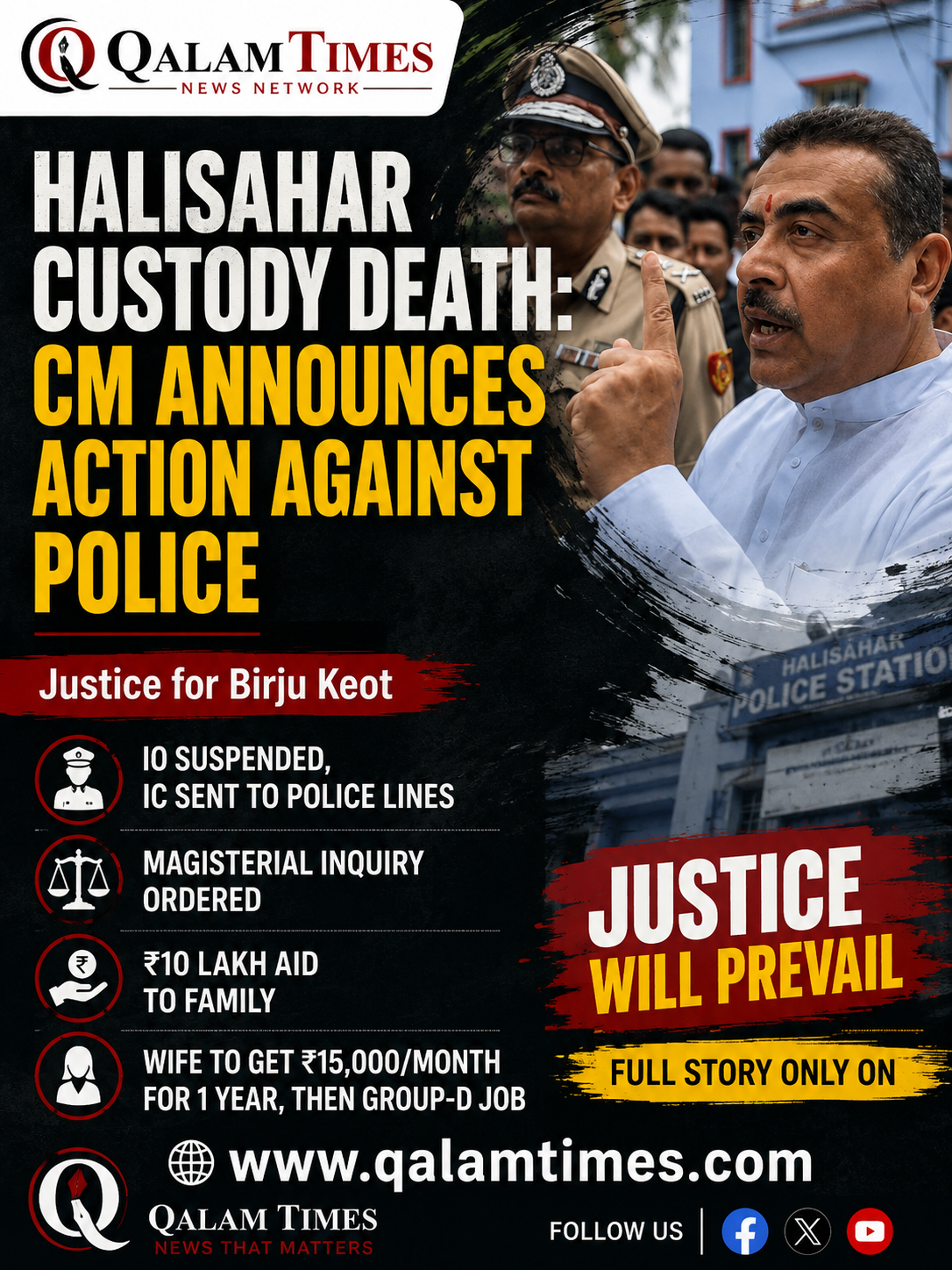
Chief Minister Suvendu Adhikari has reportedly announced compensation for the families of those who died and expressed his intention to seek a fact-finding inquiry led by a sitting judge of the Calcutta High Court. These announcements must now be followed by transparent action. Compensation can provide some financial relief, but it cannot replace a loved one or resolve the questions surrounding the tragedy.

An impartial investigation should establish the sequence of events, examine the crowd-control arrangements, review police deployment and assess the emergency response. It should also determine whether the venue had adequate entry and exit routes, whether the expected number of visitors was properly assessed and whether officials responded appropriately when the situation deteriorated. The role of weather conditions, including the reported heavy rainfall, should also be examined. If rain contributed to overcrowding or forced people into confined spaces, investigators should determine whether contingency plans were adequate and whether the risks had been anticipated. The investigation must be independent enough to examine every relevant institution without political interference. Its findings should be made public, subject to applicable legal requirements and the protection of legitimate privacy interests. If negligence is established, the responsible individuals must face appropriate consequences under the law. If the evidence does not support particular allegations, that too should be stated clearly. Justice requires both accountability and fairness. The hospital visits by representatives of Jamaat-e-Islami Hind, APCR and Jamiat Ulama-i-Hind demonstrate the important role civil society can play during a crisis.
Public organisations do not need to wait for every administrative question to be resolved before offering humanitarian assistance. They can help families obtain information, identify medical needs, coordinate voluntary blood donation where required and connect affected people with available support services. Such work must be carried out responsibly, in coordination with medical professionals and hospital authorities. Patients’ privacy and the wishes of their families should always be respected. The delegation’s reported willingness to mobilise young volunteers for blood donation is particularly relevant when hospitals are treating multiple injured people. Any such effort should follow the requirements of authorised blood banks and medical teams so that donations are safe and useful. Civil society can also help ensure that the needs of affected families remain visible after the immediate media attention fades. Some families may face loss of income, medical expenses, psychological distress or long-term care responsibilities. Support should therefore extend beyond the first few days after the incident. The humanitarian response must be judged by whether it reaches those who need it, not merely by the public announcement of assistance. Large religious gatherings are an important part of West Bengal’s cultural and social life. Durga Puja brings together residents, visitors, families and communities across the state. The scale of participation, however, makes careful planning essential. Crowd safety requires more than deploying personnel at a venue. Organisers and authorities must assess the capacity of the location, establish clear entry and exit arrangements, prevent dangerous congestion and maintain access for ambulances and emergency responders. Security personnel must receive clear instructions and understand their responsibilities. Supervisors must monitor changing conditions, while organisers should maintain reliable communication with the police and medical services.
Weather-related contingency plans are also essential. Heavy rain can change crowd movement rapidly as visitors seek shelter or move towards narrow passages. A safe event must account for such foreseeable changes rather than rely on arrangements designed only for normal conditions. Authorities should also ensure that emergency procedures can be activated quickly when congestion becomes dangerous. If visitor numbers exceed a venue’s safe capacity, access may need to be restricted or the event temporarily suspended. These measures are not administrative formalities. They are safeguards intended to prevent avoidable injuries and deaths.
Compensation Is Necessary, but Prevention Is More Important
The reported compensation announcement by the state government is an important immediate issue for affected families. Authorities should communicate the eligibility criteria, required documentation and payment schedule clearly so that families are not left struggling with uncertainty. However, the effectiveness of a government response cannot be measured by financial assistance alone. A meaningful response must also address the conditions that allowed the disaster to occur. The administration should review safety arrangements at other major festival venues, particularly those with narrow access routes or exceptionally high visitor numbers. Risk assessments should be completed before gatherings begin, and organisers should be required to correct identified weaknesses. Where deficiencies are discovered, the authorities should provide clear deadlines for corrective action and verify that the measures have been implemented. Lessons from the investigation should be incorporated into future crowd-management plans. The objective must be to prevent another family from receiving the same devastating news.
A Test of Governance and Collective Responsibility
The Chorebagan tragedy presents a test not only for the government but also for the police, event organisers, political parties and civil society. The government must demonstrate that its promise of an impartial inquiry will be honoured. The police must cooperate fully with the investigation and provide relevant records. Organisers must answer legitimate questions about their preparations. Political parties must allow the search for truth to proceed without turning every development into an opportunity for partisan confrontation. Civil society organisations, meanwhile, can continue to support the injured, assist families and advocate for transparent findings. Their contribution is most valuable when it combines compassion with a firm commitment to evidence and the rule of law.
The people who died at Chorebagan were not participants in a political contest. They were individuals attending a public celebration, each with a family, relationships and hopes for the future. Those left behind deserve respect, timely assistance and truthful answers.
The reported hospital visits by the joint delegation are a reminder that solidarity can begin even while difficult questions remain unresolved. Offering help to an injured person, reassuring a grieving family or arranging essential assistance may not resolve the wider administrative crisis, but each is a meaningful act of public service. The true significance of the Chorebagan tragedy will depend partly on what follows it. If the incident produces only political accusations, temporary announcements and a gradual fading of public attention, its most important lessons will have been lost. If it leads to a credible investigation, fair legal action where warranted, sustained support for victims and stronger safety standards at public gatherings, it can become an opportunity for meaningful reform. The demand for accountability must therefore remain focused on evidence, justice and prevention. No political party should be permitted to dictate the findings, and no authority should be allowed to avoid scrutiny merely because the questions are uncomfortable.
The measure of a responsible administration is not simply how it responds after lives have been lost, but how diligently it works to prevent such losses in the first place.
At this painful moment, compassion must guide the immediate response, transparency must guide the investigation and public safety must guide future decisions. The victims and their families deserve nothing less.