



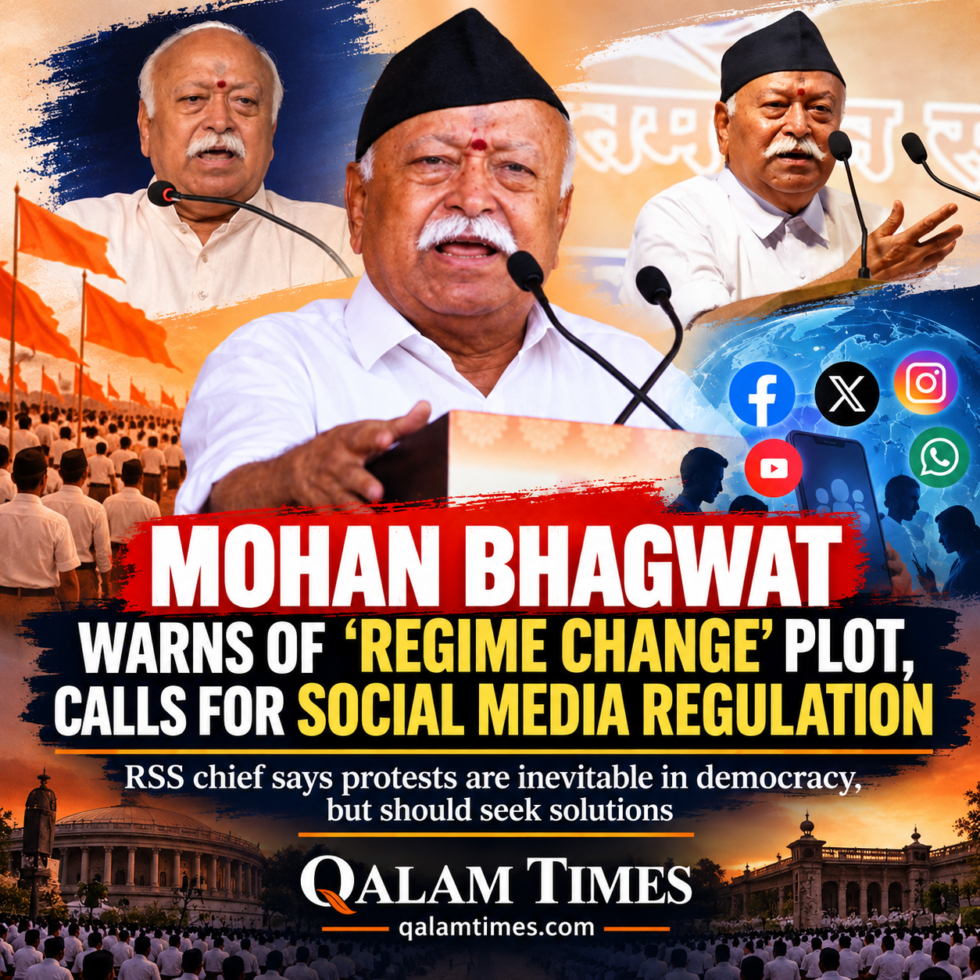
Regime Change in India is at the centre of RSS chief Mohan Bhagwat’s speech as he alleges foreign interference, defends solution-oriented democratic protests and calls for greater regulation of social media and OTT platforms.
Qalam Times News Network
Nagpur, 20 October 2026
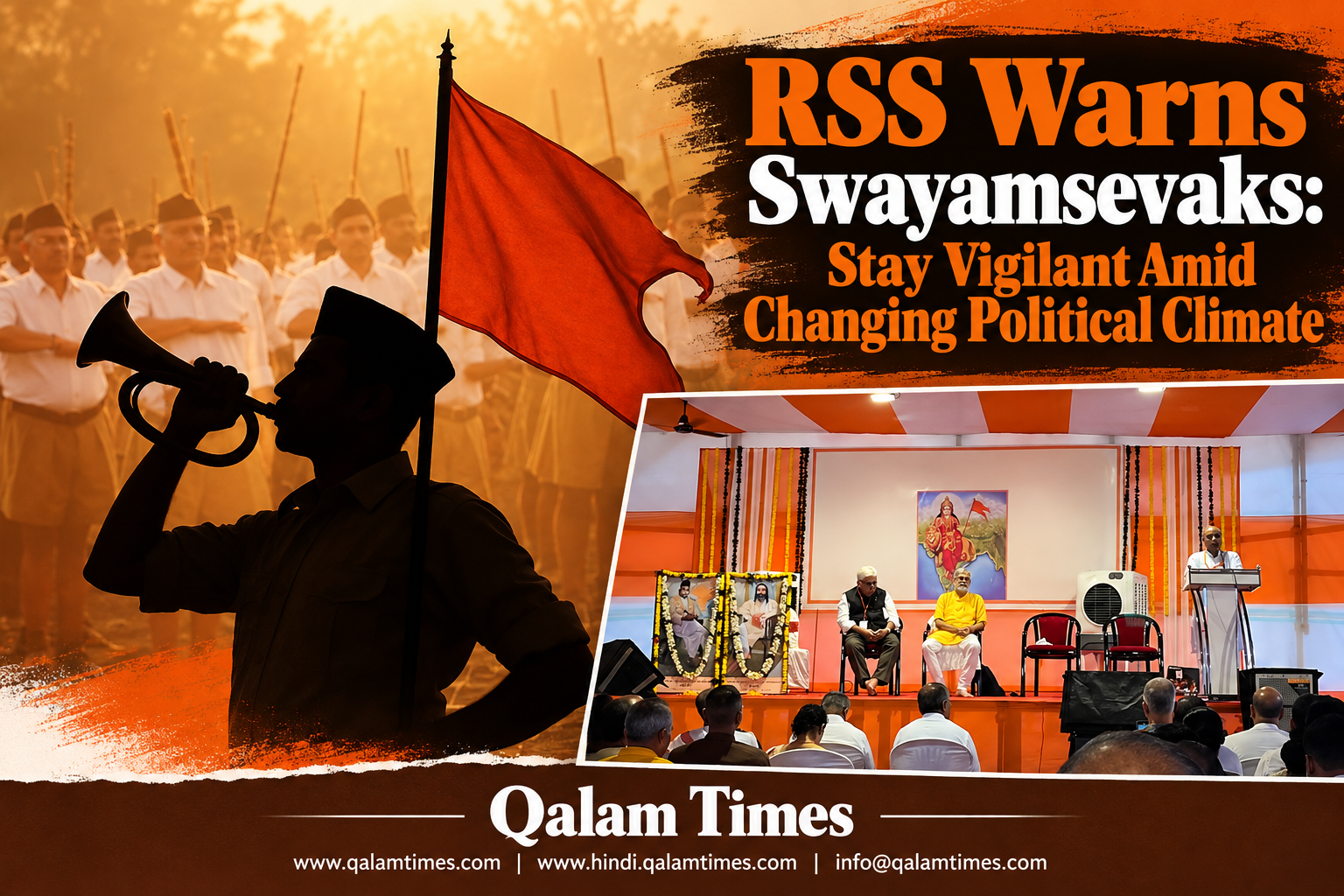
Regime Change in India emerged as a central theme of Rashtriya Swayamsevak Sangh (RSS) chief Mohan Bhagwat’s annual Vijayadashami address on Tuesday, as he alleged that certain international and domestic forces were attempting to weaken the country. While asserting that such efforts would not succeed, Bhagwat also acknowledged that protests were an inevitable part of democracy, provided they sought solutions rather than created divisions.
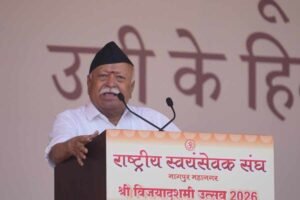
Addressing the RSS gathering in Nagpur, Bhagwat referred to political upheavals in Bangladesh, Nepal, France and Albania to illustrate what he described as a wider international trend of attempts to alter political systems in pursuit of vested interests. He argued that India’s growing strength and development had made it a target for forces that did not want the country to emerge as a major global power.
According to Bhagwat, these forces believed that changing a government would automatically transform a country’s circumstances. He rejected that proposition, arguing that regime change did not necessarily resolve the underlying problems faced by societies.
He alleged that some global powers wanted India to develop but were uncomfortable with the prospect of it becoming sufficiently powerful to challenge their influence. Bhagwat claimed that such interests were attempting to exploit internal divisions and weaken the country’s social cohesion. However, he did not identify the alleged foreign actors or present independently verifiable evidence establishing a coordinated international campaign against India.
SIR Protests Put Democratic Accountability in Focus
Bhagwat’s remarks came amid political demonstrations over the Election Commission of India’s Special Intensive Revision (SIR) of electoral rolls and demands for action against Chief Election Commissioner Gyanesh Kumar. Opposition parties and activist groups have raised concerns about the electoral-roll revision process, alleging irregularities and demanding greater accountability from the Election Commission. The controversy has developed into a broader political dispute involving electoral transparency, the conduct of constitutional institutions and the right of citizens to challenge government decisions. Against this backdrop, Bhagwat sought to distinguish between legitimate democratic demonstrations and protests that, in his view, could be used to advance political interests or create hostility in society. “Problems will remain, and protests are inevitable in a democracy. But what should the purpose of protests be? They should be aimed at finding solutions,” was the central message of his remarks. The RSS chief argued that demonstrations should address public grievances rather than become instruments for targeting individuals, organisations or ideological groups. He also appealed to political leaders, protesters and government authorities to ensure that their conduct did not deepen social divisions.
Bhagwat stressed that public emotions, however intense, should remain within the boundaries of the Constitution, civilised public debate and acceptable standards of conduct.
His comments did not amount to a rejection of protest as a democratic right. Instead, he emphasised that demonstrations should have a constructive objective and should not be allowed to become a source of persistent hostility.
Political Leaders Clash Over the Meaning of Regime Change
The debate over regime change has also drawn reactions from political leaders and prominent legal figures. Senior advocate Prashant Bhushan, commenting on the protests against the Election Commission, has argued that the demand is for a fair electoral system. He warned that continued repression, if it persisted, could eventually lead to calls for a change of government. The BJP criticised this position, interpreting the remarks as an indication that the protests extended beyond electoral reforms. Defence Minister Rajnath Singh accused the opposition of pursuing a broader political agenda and invoked the developments in Bangladesh as a warning against attempts to capture power through unrest. The Congress rejected that interpretation and defended the opposition’s role in a parliamentary democracy. Party leader Jairam Ramesh referred to the views of former President Pranab Mukherjee, arguing that opposition parties are expected to scrutinise the government, highlight its shortcomings and seek to replace it through democratic processes. The disagreement reflects two competing interpretations of the current political situation. The BJP has raised concerns about alleged attempts to destabilise the government, while opposition parties maintain that questioning electoral procedures and seeking political change are legitimate democratic activities. Whether particular allegations of electoral misconduct or political destabilisation are substantiated remains a matter for evidence and appropriate institutional scrutiny.
Bhagwat Calls for Greater Regulation of Social Media and OTT Platforms
Beyond the political controversy, Bhagwat used his address to call for stronger oversight of online content, particularly material available through social media and over-the-top (OTT) streaming platforms. He expressed concern about the potential effects of unrestricted digital content on society, especially among young people. According to the RSS chief, the rapid expansion of access to information and entertainment has increased the need for individuals to develop the judgement required to distinguish between responsible and harmful material. Bhagwat suggested that the government should consider appropriate regulatory measures in the wider social interest. He referred to restrictions and regulatory approaches adopted in other countries and argued that India should also examine the issue, particularly in relation to OTT platforms. His argument focused on the possible consequences of content that he considers harmful to social values and the development of younger generations. He maintained that access to information alone was insufficient without the ability to evaluate it critically. At the same time, the question of greater government control over digital platforms raises important issues concerning freedom of expression, artistic freedom, privacy and the prevention of harmful content. Any proposed regulatory framework would need to be considered in the context of existing law, constitutional protections and the practical challenges of enforcing restrictions online. Bhagwat’s remarks add to the wider debate over how governments and societies should respond to the growing influence of digital media without unnecessarily restricting lawful expression. The RSS chief also highlighted the importance of teaching young people to assess the information they encounter online. With social media serving as a major channel for political discussion, news and public criticism, digital platforms have become increasingly significant in shaping how younger citizens understand government policies and public institutions. Bhagwat argued that families, educational institutions and society more broadly have a role in helping young people develop sound judgement. He suggested that responsible consumption of information should accompany the growing availability of digital content. His position places considerable emphasis on personal responsibility and social values. However, questions about online misinformation, political criticism and the regulation of digital platforms also require distinctions between demonstrably harmful material and legitimate debate or dissent. The challenge for policymakers is to address genuine risks without treating criticism of public authorities or unpopular opinions as inherently harmful.
Protests, Police Conduct and the Wider Political Climate
The speech also comes amid a wider climate of youth-led demonstrations and criticism of the government across digital platforms and public spaces.
The supplied reports describe allegations of excessive police force against largely peaceful demonstrators in several states. Such allegations require assessment on a case-by-case basis, including scrutiny of police conduct, the circumstances of individual protests and any available independent evidence. The broader demonstrations have brought together concerns about electoral transparency and demands for institutional accountability, alongside wider grievances expressed by young people. Social media has played an important role in circulating criticism and enabling political mobilisation. The government and Prime Minister Narendra Modi have faced sharp criticism online, much of it directed at their policies and handling of public issues. Such criticism, by itself, does not establish an attempt to destabilise the constitutional system; its significance depends on the content, methods and objectives of the activities concerned. This context makes the distinction between peaceful dissent, unlawful conduct and demonstrable efforts to undermine constitutional institutions particularly important.
National Unity and the Limits of Political Confrontation
Bhagwat’s address ultimately returned to the themes of national unity, social cohesion and India’s place in the world. He argued that the country’s progress depended on a strong and united society capable of resisting attempts to exploit internal differences. His warnings about foreign influence and regime change reflected his broader concern that political instability could weaken India’s national interests. He maintained that public movements should contribute to resolving problems rather than intensifying conflict. The RSS occupies a distinct organisational position but has a longstanding ideological relationship with the BJP. Consequently, Bhagwat’s comments on political protests, national security and government stability carry significance beyond the organisation’s annual gathering. Nevertheless, the democratic debate extends beyond the competing claims of political parties and ideological organisations. Electoral accountability, peaceful protest, freedom of expression and the protection of constitutional institutions are all important elements of democratic governance. The central question is how India can address genuine threats to public order and institutional integrity while ensuring that citizens retain the ability to question authority and seek political change through lawful democratic means.
Bhagwat has called for restraint, unity and a solution-oriented approach to protest. The opposition, meanwhile, continues to argue that scrutiny of electoral processes and government decisions is essential to democratic accountability. How these competing positions develop will remain an important part of India’s political debate.