



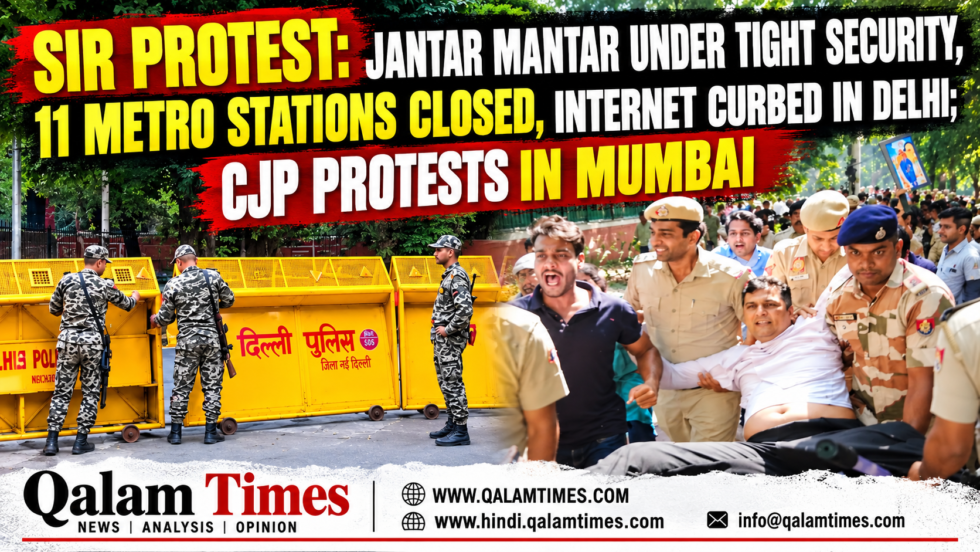
SIR Protest intensifies in Delhi and Mumbai as opposition groups and CJP demand action against CEC Gyanesh Kumar, while 11 metro stations close and internet restrictions are imposed around Jantar Mantar.
Qalam Times News Network
New Delhi/Mumbai | October 2, 2026
SIR Protest against Chief Election Commissioner Gyanesh Kumar and the Election Commission of India intensified on Friday, October 2, with demonstrations and protest calls in Delhi and Mumbai. Student organisations, civil society groups and opposition-linked political leaders have raised objections over the Special Intensive Revision (SIR) of electoral rolls and have demanded greater transparency in the functioning of the Election Commission.
The SIR Protest in Delhi has triggered extensive security arrangements around Jantar Mantar. Delhi Police has not granted permission for the proposed gathering and has imposed prohibitory restrictions under Section 163 of the Bharatiya Nagarik Suraksha Sanhita (BNSS). Mobile internet services were also suspended in the area around Jantar Mantar, while entry and exit facilities at 11 metro stations were closed amid heightened security.
Saurabh Bharadwaj Detained at Jantar Mantar
AAP Delhi president Saurabh Bharadwaj was detained after arriving at Jantar Mantar amid the protest activity. Police said that no permission had been granted for a protest or march at the site and that preventive security measures had been put in place.
The restrictions come as organisers and supporters sought to gather at Jantar Mantar to protest against the Election Commission and demand action concerning the ongoing controversy over electoral-roll revisions.
Section 163 Restrictions in New Delhi
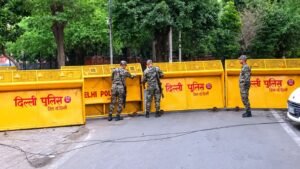
Authorities have imposed prohibitory orders across the New Delhi district under Section 163 of the BNSS. The restrictions prohibit unauthorised gatherings of five or more people and place limits on processions, demonstrations, slogans and public meetings without written permission.
Police have also strengthened barricading and security arrangements around Jantar Mantar and adjoining roads. Reports indicate that several thousand people were expected to participate in or approach the proposed protest, prompting additional deployment of police and central armed forces.
11 Delhi Metro Stations Closed
The Delhi Metro Rail Corporation announced the closure of entry and exit facilities at 11 stations in central Delhi amid the security arrangements.
The affected stations include Janpath, Patel Chowk, Central Secretariat, Rajiv Chowk, Seva Teerth, Mandi House, Lok Kalyan Marg, INA, Chawri Bazar, Ramakrishna Ashram Marg and New Delhi. Interchange facilities at some stations continued to operate despite the restrictions.
Traffic restrictions and diversions have also been put in place or kept ready around Jantar Mantar, Parliament Street, Connaught Place and other central Delhi roads.
Mobile Internet Services Suspended
Mobile internet services were suspended around Jantar Mantar as part of the security arrangements. A report by The Week, citing police information, said the suspension covered an area of approximately 1.5 kilometres around the protest site and was expected to remain in force until midnight.
The Internet Freedom Foundation has separately criticised the shutdown and said it was seeking details of the order under which the services were suspended.
Who Is Behind the Delhi Protest?
The Delhi protest call has been associated with student organisations, social activists and opposition-linked figures. AISA and other groups have raised concerns over the Election Commission’s handling of electoral rolls and the SIR process.
AAP leaders including Atishi and Sanjay Singh have also urged supporters to participate in the October 2 demonstration. The protest campaign has included demands for accountability from CEC Gyanesh Kumar and greater transparency in electoral-roll management.
The Indian Youth Congress has separately announced a protest programme, while the INDIA bloc has announced a wider campaign around what it describes as the need to “save democracy”.
CJP Announces ‘Jail Bharo Andolan’ in Mumbai
In Mumbai, the Cockroach Janta Party (CJP) has announced a separate protest at Shivaji Park at 4 pm. The organisation, led by founder Abhijeet Dipke, has demanded the resignation of CEC Gyanesh Kumar and changes to the electoral-roll revision process.
CJP has said that its Mumbai programme will proceed despite the absence of police permission. Mumbai Police has maintained that it is not empowered to grant permission for a political gathering at Shivaji Park because of a 2013 Bombay High Court order and the site’s designated status as a silence zone.
CJP’s Three Main Demands
According to reports, CJP’s campaign centres on three principal demands:
- Resignation of CEC Gyanesh Kumar, along with an investigation into decisions concerning electoral-roll management.
- Suspension of the SIR process, restoration of the January 2025 electoral roll and an independent inquiry into the revision exercise.
- Changes to the 2023 law governing the appointment of the Chief Election Commissioner and Election Commissioners, with CJP calling for a more transparent mechanism and wider civil-society participation.
CJP has also indicated that it intends to take its campaign to other cities, including Goa, Bengaluru, Kolkata, Patna, Ranchi and parts of Uttar Pradesh, before eventually taking the movement to Delhi.
Dispute Over CJP Founder’s Detention
There have also been conflicting reports concerning CJP founder Abhijeet Dipke and an alleged police detention in Mumbai.
Some reports said Dipke was briefly detained after being seen with supporters carrying placards near Marine Drive. However, a CJP spokesperson later disputed the description and said that Dipke had not been detained. The conflicting accounts remain part of the developing story.
SIR at the Centre of the Election Commission Dispute
The controversy largely centres on the Election Commission’s Special Intensive Revision (SIR) of electoral rolls.
Critics, including opposition parties and protest organisers, have questioned the manner in which voter lists are being revised and have raised concerns about possible exclusion of eligible voters. An Indian Express investigation reported that Election Commissioners Sukhbir Singh Sandhu and Vivek Joshi had formally raised objections on multiple occasions over decisions concerning electoral-roll management.
The Election Commission, however, has rejected suggestions of a breakdown within the three-member panel. It has said that final decisions concerning SIR were taken unanimously with the approval of all three Election Commissioners.
The dispute has also reached the Supreme Court, with a petition questioning aspects of the Election Commission’s internal decision-making process scheduled for consideration.
Protests Spread Beyond Delhi and Mumbai
The October 2 mobilisation marks another phase of the wider political and civil-society campaign surrounding the Election Commission and the SIR exercise. While Delhi has witnessed major restrictions around Jantar Mantar, Mumbai has become the starting point for CJP’s separate campaign.
With competing claims from protesters, political groups and the Election Commission, the controversy over electoral-roll revision is likely to remain a major issue in the coming days.