



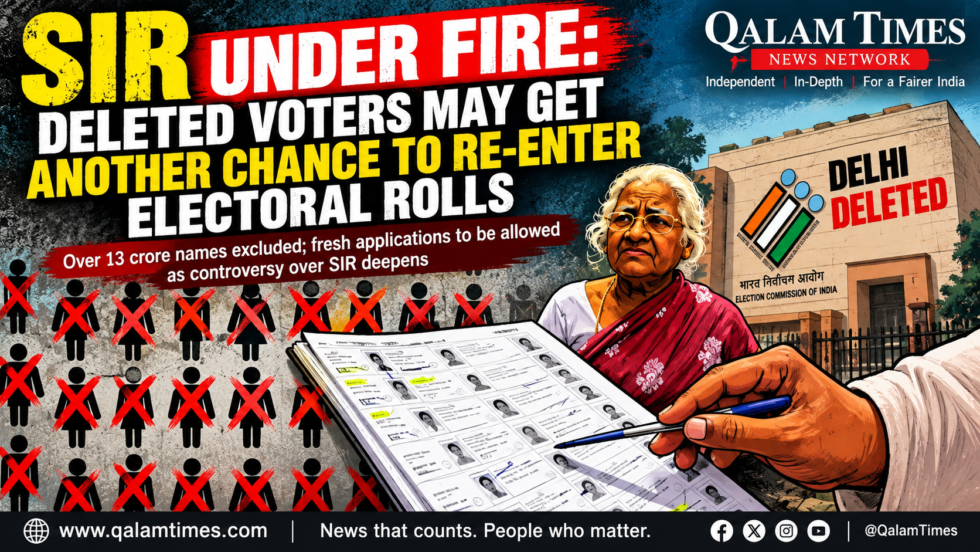
SIR controversy deepens as over 13 crore names face exclusion from electoral rolls, while deleted voters seek restoration and questions grow over transparency.
Qalam Times News Network
New Delhi/Kolkata | September 30, 2026
SIR—the Special Intensive Revision of electoral rolls—has once again become the centre of a nationwide political and institutional controversy, with voters whose names were left out of revised electoral rolls now expected to get opportunities to seek inclusion through the prescribed process.
The SIR exercise has already resulted in more than 13 crore names being left out of draft electoral rolls across 30 States and Union Territories, according to data reported from the ongoing revision process. The scale of the deletions has triggered questions from opposition parties, civil society groups and others about how genuine voters will be protected from wrongful exclusion.
The controversy has become particularly sensitive in West Bengal and Bihar, where electoral-roll revisions have taken place against the backdrop of major elections. For voters whose names have disappeared from the rolls, the next phase could mean approaching Electoral Registration Officers (EROs), Booth Level Officers (BLOs) or other designated authorities and submitting the required documents and applications.
That prospect has itself raised concerns among voters. Critics argue that citizens who were already registered and had previously exercised their franchise should not be forced through complicated procedures merely because their names disappeared during an administrative revision. The Election Commission, however, maintains that electoral rolls must be periodically updated to remove ineligible entries while ensuring that eligible citizens are able to register or seek correction through the statutory process.
Questions Over Election Commission’s Internal Functioning
The SIR controversy has also exposed an unusual disagreement within the Election Commission itself. Election Commissioners Sukhbir Singh Sandhu and Vivek Joshi reportedly raised objections on several occasions over decisions connected with the electoral-roll revision. An investigation by The Indian Express reported that the two commissioners had formally objected at least 14 times over a period of ten months to various steps associated with the process.
The disagreement became more visible after reports that certain decisions relating to the voter-roll process had been taken without the involvement or approval of the other commissioners. A subsequent Supreme Court petition has also challenged the manner in which the Chief Election Commissioner exercised his powers, although those allegations remain matters for judicial consideration rather than established findings.
Against this background, Chief Election Commissioner Gyanesh Kumar held a meeting with Election Commissioners Sandhu and Joshi at the Election Commission headquarters in New Delhi on September 26. The meeting was the first such interaction involving all three commissioners after reports of internal differences over the SIR process emerged.
The Election Commission subsequently issued clarifications on several issues surrounding the controversy. It has also rolled back a disputed SIR-related declaration from Form 6 in states where the revision process has already been completed.
For the Election Commission, the immediate challenge is therefore not merely administrative. It is also one of institutional credibility. The more questions that arise about how decisions are taken, the greater the demand for transparency over the procedures used to delete, restore and add names to electoral rolls.
SIR: CJP Announces Fresh Protest Against the Election Commission
The controversy has also provided a fresh issue for the youth-led Cockroach Janta Party (CJP), which emerged during the major protests earlier this year.
The CJP has announced a new mobilisation against Chief Election Commissioner Gyanesh Kumar and the SIR exercise. The organisation has said it intends to hold a protest in Mumbai on October 2, although Mumbai Police has reportedly denied permission for the proposed Shivaji Park demonstration. Following the denial, CJP founder Abhijeet Dipke announced a “Jail Bharo Andolan”.
The group had previously emerged as a major protest movement during the controversy surrounding examination irregularities. In July, Union Education Minister Dharmendra Pradhan resigned after weeks of protests led by the movement, although the circumstances surrounding his resignation and the protesters’ demands should not be interpreted as establishing a direct legal finding against him.
The CJP’s renewed campaign now places the Election Commission at the centre of its demands. Among its stated demands are action concerning the SIR exercise, restoration of the earlier electoral roll and changes to the legal framework governing the Election Commission.
SIR in West Bengal: The Numbers Raise Difficult Questions
West Bengal presents one of the most politically consequential aspects of the controversy. Large numbers of names have been excluded during the electoral-roll revision, while the eventual electoral outcome in the state has also intensified debate over how voter deletions may affect political calculations.
However, a simple comparison between the number of deleted names and an election victory margin cannot by itself establish that SIR determined an election result. A deleted voter may be ineligible, deceased, shifted, duplicated or otherwise subject to removal; equally, an eligible voter whose name has been wrongly excluded may have a legitimate claim to restoration. The two categories cannot be treated as identical without constituency-level verification.
That is why the demand for transparent, constituency-wise information has become increasingly important. Researchers and political analysts would need access to reliable data showing how many excluded names belonged to genuine voters, how many were subsequently restored, how many applications were rejected and how the changes affected the final electoral rolls.
The larger question is therefore not simply how many names disappeared from the rolls, but who was removed, why they were removed, whether they were eligible voters and whether they were given an effective opportunity to appeal.
The SIR controversy has now moved beyond the routine question of electoral-roll management. It has become a wider debate about institutional transparency and public confidence in the electoral process.
A clean and accurate electoral roll is fundamental to a functioning democracy. At the same time, accuracy cannot be achieved at the cost of excluding eligible citizens. The responsibility of an electoral authority is therefore twofold: to remove genuinely ineligible entries and to ensure that legitimate voters are not deprived of their constitutional right to participate in elections.
The present controversy also raises a broader question about the relationship between constitutional institutions and political parties. Allegations of partisan conduct have been made by political actors, while the Election Commission has defended its procedures and rejected suggestions that its decisions are politically motivated. Those competing claims require evidence, documentation and, where necessary, judicial scrutiny rather than political assertion alone.
India’s electoral institutions ultimately depend not only on legal authority but also on public confidence. When citizens begin questioning whether their names can disappear from the voter list without adequate explanation, restoring that confidence becomes as important as completing the administrative exercise itself.
The coming months will therefore be significant. The manner in which excluded voters are allowed to seek restoration, the transparency of the appeal process, the publication of relevant data and the Election Commission’s response to internal disagreements will all influence how the SIR exercise is viewed.
For West Bengal, Bihar and the other states affected by the revision, the central issue remains straightforward: every eligible citizen must have a fair and accessible opportunity to remain on, or return to, the electoral roll.
The debate over SIR is unlikely to disappear soon. If anything, the controversy is moving from the question of voter-list revision to a much larger question—how can electoral institutions demonstrate, through transparent procedures and verifiable data, that every legitimate vote remains protected?