



Muslim Leadership Crisis raises urgent questions about dignity, justice and accountability, from the killing of Mohsin Sheikh to the reported treatment of Muslim youths in Songadh.
Qalam Times News Network
Kolkata, October 28, 2026
The Muslim Leadership Crisis is not simply about who represents the community or who occupies an influential position. It is a much more painful question: when ordinary people feel frightened, humiliated or abandoned, who stands beside them?
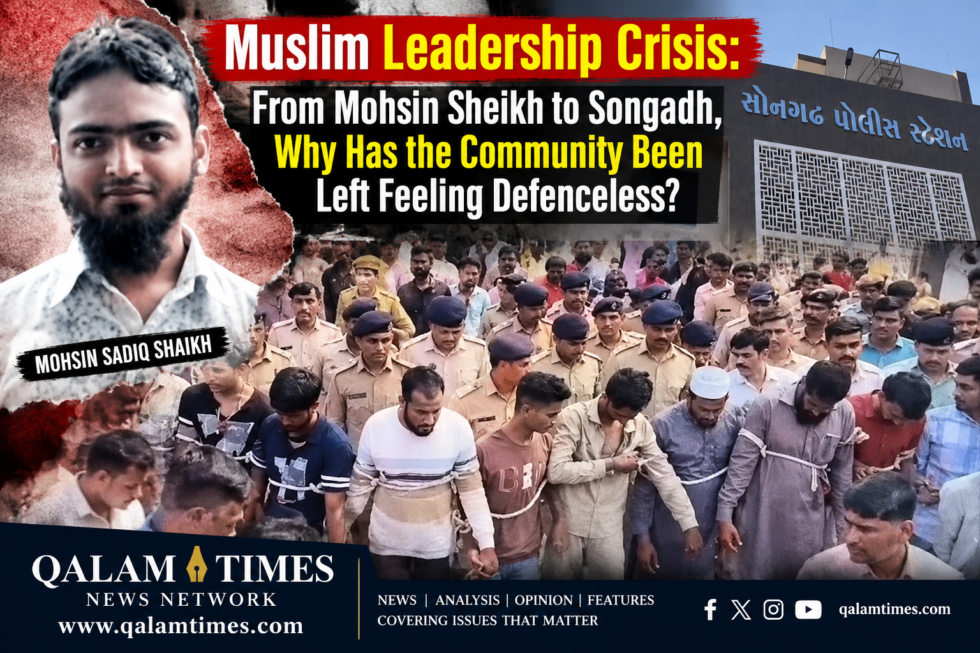
The reported incident in Songadh, Gujarat, has brought that question into sharp focus. According to reports, nine Muslim youths were paraded through the streets with ropes tied around their bodies after being accused of throwing stones at the home of a Hindu man who had allegedly made offensive remarks about Moti Masjid on social media. The allegations must be investigated, and the accused must have the opportunity to defend themselves through the legal process. No one should be treated as guilty before a court has established guilt, and the police must respect the dignity and legal rights of people in their custody.

In his report published by Muslim Mirror, Syed Zubair Ahmad, Editor of the publication, draws a connection between the Songadh incident and what he sees as a wider failure of Muslim leadership to respond effectively to the community’s experiences of violence, insecurity and humiliation. His argument goes beyond criticism of individual incidents. He questions whether those who claim to represent the community have done enough to defend its rights and stand beside people in moments of crisis.
From Mohsin Sheikh to Songadh: The Muslim Leadership Crisis and a Decade of Unanswered Questions

To understand Zubair Ahmad’s criticism, it is necessary to look back at the killing of Mohsin Sheikh in Pune on June 2, 2014. Mohsin Sheikh was killed in an attack attributed to members of the Hindu Rashtra Sena. His death became one of the early cases to draw widespread attention to concerns about communal violence following the change of government at the Centre in 2014.
Reflecting on this history, Syed Zubair Ahmad writes in his report for Muslim Mirror that the response of prominent Muslim leaders has too often been limited to statements of condemnation, without the sustained public pressure and follow-up needed to pursue accountability. In his view, the real test of leadership comes after the headlines fade and the families affected by violence are left to rebuild their lives.
A statement of condemnation has its place, but it cannot by itself secure justice for a victim, rebuild a family’s home or ensure that an investigation is conducted fairly. Those things require legal support, documentation, persistent advocacy and the willingness to keep asking difficult questions.
Zubair Ahmad also raises concerns about demolitions of homes and properties belonging to Muslims, alongside reports of mob violence and attacks on members of the community. He argues that a stronger and more united response from Muslim leaders could have helped challenge such practices and support those affected.
The precise numbers cited in public debates about lynchings and demolitions should be checked against reliable records. Nevertheless, every credible allegation of communal violence or unlawful demolition deserves impartial scrutiny. A demolished home may represent a family’s savings, security and future. Where public authorities take action against property, the legality of that action and compliance with due process are essential.
Community leaders and organisations can help affected families access lawyers, document incidents, approach the authorities and pursue appropriate legal remedies. They can also work with people from other communities to defend the principle that everyone’s rights deserve equal protection.
In his report, Zubair Ahmad questions whether influential leaders have done enough to provide this kind of practical support. His central point is that representation should mean more than speaking on behalf of people; it should also mean standing beside them when they need help.

Zubair Ahmad also expresses concern over the arrests of E. Abubacker, whom he identifies as a founding member of the All India Muslim Personal Law Board and describes as suffering from serious illnesses, including cancer, and Maulana Tauqir Raza Khan. He argues that these cases deserved a stronger response from prominent Muslim representatives.
The circumstances of the arrests and the medical condition of any detainee must be assessed through reliable information. Anyone who is seriously ill in custody should receive appropriate medical care, and every accused person is entitled to due process and a fair hearing.
The Muslim Mirror report also questions what Ahmad sees as the limited response of community leaders to disputes involving mosques and the treatment of people offering prayers in public spaces. Such cases can involve complex legal and administrative issues, but they should be addressed through fair procedures, evidence and respect for religious freedom.
Ahmad further challenges the argument, attributed to some leaders, that the community should remain patient and avoid resistance because confrontation might strengthen the ruling establishment. Patience and restraint can help prevent violence, but they need not mean abandoning lawful efforts to seek justice. Peaceful protest, litigation, public advocacy and cooperation with civil-society organisations remain possible ways to challenge injustice.
Drawing on the sacrifices of Muslim scholars and activists during India’s freedom struggle, Ahmad argues that today’s leaders should rediscover the courage and sense of responsibility shown by earlier generations. He also rejects the idea that Indian Muslims should repeatedly be required to prove their patriotism because of Partition. Citizenship and national belonging should not depend on religious identity or on satisfying political critics.
Another important aspect of Zubair Ahmad’s argument is the need to build alliances beyond the Muslim community. He points to movements and figures such as Sonam Wangchuk, the farmers’ protests in Punjab, Irom Sharmila and the women of Shaheen Bagh as examples from which campaigners can draw inspiration. Although these movements had different aims, they demonstrate the importance of organisation, persistence and public participation.
Zubair Ahmad’s criticism also extends to the resources and privileges enjoyed by some community leaders. He argues that those who receive donations, public respect and institutional positions must be accountable to the people who support them. Organisations should maintain transparent accounts, follow their governing rules and provide members with meaningful opportunities to ask questions.
Financial allegations, however, must be supported by evidence and handled fairly. Accountability means both allowing legitimate scrutiny and avoiding unsubstantiated accusations. Leadership should be measured by service, honesty and results rather than status or public display.
In his report, Ahmad ultimately calls on established Muslim leaders to reflect on their responsibilities and make room for a new generation if they cannot meet the community’s expectations. Meaningful renewal would require more than replacing familiar personalities. It would mean giving young people, women, professionals and less-heard sections of the community a genuine role in decision-making and building institutions that remain answerable to their members.
The questions raised by the Songadh incident extend beyond one town or one community organisation. How should the dignity of accused persons be protected? How can allegations of communal injustice be investigated fairly? And what should people reasonably expect from those who claim to represent them?
As Syed Zubair Ahmad argues in his report for Muslim Mirror, leadership must be judged by what it does when people are in trouble—not simply by what it says after a tragedy. That means providing practical support, pursuing lawful remedies, maintaining transparent institutions and building peaceful alliances with everyone committed to equal rights.
No leader can prevent every injustice, and no organisation can guarantee that every campaign will succeed. But people are entitled to expect their representatives to make a serious effort, stand beside those who are suffering and explain their actions honestly.
The ultimate purpose of leadership is not to enjoy the community’s loyalty while asking it to remain patient indefinitely. It is to turn that trust into meaningful service. Dignity and security depend on the protection of the law, the strength of democratic institutions and the willingness of citizens to defend one another’s rights.