



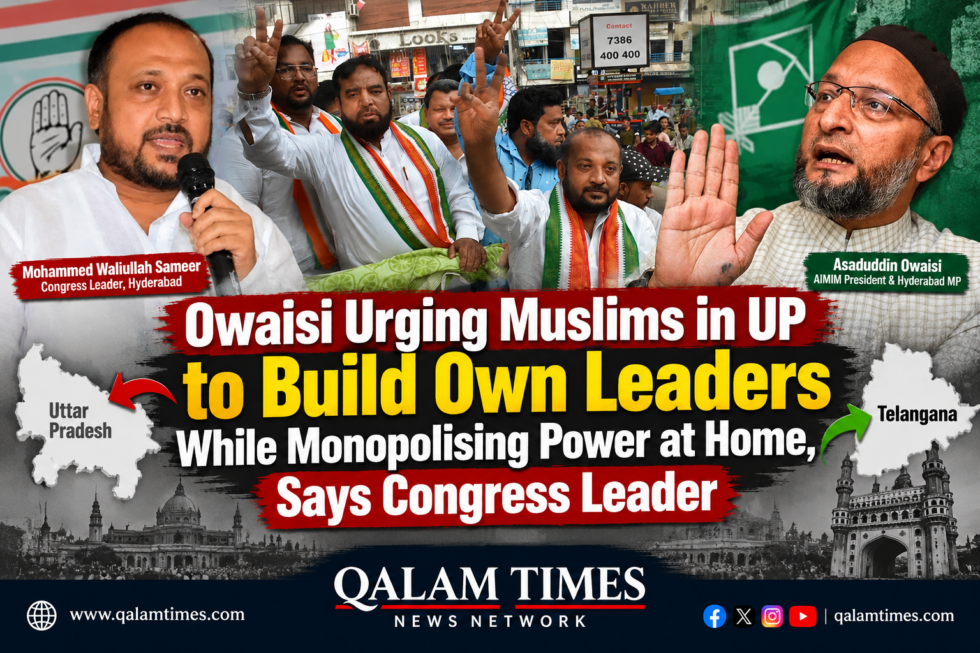
Muslim Political Representation becomes the centre of a political dispute as Congress leader Mohammed Waliullah Sameer questions Asaduddin Owaisi’s appeal for independent Muslim leadership in Uttar Pradesh and AIMIM’s record in Telangana.
Qalam Times News Network
Kolkata, October 27, 2026
Congress Leader Questions Owaisi‘s Call for Muslim Leadership in Uttar Pradesh
Muslim Political Representation has become the focus of a fresh political confrontation after Hyderabad Congress leader Mohammed Waliullah Sameer challenged AIMIM president and Hyderabad MP Asaduddin Owaisi over his appeal for Muslims in Uttar Pradesh to develop independent leadership rather than remain dependent on established political families and regional power centres.
Sameer argued that the demand for greater Muslim participation in politics deserves serious consideration, but questioned whether AIMIM’s political record in Telangana reflects the same principles that Owaisi advocates in other states. He challenged the AIMIM chief to explain why the party’s electoral presence has remained concentrated in a limited number of constituencies in its home state.
The dispute raises a broader political question: if Muslims are being encouraged to build leadership from within their own communities, what practical steps are being taken to expand their political participation beyond established strongholds?
‘Build Your Own Leaders’ — But What Has Happened in Telangana?
Reacting to Owaisi’s reported speeches in Uttar Pradesh, Sameer questioned the consistency between the AIMIM chief’s message to Muslim voters in northern India and the party’s electoral strategy in Telangana.
Owaisi has urged Muslims in Uttar Pradesh to move beyond dependence on established political leadership associated with the Nehru-Gandhi family and Yadav political networks. His message, as described in the report, is that Muslims should develop their own leaders and seek a more direct role in political decision-making.
Sameer welcomed the principle of independent leadership but challenged Owaisi to explain how it has been implemented in Telangana.
He questioned why, in his view, Muslim political participation had not expanded more widely across the state and why AIMIM had not fielded candidates in a larger number of constituencies.
His criticism centred on a fundamental issue: political empowerment cannot be measured solely by speeches about representation. It must also be examined through candidate selection, opportunities for emerging leaders and the extent to which political organisations encourage participation beyond their established electoral bases.
AIMIM Contested Only Nine Telangana Seats in 2023, Says Sameer
Sameer pointed to the 2023 Telangana Assembly election as a key example in his criticism of AIMIM’s approach.
According to the figures cited by the Congress leader, AIMIM contested nine of the state’s 119 Assembly constituencies, leaving 110 constituencies without an AIMIM candidate. He also alleged that the party supported the Bharat Rashtra Samithi (BRS) in most of the constituencies where it did not contest.
Sameer questioned whether AIMIM could have offered more opportunities to capable candidates from different professional and social backgrounds, including lawyers, doctors, entrepreneurs, social workers, women and educated young people.
His argument was that a political organisation committed to expanding Muslim representation should consider creating opportunities for emerging leaders across a wider geographical area rather than concentrating primarily on seats where it already possesses electoral strength.
However, the number of constituencies contested does not, by itself, establish whether a party has failed to empower a community. Electoral alliances, local political conditions, candidate viability and strategic priorities can also influence where parties field candidates. AIMIM’s broader record would need to be examined alongside these factors to assess the competing claims fairly.
Representation Must Extend Beyond a Handful of Political Strongholds
Sameer’s criticism goes beyond the number of candidates fielded in one election. He questioned whether AIMIM’s approach has created sufficient opportunities for a broader range of Muslim leaders to enter public life in Telangana.
Political representation can take several forms, including elected legislators, members of Parliament, ministers, municipal representatives, councillors and party office-bearers. The presence of established leaders does not necessarily guarantee that new voices have access to political platforms.
The Congress leader argued that Muslims seeking greater representation should not be restricted to a limited set of constituencies or dependent on a small circle of political figures.
The issue is particularly relevant to young people and professionals who may possess the qualifications and experience required for public service but lack access to established political networks. Whether AIMIM has provided sufficient opportunities to these groups is a question that requires evidence about its candidate selection, internal organisation and record of promoting new leadership.
For Owaisi, the challenge presented by Sameer is one of consistency: whether the principles he advocates in Uttar Pradesh are reflected in the opportunities available to emerging leaders in Telangana.
Owaisi’s Expansion Beyond Hyderabad Comes Under Question
Sameer also criticised what he described as AIMIM’s emphasis on expanding into other states, including Uttar Pradesh, Bihar, Maharashtra and West Bengal, while questioning the extent of leadership development within Telangana.
AIMIM’s participation in elections beyond Hyderabad has made the party part of wider debates about Muslim political representation, minority political participation and the relationship between regional parties and national political formations.
Supporters of independent political mobilisation may view such expansion as an attempt to provide voters with an alternative to established parties. Critics, however, may question whether electoral expansion produces lasting political opportunities for local leaders or primarily strengthens the profile of an existing organisation.
Sameer’s remarks reflect the latter concern. He argued that the party’s claims about empowering Muslims should be evaluated not only through its presence in new states but also through its ability to widen participation where it has an established political base.
The distinction matters because electoral visibility and the development of a broad leadership network are not necessarily the same thing.
Hyderabad’s Political Influence and Everyday Challenges
Sameer further argued that Hyderabad should serve as a significant example of AIMIM’s political model because the party has established electoral representation in the city and at the parliamentary level.
He questioned whether this political influence had translated into sufficiently broad opportunities for Muslim leadership and improvements in the everyday conditions of ordinary residents.
His concerns included education, employment, housing, healthcare and basic civic infrastructure. These issues affect the quality of life of residents and are often central to debates about the performance of elected representatives and local government institutions.
The criticism raises an important distinction between political representation and social outcomes. Having elected representatives can provide communities with channels to raise concerns, but the impact of that representation must be assessed through policies, public services, administrative performance and measurable results.
A fair assessment of Hyderabad’s development would therefore require detailed evidence about public spending, service delivery, employment and educational outcomes, as well as the respective responsibilities of municipal, state and central authorities. Sameer’s allegations alone do not establish that AIMIM’s political influence has failed to deliver improvements.
The Larger Debate: Can Muslim Political Leadership Become More Inclusive?
The controversy surrounding Owaisi and Sameer reflects a wider discussion about how Muslim political participation can be expanded in India’s electoral system.
One approach emphasises independent political organisations that seek to represent Muslim interests directly. Another stresses participation through established national and regional parties, where minority leaders can work within broader electoral coalitions.
Neither approach automatically guarantees effective representation. The results depend on candidate selection, organisational openness, electoral performance, policy commitments and the ability of representatives to address constituents’ concerns.
The central question is whether political parties create meaningful opportunities for capable new leaders and whether those leaders can influence decisions rather than merely occupy symbolic positions.
For Uttar Pradesh, Telangana and other states where AIMIM seeks support, this debate has implications beyond any single political confrontation. Voters have reason to examine what different parties promise, how they select candidates and what evidence supports their claims about representation.
Owaisi Faces Questions About Consistency, While the Debate Remains Open
Sameer’s challenge places the relationship between political messaging and electoral practice at the centre of the debate. His argument is that calls for independent Muslim leadership should be accompanied by a demonstrable effort to widen political opportunities in Telangana.
Owaisi and AIMIM’s position would need to be considered alongside their own explanations of the party’s electoral strategy, candidate selection and political priorities. A complete assessment should also distinguish between the decision not to contest a seat and the broader question of whether a party has contributed to community representation through other political activities.
Ultimately, the debate should be judged through verifiable electoral records, documented organisational decisions and the experiences of voters and emerging leaders.
The larger issue remains significant: political empowerment requires more than slogans. It involves access to political participation, opportunities for new leadership, effective representation and the ability to address people’s everyday concerns.