



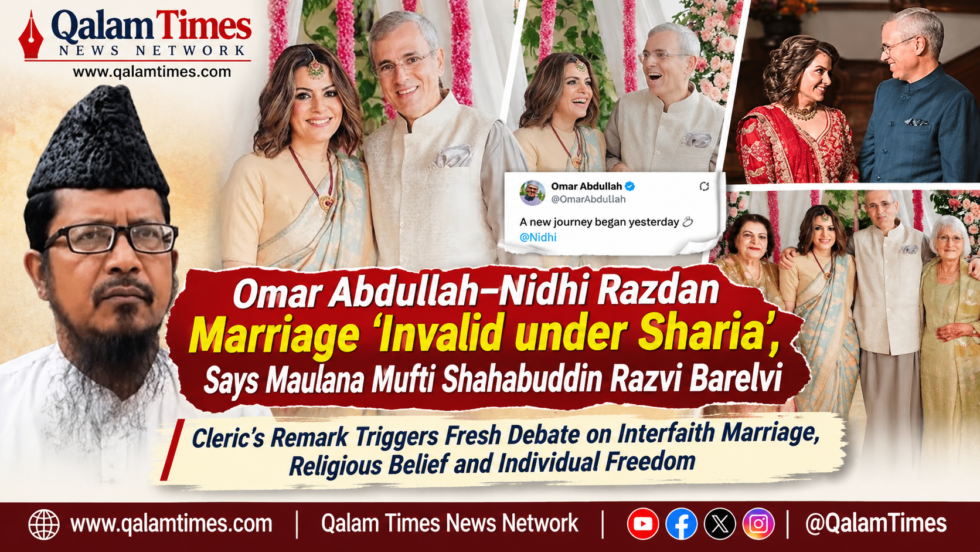
Interfaith Marriage controversy erupts as Maulana Mufti Shahabuddin Razvi Barelvi declares Omar Abdullah and Nidhi Razdan’s marriage invalid under Sharia, sparking debate over religious freedom and constitutional rights in India.
Muslim Cleric Questions the Religious Validity of the Union, Bringing Personal Choice, Freedom of Religion and India’s Secular Legal Framework into Focus
Qalam Times News Network
Kolkata November 2, 2026
Interfaith Marriage has once again entered the national conversation following the wedding of Jammu and Kashmir Chief Minister Omar Abdullah and senior journalist Nidhi Razdan. The couple’s decision to begin a new chapter together has attracted widespread public attention, but the celebrations have also been followed by a religious controversy. Maulana Mufti Shahabuddin Razvi Barelvi, president of the All India Muslim Jamaat, has questioned the religious validity of their marriage, arguing that the union does not meet the requirements of Islamic law as he interprets them. His remarks have opened a wider discussion about the relationship between religious beliefs, individual freedom and the constitutional rights of citizens in a pluralistic society.
The Interfaith Marriage controversy emerged shortly after the couple publicly shared photographs announcing their wedding. Omar Abdullah posted pictures with Nidhi on social media, writing that a new journey had begun, while Nidhi responded with the light-hearted message, “It’s done bro.” According to reports, the marriage was solemnised in New Delhi on October 30 under the Special Marriage Act, 1954, in the presence of family members from both sides. The announcement quickly attracted congratulatory messages, but the subsequent statement by the Bareilly-based religious leader shifted public attention towards the religious and legal dimensions of the marriage.
The Cleric’s Objection: What Does His Religious Position Mean?
Maulana Mufti Shahabuddin Razvi Barelvi has maintained that the marriage cannot be considered permissible under Islamic principles because Omar Abdullah is Muslim while Nidhi Razdan belongs to a non-Muslim family. According to his interpretation of Sharia, a Muslim man should not enter into a nikah with a non-Muslim woman unless the religious conditions recognised by the relevant Islamic jurisprudence are fulfilled. The cleric further argued that Nidhi should have embraced Islam before the marriage if the couple intended to solemnise a nikah in accordance with the religious requirements he described. Since this condition was not fulfilled, he characterised the union as impermissible from his religious perspective. However, it is important to distinguish between a religious opinion and a legally enforceable decision. A statement by an individual religious leader does not, by itself, determine the civil status of a marriage solemnised under Indian law. His remarks represent his interpretation of religious principles and should be understood within that context. The issue also raises a broader question: should an individual’s personal relationship become a subject of public religious pressure simply because the two partners come from different religious backgrounds?
The Special Marriage Act and the Constitutional Framework
One of the most important aspects of this controversy is the legal framework under which the couple reportedly married. India’s Special Marriage Act, 1954, provides a civil mechanism through which two individuals can marry irrespective of their religious affiliations, subject to the statutory conditions. Section 4 lays down requirements concerning age, marital status, consent and prohibited degrees of relationship. It does not make conversion to a common religion a condition for solemnising a marriage under the Act.
The legislation was introduced to provide a legal route for marriages beyond the boundaries of religion and community-specific personal laws. Its underlying purpose is to allow eligible individuals to exercise their choice of partner without being required to adopt the religious identity of the other person.
Accordingly, if the marriage has been duly solemnised under the Special Marriage Act, its civil validity must be assessed under that legislation and applicable Indian law, not simply by reference to a religious declaration. This distinction is particularly important in a country where constitutional democracy recognises religious diversity and individual autonomy. Religious communities have the freedom to maintain their beliefs and traditions, but those beliefs must be distinguished from the legal rights and obligations established by the Constitution and legislation.
A Personal Decision Under the Public Spotlight
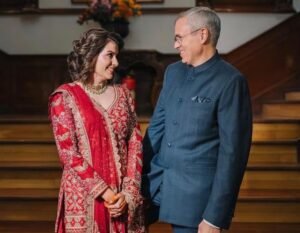
The marriage has attracted additional attention because Omar Abdullah is not merely a private individual. As the Chief Minister of Jammu and Kashmir and a prominent leader of the National Conference, his personal life inevitably receives considerable public scrutiny. However, holding a constitutional office does not mean surrendering every aspect of one’s personal life to public judgement. Political leaders, like other citizens, have personal relationships, family responsibilities and the right to make private decisions within the framework of the law. Nidhi Razdan is an established journalist who has spent years working in Indian television journalism and public affairs. Her professional identity and personal choices should also be considered independently of assumptions based on her family or religious background. The controversy should therefore be approached with sensitivity rather than turning the couple’s marriage into an opportunity for communal speculation or personal attacks.
Their Previous Marriages and a New Chapter of Interfaith Marriage
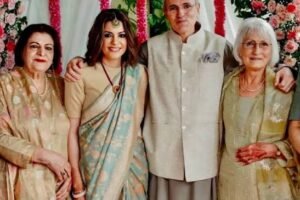
The wedding also comes after significant developments in the personal lives of both individuals. Omar Abdullah married Payal Nath in 1994, and the couple have two sons, Zahir and Zamir. Their relationship eventually became strained, and they began living separately. Their marital dispute continued through the courts for several years before the Supreme Court dissolved their marriage in July 2026 following a settlement between the two parties. Nidhi Razdan was previously married to journalist and writer Neelesh Misra. They married in 2005 and subsequently divorced in 2007. The recent wedding marks a new chapter for both individuals after the conclusion of their previous marriages. Reports indicate that the ceremony was attended by close family members, including Omar’s father, National Conference president Farooq Abdullah, his mother Mollie Abdullah and his three sisters. Nidhi’s parents, veteran journalist M.K. Razdan and Sarla Razdan, were also present.
The presence of family members from both sides reflected the personal and familial nature of the occasion, even as the public discussion surrounding the marriage took a different direction.
Religious Beliefs and Individual Freedom Must Be Distinguished
The present controversy brings an important issue into focus: the difference between religious guidance within a community and the exercise of individual freedom in a constitutional democracy. Religious scholars are entitled to explain their understanding of religious texts, marriage traditions and community-specific rules. Individuals who follow those traditions may also choose to seek guidance from religious authorities. However, religious guidance and personal choice operate in different spheres. A religious opinion may carry significance for followers of a particular school of thought or community, but it does not automatically acquire the force of civil law. India’s constitutional framework protects freedom of conscience and the right to profess, practise and propagate religion, subject to constitutional limitations. Article 21 has also been interpreted by the Supreme Court as protecting personal liberty, dignity and decisional autonomy. The judiciary has repeatedly recognised the importance of individual choice in matters concerning personal relationships. In the landmark Hadiya case, Shafin Jahan v. Asokan K.M. (2018), the Supreme Court emphasised the significance of an adult’s autonomy in choosing a life partner and held that questions of personal choice cannot simply be displaced by the preferences of others. The larger principle is that religious beliefs deserve respect, but the personal decisions of consenting adults must also be treated with dignity.
Political Questions Should Not Overshadow Personal Liberty
Omar Abdullah’s political position has inevitably added another dimension to the debate. His marriage has become a subject of public discussion at a time when the National Conference and the political environment in Jammu and Kashmir are also facing their own challenges. Nevertheless, political disagreements and questions about party leadership should not be mixed unnecessarily with the personal life of an elected representative. The political consequences of a leader’s personal decisions are matters that political commentators may discuss, but speculation should not replace evidence. Nor should the religious background of a spouse become an instrument for questioning an individual’s political legitimacy. Public representatives must be accountable for their official decisions, governance and public commitments. Their private lives deserve the same legal protections and basic dignity afforded to other citizens.
The controversy surrounding Omar Abdullah and Nidhi Razdan’s marriage is about more than the statement of a religious leader. It has brought into focus the continuing tension between traditional religious interpretations, individual autonomy and the constitutional principles governing a diverse society. Maulana Mufti Shahabuddin Razvi Barelvi has expressed his religious position, and his views can be discussed within the framework of Islamic jurisprudence. At the same time, the civil status of a marriage solemnised under the Special Marriage Act must be determined according to the applicable law. India’s strength lies in its ability to accommodate different religious beliefs, cultural traditions and personal choices within a common constitutional framework. No citizen should be compelled to abandon personal dignity or face public hostility merely because a private decision does not conform to another person’s religious understanding. The couple’s marriage should ultimately be viewed as a personal decision made by two adults, while the religious debate surrounding it should remain a matter of informed discussion rather than public intimidation.
In a constitutional democracy, religious faith deserves respect, personal freedom deserves protection, and the law must remain the final authority in determining the civil rights of citizens.