



Bihar Museum ranks 9th among the World’s 100 Best Museums in 2026, ahead of the Louvre. Discover Patna’s architectural landmark, ancient treasures, Buddhist sculptures, children’s gallery and heritage attractions.
From Ancient Civilisations to World-Class Architecture, Patna’s Bihar Museum Places India on the Global Cultural Map
Qalam Times News Network
Patna, November 2, 2026
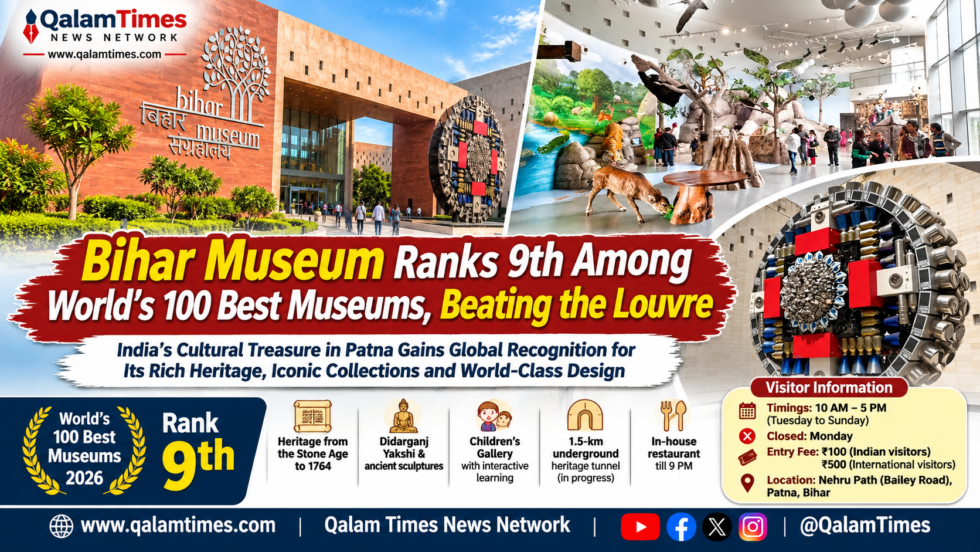
Bihar Museum has brought international recognition to India’s rich cultural and historical heritage by securing the ninth position in the prestigious World’s 100 Best Museums 2026 list, published by Munich-based travel guide and digital magazine Worth a Journey. The achievement places this remarkable institution in Patna ahead of several internationally renowned museums, including the Metropolitan Museum of Art in New York, which occupies tenth place, and the iconic Louvre Museum in Paris, ranked 31st. Bihar Museum has also emerged as the highest-ranked museum in Asia and the only Indian institution featured in the global top 100, giving Bihar a significant place on the international cultural tourism map.
The recognition is particularly significant because Bihar Museum represents a region whose historical contributions extend across ancient Indian civilisation, Buddhism, Jainism, the Mauryan and Gupta periods, medieval scholarship and artistic traditions. The ranking is not merely a recognition of an impressive building; it also draws attention to the extraordinary cultural heritage preserved within its galleries. For Bihar, it is an opportunity to introduce its historical legacy to a wider international audience and encourage more visitors to explore the state’s archaeological and artistic treasures.
An International Recognition for Patna’s Cultural Landmark
According to the 2026 ranking, Bihar Museum secured ninth place among 100 museums worldwide. Mexico City’s Museo Nacional de Antropología topped the list, followed by Spain’s Museo del Prado and Denmark’s Louisiana Museum of Modern Art. The State Hermitage Museum in Russia and Vienna’s Kunsthistorisches Museum also featured among the leading institutions.
The ranking was compiled by Worth a Journey, which assesses museums across different countries using data analysis and other evaluation methods, including in-person assessments of shortlisted institutions. Its published results cover museums dedicated to art, history, archaeology, science, technology and other fields.
The achievement is noteworthy because the Bihar Museum has managed to secure international recognition despite being considerably younger than many of the world’s historically established museums. It demonstrates the growing importance of modern museum design, thoughtful curation and the presentation of regional heritage.
An Architectural Masterpiece Spread Across More Than 13 Acres
Situated on Nehru Path, popularly known as Bailey Road, in Patna, the Bihar Museum occupies a sprawling site of approximately 13.5 to 13.9 acres. Its architectural design was developed through an international collaboration between Maki & Associates of Japan and OPOLIS Architects of Mumbai. The project was selected through an international architectural competition, bringing together Japanese design expertise and Indian architectural understanding. The principal architect, Fumihiko Maki, was an internationally acclaimed Japanese architect and recipient of the prestigious Pritzker Architecture Prize. His architectural philosophy is reflected in the museum’s contemporary design, which combines carefully planned gallery spaces, landscaped areas, open courtyards and modern building materials. The museum’s architecture creates an interesting relationship between the historical collections inside and the contemporary environment surrounding them. Rather than appearing like a conventional storage building for old objects, it offers visitors a cultural space in which history, architecture and visual art come together. The museum was partially opened in August 2015, while its remaining galleries became accessible to the public in October 2017.
A Journey Through History from the Stone Age to 1764
One of the most important attractions of Bihar Museum is its extensive historical collection. The institution presents the cultural and historical development of Bihar through artefacts, sculptures, manuscripts, coins, archaeological discoveries and artistic traditions. Its collections cover an extraordinary period, beginning with prehistoric civilisations and extending through ancient, medieval and early modern history up to 1764. Visitors can explore the rise of the Mauryan Empire, the development of Buddhism and Jainism, the Kushana and Gupta periods, the Pala dynasty, the medieval Sultanates and the artistic traditions associated with different regions of Bihar. The museum’s chronological arrangement allows visitors to understand how political developments, religious movements, artistic expression and social life evolved over centuries. The official museum collection includes more than 20,000 artefacts, covering archaeology, visual culture, regional art and historical material.
Didarganj Yakshi: The Timeless Beauty of Mauryan Art
Among the museum’s most celebrated attractions is the famous Didarganj Yakshi, a remarkable sculpture dating to the third century BCE. Carved from Chunar sandstone, the sculpture represents the extraordinary artistic skill associated with ancient Indian craftsmanship. It depicts a female figure holding a chauri, or ceremonial fly-whisk, and is widely admired for its polished surface, graceful posture and remarkable detailing. Discovered near Didarganj on the banks of the Ganga in Patna, the sculpture has become one of the most recognisable examples of Mauryan-period art. The museum describes the Yakshi as the ‘Mona Lisa of India’, reflecting its artistic significance and enduring appeal. For visitors interested in Indian sculpture, the Didarganj Yakshi is not simply an archaeological object. It offers a glimpse into the aesthetic imagination, craftsmanship and cultural sophistication of ancient India.
Kurkihar Bronzes and the Buddhist Artistic Tradition
Another important attraction is the museum’s collection of ancient bronze sculptures, including objects associated with the historic Kurkihar archaeological site in present-day Gaya district. These sculptures reflect the remarkable metalworking traditions that flourished during the Pala period, when Bihar and neighbouring regions became major centres of Buddhist learning and artistic production. Buddhist sculptures, representations of Bodhisattvas, religious figures and other bronze objects demonstrate the relationship between religion, craftsmanship and cultural exchange in eastern India. The museum also preserves historical manuscripts, coins, terracotta objects, inscriptions and other archaeological material that help researchers understand the region’s past. These collections are particularly valuable for students, historians, archaeologists and researchers studying the evolution of religious and artistic traditions across the Indian subcontinent.
A Bihar Museum Where Children Can Discover History
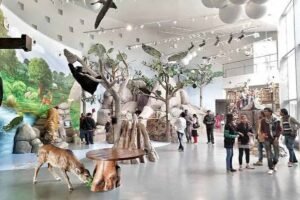
Bihar Museum is not designed exclusively for historians or adult visitors. It also offers dedicated facilities to introduce younger generations to history, art and culture. Its Children’s Gallery provides an interactive learning environment where children can explore historical themes, natural history, folk traditions and cultural subjects through engaging displays and activities. The purpose is to make learning enjoyable rather than presenting history as a collection of dates and difficult academic descriptions. For families visiting Patna, this section makes the museum an educational destination where children can develop curiosity about their surroundings and the country’s historical heritage. The museum also offers other facilities, including a museum shop, library and children’s café, adding to the overall visitor experience
A 1.5-Kilometre Underground Heritage Corridor
An ambitious infrastructure project is also expected to add another dimension to Patna’s cultural tourism.The Bihar government has initiated construction of an approximately 1.5-kilometre underground tunnel connecting Bihar Museum with the historic Patna Museum, popularly known as Jadughar.The project, with an approved cost of approximately ₹542 crore, is intended to connect the two institutions and create an integrated museum experience.
Once completed, visitors will be able to explore the collections of both museums through a connected underground passage. The proposed corridor is expected to include air-conditioning, lifts, pedestrian facilities and battery-operated transport for visitors.This connection will bring together two important institutions: Bihar Museum, with its modern architecture and extensive historical presentation, and Patna Museum, which preserves a significant collection of archaeological and historical treasures.The project could make it easier for tourists to explore a much wider account of Bihar’s history within a single cultural itinerary.
Food, Leisure and Facilities for Visitors
A visit to Bihar Museum is not limited to walking through historical galleries. The institution also offers facilities designed to make the experience comfortable for families, students and tourists.Its in-house restaurant serves visitors and provides an opportunity to experience food during a cultural excursion. The museum’s broader visitor facilities include a children’s café, museum shop, library and other amenities.The combination of historical collections, modern architecture, educational activities and dining facilities makes the museum suitable for a range of visitors, from school groups and researchers to families and international tourists.