



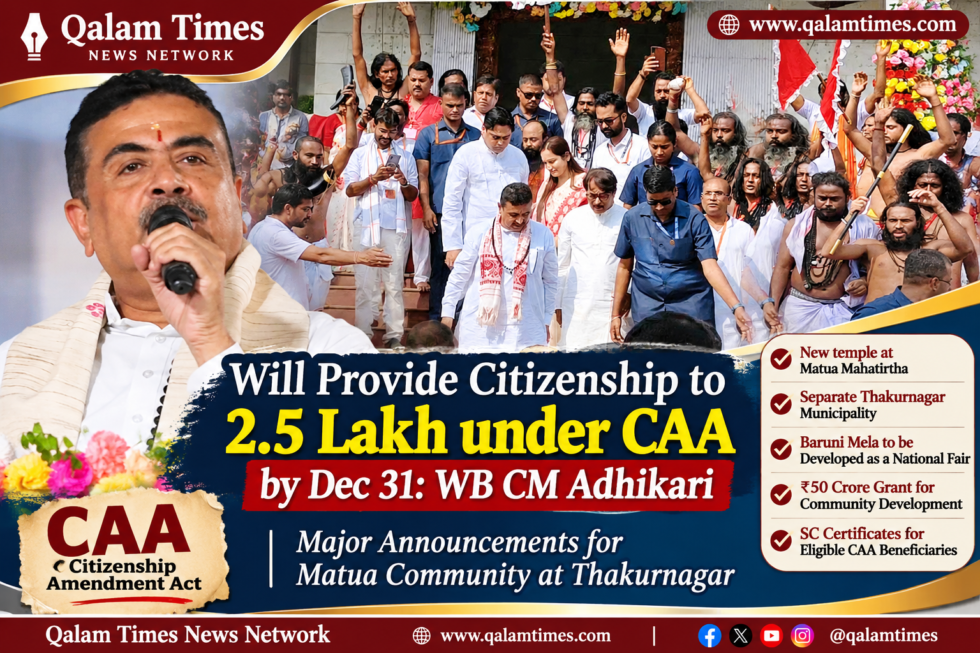
West Bengal CM Suvendu Adhikari announces a target to grant CAA Citizenship to 2.5 lakh applicants by December 31, alongside major development plans for the Matua community in Thakurnagar.
Qalam Times News Network
Kolkata, November 1, 2026
CAA Citizenship has once again emerged as a major political and administrative issue in West Bengal, with Chief Minister Suvendu Adhikari announcing an ambitious target to grant citizenship to 2.5 lakh applicants under the Citizenship Amendment Act (CAA) by December 31, 2026. Speaking at the International Matua Gosai Convention in Thakurnagar, North 24 Parganas, on Sunday, the Chief Minister said his government would accelerate the hearing and verification process to ensure that eligible applicants receive citizenship within the announced deadline.
According to Adhikari, approximately 25,000 people have received citizenship under the CAA in West Bengal so far. He said the state administration would now take steps to speed up the processing of pending applications. The announcement is particularly significant for the Matua community, a large section of which has longstanding historical, social and cultural roots in the territory that is now Bangladesh. For many Matua families, the question of CAA Citizenship is closely connected with their demand for legal security and recognition in India.
Matua Community at the Centre of CAA Citizenship and Development Announcements
Addressing the gathering, Adhikari credited the Matua community with playing an important role in the formation of the BJP government in West Bengal. He also announced a financial allocation of ₹50 crore for the development of the community and its associated institutions. The Chief Minister further stated that eligible members of the Scheduled Caste community who obtain citizenship under the CAA would be issued Scheduled Caste certificates in accordance with the applicable rules and procedures.
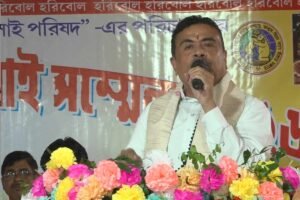
The Chief Minister contrasted his government’s approach with that of the previous administration led by Mamata Banerjee, which had opposed the implementation of the CAA in the state. Adhikari alleged that the previous government had failed to adequately address the concerns of the Matua community and had contributed to divisions within it. These remarks formed an important part of his political message at a convention attended by members and representatives of the community.
Earlier, speaking to journalists in Thakurnagar, Adhikari expressed his commitment to the development of the area. He said that contributing to Thakurnagar’s progress would be a significant achievement for him and assured the people that his government would work towards addressing their longstanding demands.
The CAA provides a pathway to Indian citizenship for members of Hindu, Sikh, Buddhist, Jain, Parsi and Christian communities from Afghanistan, Bangladesh and Pakistan who entered India on or before December 31, 2014, subject to the statutory eligibility requirements. The legislation was passed by Parliament in December 2019, while the rules governing its implementation were notified in March 2024. It is important to distinguish between the law’s eligibility provisions and the separate process of application, scrutiny and approval; citizenship is not automatically conferred on every member of the communities covered by the Act.
New Temple, Thakurnagar Municipality and National Recognition for Baruni Mela
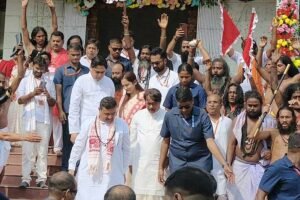
Alongside the citizenship announcement, the Chief Minister outlined a series of development proposals for Thakurnagar, seeking to address demands that have been raised by the Matua community and local residents over the years.
One of the major announcements concerned the construction of a new and larger temple at Matua Mahatirtha, the principal religious and spiritual centre of the Matua community. Referring to his conversation with Bangaon MP and Matua Mahasangha leader Shantanu Thakur, Adhikari said that the expansion of the temple had been discussed and that the necessary arrangements would be made through the funds of the pilgrimage site’s trust.
He indicated that he would personally attend the foundation-laying ceremony once the preparations were completed and also expressed the expectation that Prime Minister Narendra Modi would participate in the occasion.
The Baruni Mela, another important religious and cultural event associated with the Matua tradition, also featured prominently in the Chief Minister’s announcements. Adhikari said that the state government would extend special assistance to the fair and work towards securing its recognition as a national-level fair in the future. He added that the government would support its gradual expansion and development, drawing a comparison with the arrangements made for other major religious gatherings, including the Shravani Mela at Tarakeswar.
The Chief Minister also announced plans to establish a separate municipality for Thakurnagar, a demand linked to the area’s growing population, religious importance and requirements for civic infrastructure. If implemented, the proposed municipal body could bring local administration and public services under a more dedicated institutional framework.
Understanding the Matua Movement and Its Historical Significance
The Matua community’s importance in West Bengal extends well beyond contemporary politics. The Matua religious and social reform movement emerged in the second half of the nineteenth century under the leadership of Harichand Thakur in the region of undivided Bengal. It developed as a movement for spiritual equality, social dignity and the empowerment of marginalised sections of society, particularly the Namasudra community.
Over generations, the movement became an important source of collective identity and social organisation. Following the Partition of India in 1947 and the subsequent political upheavals in the Indian subcontinent, many Matua families migrated from what is now Bangladesh to West Bengal. Migration continued in different phases, influenced by political instability, insecurity and social circumstances.
Today, the community has a substantial presence in several parts of West Bengal, particularly in North 24 Parganas and adjoining districts. Its historical experience, social identity and concerns regarding citizenship have made it an important subject in discussions about migration, constitutional rights, public policy and electoral politics.
CAA Citizenship Implementation and the Road Ahead
Adhikari’s December 31 target places the spotlight on the practical implementation of the CAA in West Bengal. The announcement will now be measured against the progress made in processing applications, conducting hearings, verifying documents and communicating decisions to eligible applicants.
For Matua families and other communities covered by the legislation, the central concern remains the timely and transparent completion of the citizenship process. At the same time, the proposed temple expansion, financial assistance, development of Baruni Mela and creation of a separate municipality indicate that the state government’s announced agenda extends beyond citizenship to the broader cultural, religious and civic aspirations of Thakurnagar.
Whether the government can meet its stated target of granting citizenship to 2.5 lakh applicants by the end of December will depend on the pace of administrative scrutiny and the number of applications that satisfy the legal requirements.
For the Matua community, the coming weeks will therefore be important not only for the citizenship process but also for the implementation of the development commitments announced at its principal religious centre.