



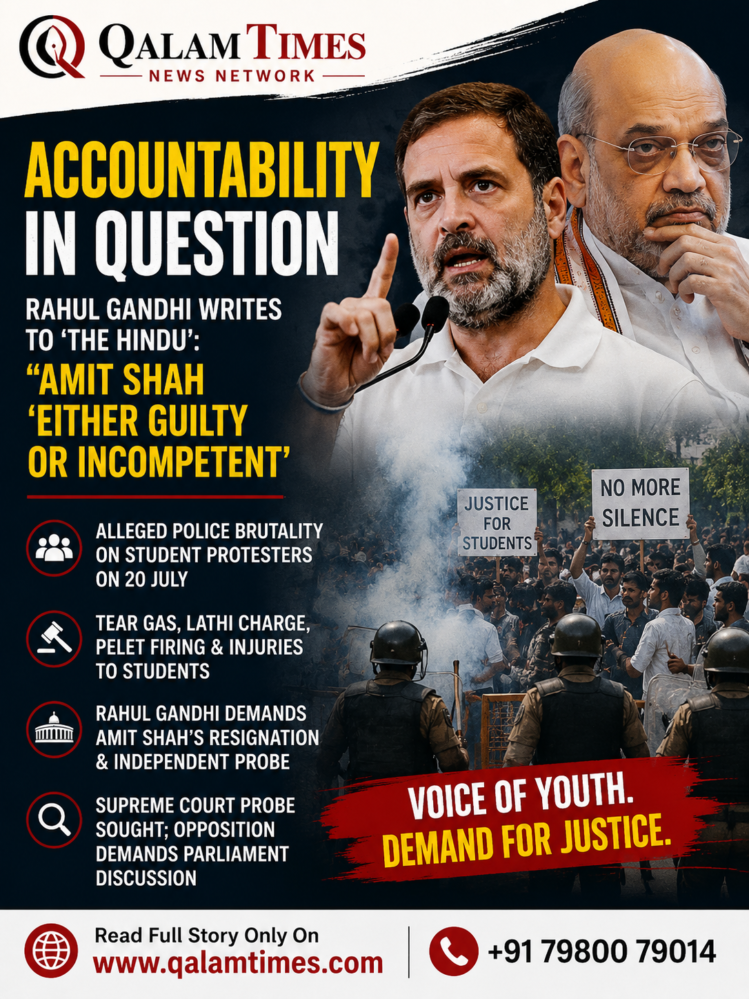
Accountability is at the heart of Rahul Gandhi’s demand for an impartial probe into the alleged police action against student protesters and questions over Amit Shah’s responsibility.
The allegations surrounding the July 20 student protests demand an impartial inquiry, parliamentary scrutiny and clear accountability
By Qalam Times News Network – Editorial Desk
Kolkata, 11 August 2026
Accountability has become the central question in the political controversy surrounding the alleged police action against student protesters on July 20. Congress leader and Leader of Opposition in the Lok Sabha, Rahul Gandhi, has accused Union Home Minister Amit Shah of either authorising the alleged crackdown or failing to prevent it, and has called for his resignation. These are serious political allegations, and they must be examined through evidence, an independent investigation and parliamentary scrutiny rather than political rhetoric alone.
The controversy concerns claims of excessive force against students protesting over education-related issues and alleged paper leaks. In his article published by The Hindu, Rahul Gandhi alleged that protesters were subjected to tear gas, baton charges and pellet firing. He also referred to the case of 19-year-old student Sahil Lochab, whom he said suffered serious pellet injuries. Gandhi further alleged that women and even minors were among those affected. Accountability, however, cannot be established merely through competing political claims; it requires an investigation capable of determining precisely what happened, who ordered the action and whether the force used was lawful and proportionate.
Rahul Gandhi’s argument rests on a straightforward political principle: when a major law-and-order operation involves agencies under the Union Home Ministry, the political leadership must answer questions about command, oversight and responsibility.
His contention is that there are two possibilities. If the Home Ministry authorised the operation, the minister must accept responsibility for the decision. If senior officials acted without his knowledge, Gandhi argues that it raises questions about the minister’s administrative control. From the Opposition’s perspective, either scenario warrants Amit Shah’s resignation.
That argument carries political weight, but determining ministerial culpability requires more than establishing that a police force falls under a particular ministry. An impartial inquiry must establish the chain of command, written or verbal instructions, the circumstances in which force was deployed and whether established protocols were followed.
The allegations described by Rahul Gandhi are grave enough to warrant transparent examination. Claims involving pellet injuries, alleged assault on women, injuries to minors and the use of firearms against protesters cannot simply become another chapter in India’s political confrontation.
At the same time, allegations should not automatically be treated as established facts. The credibility of any investigation will depend upon medical records, video evidence, eyewitness testimony, police records, orders issued to security personnel and other available material. The investigation must also examine the conduct of protesters and security personnel alike, without political prejudice.
The demand for a probe under the supervision of the Supreme Court therefore deserves serious consideration if there is a genuine dispute over the independence or credibility of the investigation. At the very least, an independent fact-finding process should provide the public with a clear account of what happened.
Another important issue raised by the controversy is the reported parliamentary deadlock. If the Opposition is demanding an explanation from the Home Minister, the government should address the matter in Parliament rather than allowing allegations and counter-allegations to dominate public debate.
Parliament is precisely the institution where the executive is expected to explain decisions involving public administration and internal security. A ministerial statement, followed by questions and debate, would not prejudge any investigation. Instead, it would strengthen democratic accountability.
The government, too, has a legitimate interest in presenting its version of events and responding to allegations with facts. Silence can allow political narratives to fill an information vacuum.
Rahul Gandhi has accused the government of attempting to intimidate young protesters and has criticised Prime Minister Narendra Modi and the BJP’s political communication surrounding the protests. Congress leaders, including Jairam Ramesh and Mallikarjun Kharge, have supported the demand for the Home Minister’s resignation.
The government and the BJP, however, should have an opportunity to respond fully to every allegation. Political criticism is an essential part of democracy, but accusations of criminal misconduct and excessive force require evidence and due process.
The larger issue goes beyond Rahul Gandhi versus Amit Shah or Congress versus BJP. Students protesting about examinations, recruitment and their future should be able to express their grievances peacefully. Equally, law-enforcement agencies have a responsibility to maintain public order without resorting to disproportionate force.
India’s democratic institutions are strongest when governments are willing to answer difficult questions and Opposition parties are willing to substantiate serious allegations. The July 20 controversy should therefore not be reduced to a political slogan or a partisan battle.
If excessive force was used, those responsible must face appropriate legal and administrative consequences. If the allegations are found to be exaggerated or incorrect, that too should be established transparently. Either way, the public deserves facts.
The ultimate test is accountability—not the political convenience of any party. A credible, independent investigation, meaningful parliamentary discussion and publication of relevant findings would be the most constructive way forward.
Students deserve to be heard. Police personnel deserve a fair assessment of their actions. Ministers must answer for decisions taken under their authority. And citizens deserve to know the truth.