



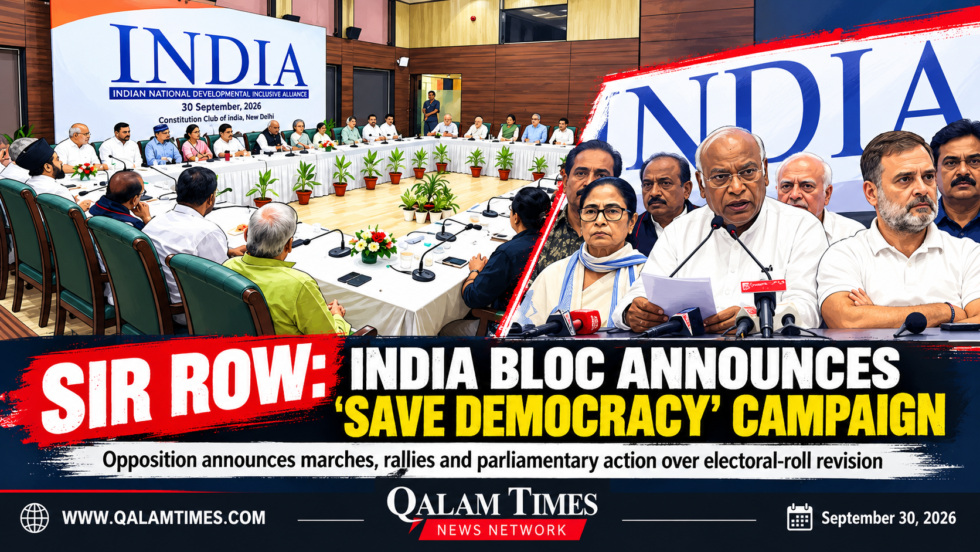
SIR controversy intensifies as the INDIA bloc announces a nationwide ‘Save Democracy’ campaign, marches and parliamentary action over electoral rolls and the Election Commission.
Qalam Times News Network
New Delhi | September 30, 2026
SIR has emerged as the central issue in the latest INDIA bloc meeting in New Delhi, with opposition parties announcing a nationwide “Save Democracy March”, plans for public rallies and further parliamentary action over the Special Intensive Revision of electoral rolls and the functioning of the Election Commission of India.
The SIR controversy has intensified following an Indian Express investigation reporting that Election Commissioners Sukhbir Singh Sandhu and Vivek Joshi had recorded at least 14 objections over a period of 10 months regarding various decisions connected with voter enrolment, deletion of names and the management of electoral data. The Election Commission, however, has maintained that decisions concerning SIR and other matters were taken with the approval of the three-member Commission.
The INDIA bloc meeting was held at the Constitution Club in New Delhi on Wednesday and brought together senior leaders from several opposition parties. The discussions focused primarily on the electoral-roll revision, the Election Commission’s functioning and the political strategy that the opposition intends to pursue in the coming weeks.
SIR : INDIA Bloc Announces ‘Save Democracy March’
Addressing reporters after the meeting, Congress president Mallikarjun Kharge said the opposition parties had agreed to fight the issue collectively.
Kharge announced that the INDIA bloc would organise a “Save Democracy March” from October 2 to October 8. Opposition MPs are also expected to march towards the Election Commission on October 6 as part of the programme.
The Congress president further said that Leader of Opposition in the Lok Sabha Rahul Gandhi would seek an appointment with the President in the second week of October.
The Congress is also planning a series of public rallies during October and November. Kharge said a major rally would be organised in Delhi on November 1, although the final venue and other arrangements would be announced later.
The opposition says the campaign is intended to highlight its concerns about electoral processes and what it describes as the erosion of citizens’ voting rights. These allegations are political claims made by opposition leaders; the Election Commission has defended its procedures and the BJP has rejected the opposition’s accusations.
SIR : Opposition Raises Questions Over Gyanesh Kumar
The INDIA bloc’s meeting also discussed demands concerning Chief Election Commissioner Gyanesh Kumar. The issue gained fresh momentum after reports of disagreements within the three-member Election Commission. According to The Indian Express investigation, Commissioners Sandhu and Joshi had raised objections on at least 14 occasions during the preceding 10 months. The report said their concerns covered issues including the addition and deletion of voters and the handling of electoral databases.
The Election Commission has disputed the interpretation that the reported disagreements represented a breakdown in collective decision-making. Officials have said that SIR and other decisions were approved by all three commissioners.
The controversy has also entered the judicial arena. The Supreme Court has agreed to hear a petition challenging the functioning of CEC Gyanesh Kumar and questioning the legality of the nationwide SIR exercise. The petition raises arguments concerning the collective functioning of the Election Commission under Article 324 of the Constitution. These are allegations contained in the petition and are yet to be adjudicated by the court.
Rahul Gandhi has been sharply critical of the Election Commission and Gyanesh Kumar over the electoral-roll controversy. In his political statements, Gandhi has questioned the safeguards surrounding the Chief Election Commissioner’s office and alleged that the electoral machinery is being used to influence elections. The Congress leader has also repeatedly used the phrase “vote chori” while describing his allegations concerning electoral processes.
The BJP and the Election Commission have rejected such allegations.
Mamata Banerjee Calls CEC ‘Vanish Kumar’
West Bengal Chief Minister Mamata Banerjee also criticised Gyanesh Kumar during the opposition’s campaign over SIR. Banerjee has referred to the CEC as “Vanish Kumar” while raising concerns about voter deletions and the impact of SIR on electoral participation. She has demanded greater transparency in the revision process and restoration of names where eligible voters have been excluded.
Her comments form part of the wider opposition campaign against the Election Commission and the current electoral-roll revision process.
Kharge said the INDIA bloc meeting lasted around three to three-and-a-half hours, with some leaders participating online.
According to Kharge, Rahul Gandhi, Mamata Banerjee and other leaders made suggestions during the discussions. He said the participating parties agreed on the need for a coordinated political response.
The meeting included leaders from Congress, Trinamool Congress, CPI(M), CPI, CPI(ML)-Liberation, Samajwadi Party, NCP (Sharad Pawar), Shiv Sena (UBT), RJD, Jharkhand Mukti Morcha, Jammu and Kashmir National Conference, PDP, IUML and several other opposition parties.
CPI(M) general secretary M.A. Baby had earlier written to opposition parties seeking coordinated action on the Election Commission controversy. The meeting followed those consultations.
Akhilesh Yadav’s Absence Sparks Debate
Samajwadi Party chief Akhilesh Yadav was not physically present at the Delhi meeting. Reports said he was occupied with the Rajya Sabha election process in Uttar Pradesh.
Yadav nevertheless responded to criticism over his absence, saying that the BJP’s concern was that the INDIA bloc remained united.
The SP’s participation in the broader opposition discussions therefore remained significant despite Yadav’s absence from the meeting venue.
DMK and AAP Stay Away
The meeting did not have the participation of every opposition party.Reports indicated that the DMK and Aam Aadmi Party did not attend the meeting, while some leaders and alliance partners participated through representatives or online channels.
The varied participation reflects the complicated political relationships among the parties that make up the broader opposition space. Despite differences on regional and electoral issues, several parties have found common ground in their concerns regarding SIR and the Election Commission.
The INDIA bloc has also discussed demands relating to electoral transparency, including calls for greater disclosure of changes made to electoral rolls and, from some parties, a return to ballot-paper voting.
Kharge has also spoken about restoring earlier electoral rolls and increasing transparency around changes made during the SIR process.
The Election Commission, meanwhile, continues to defend the electoral-roll revision process as part of its statutory responsibility to maintain accurate voter lists.
The latest INDIA bloc meeting marks a significant escalation in the opposition’s campaign over SIR. What began as a dispute over electoral-roll revision has now expanded into a wider political argument involving the Election Commission’s internal functioning, the powers of the Chief Election Commissioner, parliamentary accountability and the protection of voting rights. The opposition intends to take the issue to the streets through the October campaign, while also pursuing parliamentary and legal avenues.
At the same time, the Election Commission faces the task of addressing questions about the revision process and its internal decision-making while maintaining public confidence in the electoral system.
The Supreme Court’s forthcoming consideration of the petition concerning the CEC’s functioning and SIR could provide another important institutional forum for these questions. For the INDIA bloc, the immediate objective is to turn the controversy into a sustained national campaign. The coming weeks will show how the planned marches, rallies, parliamentary initiatives and legal proceedings shape the continuing debate over India’s electoral system.