



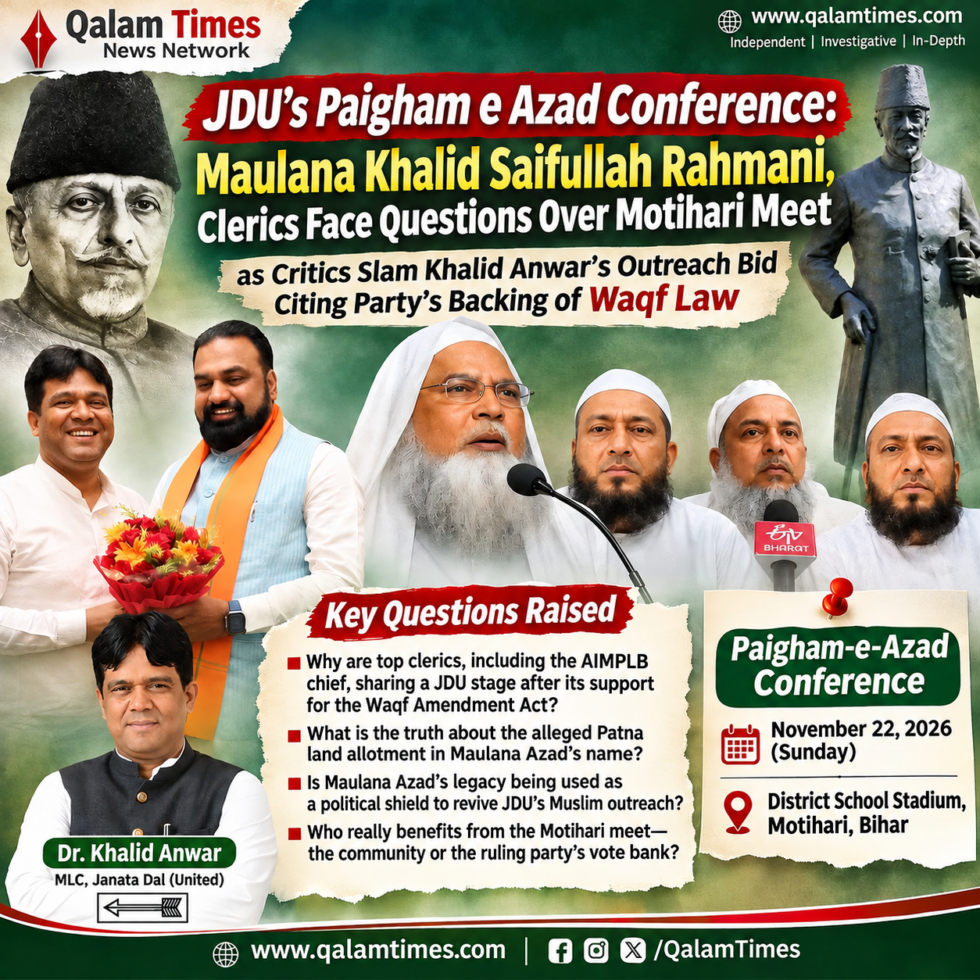
Controversy surrounds JDU’s Azad Conference in Motihari as critics slam Khalid Anwar, Maulana Khalid Saifullah Rahmani, and other clerics for legitimizing a party that backed the Waqf Amendment Act.
JDU’s AZAD CONFERENCE: WHY ARE TOP MUSLIM CLERICS JOINING KHALID ANWAR’S POLITICAL MEET?
Qalam Times News Network
Motihari / Patna | November 18, 2026
JDU’s Azad Conference, scheduled to be held on November 22 at Motihari’s District School Stadium under the banner “Maulana Azad’s Thoughts and the Current Political Situation,” has triggered widespread outrage across Bihar’s Muslim community. Community observers, activists, and conscious citizens are raising pointed questions against Janata Dal (United) MLC Khalid Anwar and the prominent religious scholars sharing the dais with him, accusing them of staging a calculated political spectacle to launder the image of a ruling dispensation that stood at the forefront of passing the controversial Waqf Amendment Act.
Critics argue that the timing and intent of JDU’s Azad Conference expose a deep-seated pattern of political opportunism aimed at dulling the political consciousness of Bihar’s Muslims. While the JDU played a decisive role in enabling legislation widely viewed by Muslims as an existential threat to mosques, graveyards, shrines, and endowed community properties across India, its political handlers are now invoking the revered legacy of freedom fighter Maulana Abul Kalam Azad to pacify public anger and rebuild a crumbling vote bank ahead of future political battles.
Questioning the Presence of Top Clerics and Self-Styled Leaders in JDU’s Azad Conference
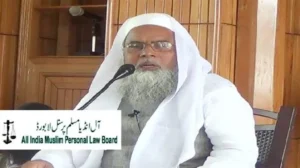
At the center of the storm is the reported participation of All India Muslim Personal Law Board (AIMPLB) President Maulana Khalid Saifullah Rahmani—often projected by his circle with lofty honorifics such as “Faqih-ul-Asr”—alongside other office-bearers and clerics. Community members are asking how leaders entrusted with safeguarding Muslim religious institutions and Waqf properties can lend credibility to a political event orchestrated by the very party that helped push through the Waqf law against the collective will of the community.
Observers point out that the participation of senior religious figures alongside political brokers blurs the line between principled community leadership and partisan appeasement. Rather than holding the Nitish Kumar administration accountable for its legislative record on Waqf, minority welfare, and institutional autonomy, these clerics are accused of providing religious legitimacy to an exercise designed to confuse ordinary voters.
A Pattern of Opportunism: From ‘Deen Bachao’ to Imarat-e-Shariah and Now Motihari
Local commentators trace this political maneuvering back to the rise of Khalid Anwar, who secured his entry into the Bihar Legislative Council after leveraging the emotional momentum of the historic “Deen Bachao, Desh Bachao” movement led by the late Amir-e-Shariat Hazrat Maulana Wali Rahmani. Critics allege that public trust and religious sentiment were converted into personal political capital, followed by sustained attempts to align community institutions with the ruling establishment.
Following that trajectory, figures such as Maulana Abu Talib Rahmani and Maulana Anisur Rahman Qasmi have also come under sharp scrutiny. Community elders recall past controversies surrounding attempts to weaken the autonomous character of Imarat-e-Shariah—Bihar’s century-old spiritual and social institution—and turn it into an extension of state influence. Having faced resistance from the institution’s guardians and an alert public, these actors are now accused of launching a fresh political front in the name of Maulana Abul Kalam Azad to secure personal relevance, state patronage, and political leverage.
Unanswered Questions Over the Alleged Patna Land Allotment
Adding fuel to the controversy are earlier public claims made by Maulana Abu Talib Rahmani suggesting that the Bihar government had allotted land in Patna in the name of Maulana Azad. Ahead of the November 22 Motihari gathering, citizens and community watchdogs are demanding transparent answers from the organizers and participating clerics:
- Where is the proof of land allotment? If land in Patna was genuinely allocated in Maulana Azad’s name, why have no official gazette notifications, title deeds, or exact location details been placed in the public domain?
- How do clerics justify sharing a JDU-backed stage after the Waqf law? Can those claiming to represent Muslim personal law and religious interests explain why they are endorsing an outreach campaign for a party that actively facilitated the Waqf Amendment Act?
- Is Maulana Azad’s legacy being reduced to a political shield? Why is the towering anti-colonial statesman—who stood firmly against political compromise and subjugation—being invoked to protect the electoral interests of a ruling alliance?
- Who benefits from dividing community consensus? Are these conferences meant to empower Bihar’s Muslims educationally and politically, or merely to secure titles, committees, and proximity to power for a handful of self-appointed intermediaries?
As November 22 approaches, voices across Champaran and the wider state insist that Bihar’s Muslim electorate is no longer easily swayed by emotional slogans or staged symposia. By calling out both the political architects and the clerics lending their names to the Motihari event, community members have signaled that institutional betrayal and political brokerage will not go unchallenged.