



Dimaagi Naxals dominate debate after PM Modi’s 80th Independence Day speech, alongside AI training, free coaching, youth power and Viksit Bharat 2047.
From ‘Dimaagi Naxals’ and youth empowerment to AI training, free coaching and ‘Shakti Ki Saptadhara’, PM Modi outlines his roadmap for a Viksit Bharat by 2047
Qalam Times News Network
New Delhi , August 15, 2026
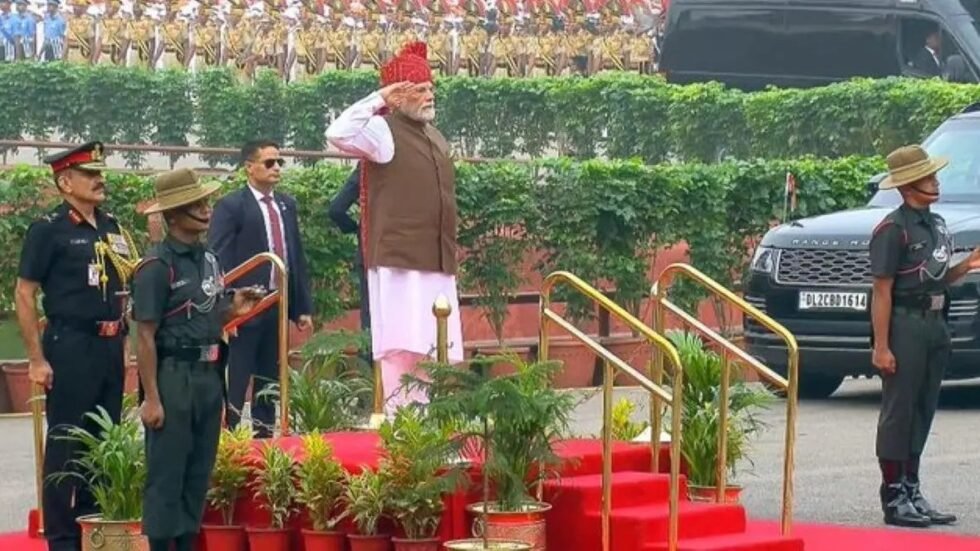
Dimaagi Naxals emerged as one of the most politically significant phrases in Prime Minister Narendra Modi’s 80th Independence Day address from the Red Fort on Saturday, as he warned that although the country had made major progress in tackling armed Naxalism, an ideological challenge still required attention.
PM Shri Narendra Modi
The reference to Dimaagi Naxals came alongside a broader Independence Day message centred on national development, youth power, self-reliance, technology and the goal of building a developed India by 2047. Modi said that the armed form of Naxalism had caused enormous suffering over several decades, but argued that the ideological influence associated with the movement had not disappeared entirely.
Modi said that people with a Naxal-oriented mindset had, in his view, occupied influential positions in the past, including roles in government advisory structures, and that Maoist ideology had affected policy debates. He called for vigilance against what he described as the new ideological dimension of the problem.
The Prime Minister, however, did not provide a formal legal definition of the expression “Dimaagi Naxal” in his address, nor did he identify any particular opposition leader, journalist, writer, academic, artist, organisation or political party as falling into that category. Consequently, applying the label to specific individuals or groups would go beyond what was stated in the speech.
The phrase also immediately entered the wider political debate because terms such as “urban Naxal” have previously been used in Indian political discourse to describe activists, intellectuals, academics, journalists and others accused by critics of supporting or advancing Maoist ideology. Supporters of the government have used such terminology to describe what they regard as an ideological challenge, while critics have argued that broad labels can be used against legitimate dissent and political disagreement.
Youth, AI and the Road to Viksit Bharat
A major portion of Modi’s address was devoted to young Indians and the government’s vision for 2047. He urged the younger generation to take a leadership role in nation-building and announced several initiatives intended to expand opportunities in education, technology and sports.
One of the headline announcements was a plan to provide artificial intelligence training to one crore, or 10 million, young people through a nationwide mission-mode programme over the coming year. The initiative was presented as part of an effort to prepare India’s workforce for an economy increasingly shaped by artificial intelligence and advanced technologies.
Modi also announced a free online coaching initiative for competitive examinations. He argued that the growing dependence on private coaching centres had placed a significant financial burden on poor and middle-class families. The proposed online system is intended to make preparation resources more accessible without requiring students to move away from their homes or spend heavily on coaching.
The Prime Minister also spoke about identifying sporting talent across the country. A nationwide talent-search programme aimed at children between five and 15 years of age was announced with the broader objective of building India’s sporting capabilities and preparing the country for major international competitions, including the 2036 Olympics.
Another appeal was directed towards young citizens in connection with the forthcoming census exercise. Modi urged young people to contribute actively to the process and help ensure that household and family information is accurately recorded.
‘Shakti Ki Saptadhara’ Development Framework
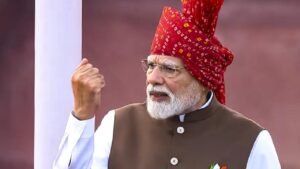
PM Modi Announces ‘Saptadhara’ from Red Fort, Calls for Seven Pillars to Build a Viksit Bharat by 2047
Beyond youth-focused announcements, Modi presented what he described as “Shakti Ki Saptadhara”, a seven-pronged framework for India’s next phase of development.
The framework places emphasis on manufacturing; agriculture and food processing; technology and innovation; Gati Shakti and infrastructure; defence production; the green and blue economy; and India’s soft power. The Prime Minister linked these areas to his broader ambition of making India a developed country by 2047.
He also stressed the importance of strengthening domestic manufacturing and reducing strategic dependence on foreign sources in critical sectors. Semiconductors, defence technology, artificial intelligence, energy security and innovation featured prominently in his economic and strategic vision.
On semiconductors, Modi set an ambitious target of bringing several new production facilities into operation in the coming years. Nuclear energy was also highlighted as a key component of India’s long-term energy strategy, with an emphasis on substantially increasing domestic nuclear-generation capacity.
The Prime Minister further called for greater participation by Indian businesses in global supply chains and encouraged the manufacturing sector, including MSMEs, to make greater use of international market opportunities.
A Speech Built Around Self-Reliance and Youth Power
The overall character of the address was markedly focused on economic transformation, technology, self-reliance and the role of young Indians. The government’s long-term objective of Viksit Bharat@2047 remained at the centre of the speech.
At the same time, the “Dimaagi Naxals” reference introduced a security and ideological dimension into an address otherwise dominated by development-related announcements. Modi presented the issue as a continuation of the country’s long struggle against Naxal violence, while arguing that the ideological roots of the movement also required attention.
The political response to the phrase is likely to continue beyond Independence Day. Supporters are expected to view the warning as an extension of the government’s campaign against Maoist ideology, while critics may question how such a term is defined and whether it could be applied too broadly to political opponents or dissenting voices.
For now, however, the Prime Minister’s speech did not attach the term to any named individual or organisation. Any such identification would therefore remain political interpretation rather than an explicit statement contained in the Independence Day address.
With his focus on AI skills, free competitive-examination coaching, sporting talent, manufacturing, energy, defence and technological self-reliance, Modi sought to present a roadmap extending well beyond the immediate political cycle.
The central message of the address was that India’s next phase of national development must be driven by its young population, technological capabilities and domestic strengths. At the same time, his warning about “Dimaagi Naxals” placed ideological security alongside economic development as an issue that the government intends to keep within the national conversation.