



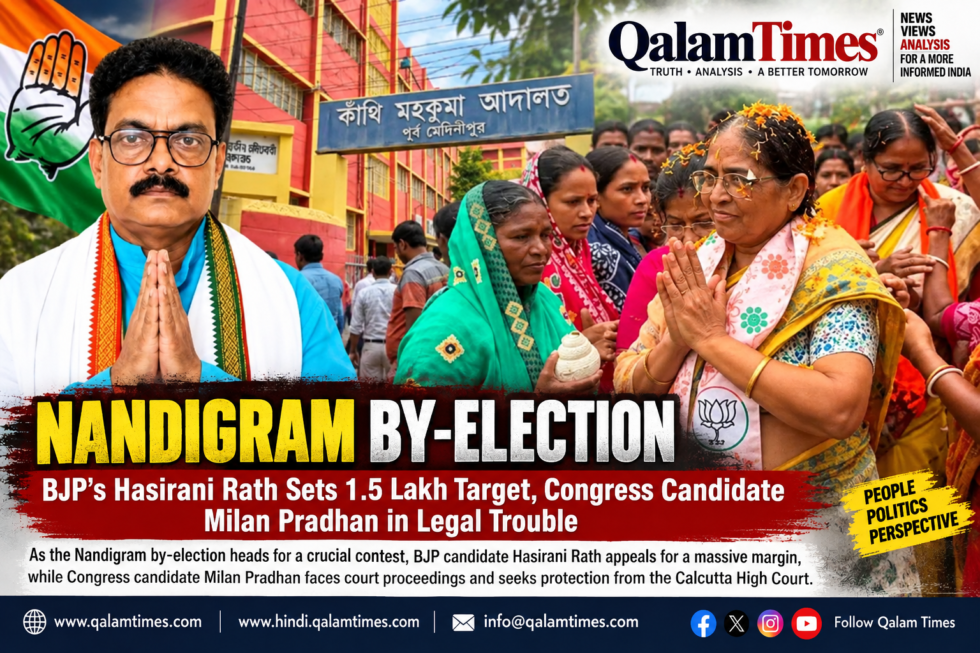
Nandigram By-Election enters a crucial phase as BJP’s Hasirani Rath sets a 1.5-lakh target while Congress candidate Milan Pradhan faces legal proceedings.
As Hasirani Rath sets an ambitious target and Congress candidate Milan Pradhan faces legal proceedings, Nandigram enters a bypoll where politics, prosecution and campaign strategy are colliding
Qalam Times News Network
Nandigram, West Bengal | September 21, 2026
Nandigram By-Election has once again become a focal point of West Bengal’s political contest, but the latest developments suggest that the campaign is being shaped as much by legal battles and political narratives as by conventional electoral mobilisation. BJP candidate Hasirani Rath has publicly set an ambitious target for her party, while Congress candidate Milan Pradhan remains in judicial custody amid proceedings in several cases. The contrasting developments have added another layer of intensity to an already closely watched contest.
Rath’s campaign message is built around a clear political objective: she wants BJP workers to seek not merely victory but a very large margin. During her campaign in Nandigram, she reportedly spoke of a target of 1.5 lakh votes, invoking the BJP’s earlier electoral margins elsewhere as a benchmark. She also presented herself as a mother who had suffered the loss of her son and sought to establish a personal connection with voters by describing herself as their daughter-in-law, mother, sister and relative.
That rhetoric is significant because Nandigram By-Election is taking place in a constituency with considerable political symbolism. The BJP is seeking to turn the contest into a demonstration of organisational strength rather than simply another by-election. Rath’s appeal to party workers not to become complacent indicates that the BJP campaign is conscious of the difference between setting a target publicly and actually translating that target into votes.
The circumstances surrounding Rath’s personal political narrative have also become part of the campaign. She referred to the killing of her son, Chandranath Rath, who had worked as an aide to BJP leader Suvendu Adhikari. BJP leaders have previously made allegations concerning the circumstances of his death. Rath has repeated those allegations during the campaign. However, allegations about responsibility for a criminal act should remain matters for investigation and judicial determination rather than being treated as established facts in an election campaign.
The Congress campaign faces a very different challenge. Its candidate, Milan Pradhan, is in custody in connection with cases dating back to the political violence of 2007. According to reports, he is scheduled to appear before the Contai subdivision court in connection with two cases related to killings in Khejuri. Police may also seek his arrest in another case. Earlier, a court in Haldia had ordered judicial custody in connection with two Nandigram police-station cases.
Pradhan’s legal difficulties have acquired direct electoral significance because he is not contesting the election from outside the political arena; he is a candidate while facing ongoing judicial proceedings. His legal team has approached the Calcutta High Court, seeking protection from arrest in several additional cases. The court has permitted the matter to be filed, with a hearing scheduled for Tuesday, according to reports.
This creates an important question for voters and political observers alike: how much can a candidate campaign when legal proceedings restrict his physical presence? Congress supporters have attempted to compensate through organisational mobilisation. A campaign rally was held in the Shamsabad Mir-Bazar area under the leadership of Congress leader Ranjit Mukherjee, reportedly becoming one of the party’s first major campaign programmes after Pradhan’s arrest.
The political field itself has added to the uncertainty. Mamata Banerjee is not contesting the by-election, while the Congress candidate remains in custody. The AJUP candidate’s position has reportedly changed during the campaign period, at different stages involving indications of withdrawal and continued participation. Such developments can affect campaign dynamics, but the eventual electoral impact cannot be established until voters cast their ballots and the result is declared.
The BJP’s 1.5-lakh-margin target therefore deserves to be understood as a campaign objective, not as a prediction of the election result. Political parties routinely set numerical targets to motivate their workers, consolidate their vote base and create a narrative of momentum. Whether such a target translates into actual votes depends on turnout, local organisation, candidate appeal, voter preferences and developments during the remaining campaign period.
There is also a broader democratic issue beneath the immediate political contest. When a candidate is in custody during an election campaign, questions naturally arise about the practical ability of that candidate and his party to communicate with voters. At the same time, criminal investigations and court proceedings cannot simply be suspended because an individual is contesting an election. The appropriate balance lies in ensuring that legal processes remain independent while candidates retain whatever lawful electoral rights they are entitled to exercise.
That distinction is especially important in a politically charged constituency such as Nandigram. Criminal allegations should be tested through evidence and due process, while electoral claims should be tested by voters through the ballot box. Neither political rhetoric nor social-media narratives can substitute for a judicial finding.
For the BJP, the immediate challenge is to convert its campaign energy into sustained voter mobilisation without assuming that an ambitious margin is already secured. For Congress, the challenge is even more complicated: it must maintain an effective campaign while its candidate deals with multiple legal proceedings. For voters, the contest offers competing narratives about development, political representation, past violence, law enforcement and the future direction of local politics.
Ultimately, the Nandigram By-Election will not be decided by the size of a target announced from a campaign platform, nor by the number of cases surrounding a candidate. It will be decided by voters. The 6 October polling date will provide the electoral test, while the result on 9 October will determine whether the campaign strategies adopted by the competing parties translated into actual electoral support.

Until then, political claims should remain claims, legal allegations should remain subject to due process, and electoral expectations should not be confused with established outcomes. Nandigram deserves a campaign in which political competition is vigorous, but the facts surrounding candidates and cases are presented with the care that an election of this importance requires.