




Bankura Killing raises serious questions about political violence, citizen rights, school accountability and the need for an impartial investigation in West Bengal.
Qalam Times News Network
Kolkata | August 17, 2026
The Bankura Killing reported after a young political volunteer raised concerns about the condition of a government primary school is deeply disturbing and demands a fair, impartial and transparent investigation. According to the account provided to Qalam Times, Sheikh Abdul Hafiz, a supporter and volunteer associated with the Cockroach Janta Party (CJP), had visited Karishunda Paschimpara Primary School on August 13 as part of the party’s “School Theek Karo” initiative. Hours later, his family was allegedly attacked at their home, and his father, Sheikh Mohammad Mafik, sustained injuries that later proved fatal.
The Bankura Killing raises questions that go beyond the immediate criminal investigation. If the sequence of events described by the family and political organisations is established by the evidence, the incident would represent a deeply troubling escalation from a disagreement over civic and educational conditions to violence against an entire family. A citizen or political volunteer raising questions about the state of a public institution must be able to do so without fearing retaliation. At the same time, allegations of political involvement must not be treated as established facts until investigators produce evidence.

A dispute over a school cannot become a licence for violence
The reported chain of events deserves close examination. Hafiz is said to have visited Karishunda Paschimpara Primary School to assess its educational conditions and subsequently met the headmaster, Kashinath Dey. According to the account, the headmaster asked him to return the following day to discuss the concerns raised. Later that night, a group of assailants allegedly entered Hafiz’s home carrying sticks, iron rods and crowbars.
Hafiz reportedly managed to escape from the house after being attacked. His father, Sheikh Mohammad Mafik, was then allegedly assaulted. Police intervened and Mafik was taken first to a nearby health centre before being referred to Burdwan Medical College when his condition deteriorated. He subsequently died while undergoing treatment.
His death transformed what might initially have appeared to be an episode of local violence into a murder investigation with serious political and social implications. Mafik’s wife, Hasina Begum, reportedly lodged the police complaint, after which a murder case was registered. Police have arrested eight people, while three individuals have reportedly been named in the FIR, and the arrested persons were produced before a district court.
The first responsibility now lies with the investigating authorities. Arrests are important, but arrests alone do not establish guilt. The investigation must determine who planned the assault, who participated in it, what weapons were used, what happened inside the house and whether there was any connection between the earlier school visit and the subsequent attack.
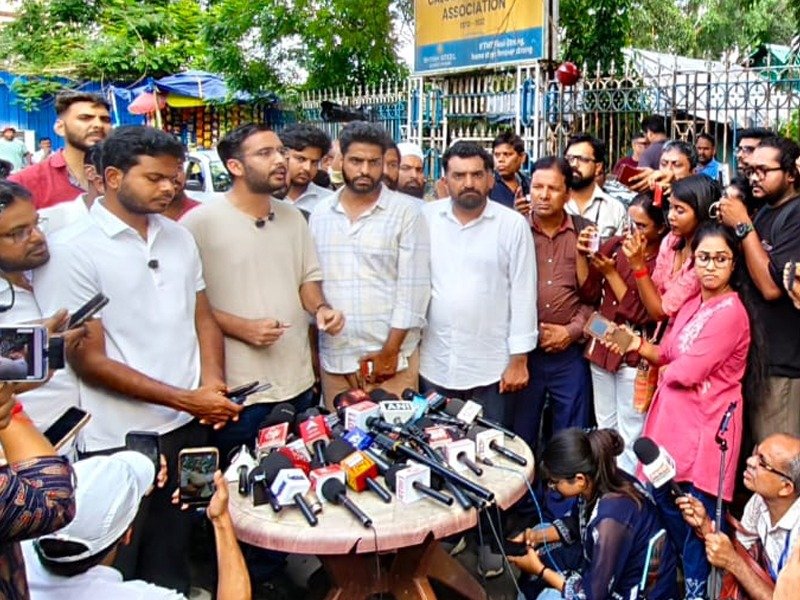
The political dimension has inevitably emerged because Hafiz was associated with the CJP and had participated in the party’s Jantar Mantar protest. CJP spokesperson Ashutosh Ranka has alleged that BJP-linked attackers targeted Hafiz after he returned from his school-related visit. The Indian Youth Congress has also alleged BJP involvement and said that it is providing legal assistance to the family.
These are serious allegations. But an editorial calling for justice must make an equally important distinction: an allegation is not a conviction.
The BJP has rejected the accusations. According to the material supplied for this report, party representatives have said that those arrested are criminals and denied any organisational connection to the killing. Such a denial must also be placed before investigators and tested against evidence.
This is precisely why an independent and professional investigation is indispensable. Political parties should not be allowed either to prejudge the case or to influence the direction of the investigation. The family deserves justice, the accused deserve due process, and the public deserves the truth.
There is another important aspect that should not be forgotten amid the political controversy: the original reason for Hafiz’s visit.
Government schools are public institutions. Their physical infrastructure, teaching standards, sanitation, availability of learning materials and overall educational environment are matters of legitimate public concern. Political organisations, civil-society groups, parents and local residents may raise questions about these issues, provided they do so peacefully and within the law.
If the allegations concerning the school’s condition are genuine, they should be examined by the relevant education authorities rather than becoming the source of political confrontation. If the allegations are inaccurate, that too should be established through facts, inspections and official records—not intimidation or violence.
A democratic society cannot permit criticism of a public institution to become dangerous.
The proposed visit by CJP leaders to Hafiz’s family on Monday and the legal assistance offered by the Indian Youth Congress show that political organisations are seeking to respond to the incident. Their presence can be constructive if it helps the family obtain legal support and ensures that the investigation receives public scrutiny.
But political mobilisation must remain peaceful. The death of Mafik should not become another reason for confrontation between rival groups. West Bengal has witnessed enough political violence and allegations of partisan attacks over the years. Every new incident creates an opportunity either to deepen that cycle or to break it.
The authorities must therefore ensure adequate security for the family and witnesses, preserve relevant evidence and conduct the investigation without fear or favour. CCTV footage, call records, eyewitness accounts, medical reports and forensic evidence—where legally relevant—should be examined carefully. The investigation should also establish whether the school visit had any direct connection with the attack or whether the two events were unrelated.
The most troubling lesson from the reported incident is not merely political. It concerns the basic relationship between citizens and public institutions.
A government school belongs to the public. A citizen asking why it is in poor condition is exercising a legitimate democratic concern. A political volunteer may have an agenda, a social activist may have an agenda, and an opposition party may have an agenda—but none of these possibilities can justify physical violence.
Equally, political affiliation cannot automatically transform every criminal incident into an act of political conspiracy. That determination belongs to the evidence and, ultimately, the judicial process.
The state must therefore protect two principles simultaneously: the right to question and the duty to establish facts.
Qalam Times News Network believes the death of Sheikh Mohammad Mafik should not be reduced to another political headline that disappears after a few days. A human life has been lost, a family has been devastated, and a young man who reportedly went to inspect a public school now finds himself at the centre of a criminal and political controversy.
The authorities must deliver an investigation that is credible enough to withstand political pressure and public suspicion. If anyone is found responsible for the assault and killing, the law must take its course without political favour. If political organisations are found to have played a role, that must be established through evidence and dealt with accordingly. If the allegations of political involvement are not supported by evidence, that conclusion too must be stated clearly.
Justice requires neither political slogans nor predetermined conclusions. It requires facts.
The reported Bankura Killing should therefore become a test—not only of policing and criminal justice, but of whether ordinary citizens can raise legitimate questions about public institutions without fear of violence. The answer must be an unequivocal yes.