



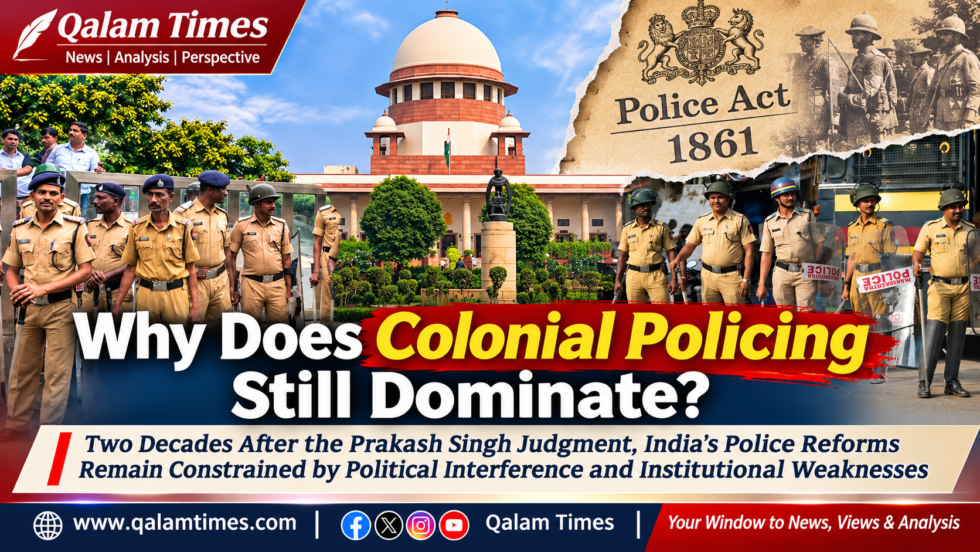
Colonial Policing continues to dominate India’s police system even two decades after the Prakash Singh judgment. Dr. Mohammad Farooque examines political interference, police accountability and the urgent need for democratic reforms.
Two Decades After the Supreme Court’s Landmark Prakash Singh Judgment, India’s Police Reforms Remain Constrained by Political Interference, Institutional Weaknesses and an Unfinished Democratic Transformation
By Dr. Mohammad Farooque
Qalam Times News Network
Kolkata, November 5, 2026
The Republic Needs a People’s Police, Not a Government’s Police
Colonial Policing remains one of the most persistent institutional legacies of British rule in independent India. The country has entered a new phase of criminal justice administration, replacing its century-old criminal statutes with a new legislative framework. Yet the institution responsible for implementing these laws continues to function under an administrative culture whose foundations were laid during British colonial rule. This contradiction raises a fundamental question: how can a nation aspire to modern, transparent and citizen-oriented justice while retaining a policing system that was originally designed to maintain the authority of rulers rather than protect the rights of the people?
The debate surrounding Colonial Policing is not simply about changing legislation, introducing technology or improving administrative efficiency. It concerns the very character of the Indian State and its relationship with ordinary citizens. In a constitutional democracy, the police must be an institution that protects the law without becoming an instrument of political convenience. Its loyalty must be to the Constitution, its responsibility must be towards the public, and its authority must always remain subject to accountability. Unfortunately, the distance between this democratic ideal and the everyday functioning of policing in India remains considerable.
Colonial Policing : A Landmark Judgment That India Has Yet to Fully Honour

September 22, 2006, should have marked a decisive turning point in the history of Indian policing. On that day, the Supreme Court delivered its historic judgment in Prakash Singh v. Union of India, recognising the urgent need to free police institutions from arbitrary political interference and establish a professional system of accountability.
The petition had been initiated by former senior police officers who sought the implementation of recommendations made by the National Police Commission. After years of administrative indifference, the Supreme Court intervened and issued seven directives intended to transform the functioning of police organisations across the country.
These directives were not ordinary administrative suggestions. They represented a constitutional vision for a police institution capable of functioning professionally, independently and responsibly.
The Court called for the establishment of State Security Commissions to protect police organisations from unwarranted political pressure; a transparent process for selecting Directors General of Police; a minimum two-year tenure for key operational officers; separation of investigation from law-and-order responsibilities; independent Police Complaints Authorities; Police Establishment Boards; and a National Security Commission for central police organisations.
Taken together, these measures sought to establish a new relationship between the political executive, the police administration and the citizens. The objective was clear: elected governments should determine legitimate policy priorities, but they should not be permitted to manipulate individual investigations, appointments or transfers for political advantage.
Yet, twenty years later, the distance between the Supreme Court’s vision and its actual implementation remains deeply troubling.
The Politics of Police Appointments and Transfers
Perhaps the most visible manifestation of political influence is the manner in which senior police officers are appointed, transferred and removed. In a professional police administration, leadership appointments should be based on merit, experience, integrity and institutional requirements. However, when an officer’s professional future depends more heavily on political preferences than administrative performance, the entire command structure becomes vulnerable. The appointment of acting or in-charge Directors General of Police became a particularly controversial issue because it undermined the transparent selection mechanism envisaged by the Supreme Court. In 2018, the Court made it clear that states should not appoint acting DGPs as a means of bypassing the prescribed selection process. The continuing legal disputes over police leadership appointments demonstrate that the problem is not merely procedural. It reflects a deeper struggle over who controls the police institution and how far constitutional safeguards can protect it from executive discretion. Transfers have become another instrument through which the independence of the police administration can be weakened. An officer who anticipates an undesirable posting for refusing to accommodate an improper demand may find it difficult to resist pressure. Conversely, an officer who enjoys political favour may receive strategically important assignments.
Such a system damages institutional confidence. It also sends a dangerous message to junior personnel: professional integrity may be less valuable than political acceptability. A democratic government must have the authority to establish policing priorities, but that authority cannot become a licence to influence investigations, reward personal loyalty or punish officers for performing their lawful duties.
Police Complaints Authorities: Accountability Without Power?
The establishment of Police Complaints Authorities was among the most important elements of the Prakash Singh judgment. The underlying principle was simple: citizens who suffer serious misconduct at the hands of police personnel must have access to an independent mechanism capable of examining their complaints.
For an ordinary citizen, approaching a police station is often the first step towards obtaining justice. But what happens when the complaint concerns the police themselves?
Without an independent and credible complaints mechanism, citizens may find themselves trapped in an institutional arrangement in which the very authority accused of wrongdoing exercises substantial influence over the process of examining that allegation. Several states have established Police Complaints Authorities, but their effectiveness has been questioned because of inadequate staffing, limited investigative capacity, insufficient financial support and concerns regarding independence. An authority that exists only in government notifications cannot provide meaningful protection. It must possess the resources, legal authority and institutional independence necessary to investigate complaints and ensure that recommendations are acted upon. Accountability cannot be reduced to a committee meeting or an annual report. It must produce consequences where wrongdoing is established. At the same time, a fair complaints mechanism must protect honest police personnel against malicious or politically motivated allegations. The objective should not be to weaken the police but to strengthen public confidence in its professionalism.
Investigation Cannot Remain a Secondary Responsibility
One of the most serious weaknesses in India’s policing structure is the continued failure to establish a meaningful separation between criminal investigation and the maintenance of law and order. The Supreme Court recognised that these functions require different professional priorities. Investigation demands patience, technical knowledge, evidence collection, forensic understanding and sustained attention to legal procedures. Law-and-order management, on the other hand, requires immediate administrative coordination, crowd management, preventive deployment and emergency response. When the same personnel are continuously required to perform both responsibilities, investigative work inevitably suffers.
Police officers are frequently diverted to VIP security, political programmes, public demonstrations, emergency deployments and other administrative assignments. Consequently, the investigation of ordinary criminal cases may receive less attention than it deserves. The greatest burden falls on ordinary citizens, particularly those who cannot afford private legal assistance or prolonged litigation. A victim waiting for an investigation, a family seeking justice in a criminal case or an individual whose complaint remains unattended cannot be expected to understand administrative excuses about staff shortages and operational pressure. If the State expects citizens to respect the law, it must also ensure that the machinery responsible for enforcing it functions efficiently. Separation of investigation from law and order should therefore be treated as an essential investment in the quality of justice, rather than an administrative luxury that can be postponed indefinitely.
The Constable: The Forgotten Foundation of Police Reform
There is another dimension of police reform that receives far less attention than senior appointments and institutional restructuring: the working and living conditions of ordinary police personnel. Public debates often focus on Directors General, commissioners, senior officers and government policies. Yet the everyday experience of policing is shaped by constables, head constables, assistant sub-inspectors and sub-inspectors who work directly with citizens. These personnel are expected to maintain public order, prevent crime, investigate complaints, manage crowds, protect vulnerable individuals and respond to emergencies. They frequently perform these responsibilities under exhausting schedules and difficult working conditions. Long duty hours, insufficient accommodation, inadequate transport facilities, irregular rest, professional stress and limited opportunities for career advancement can seriously affect morale and efficiency. A police constable who is continuously deprived of reasonable working conditions cannot be expected to deliver the highest standards of public service indefinitely. The dignity of police personnel must become an integral part of the reform agenda. Fair remuneration, timely payment of allowances, weekly rest wherever operationally possible, proper housing, modern equipment, psychological support and merit-based promotions are not privileges. They are necessary conditions for a professional police service. There is also a moral dimension to this issue. An institution entrusted with protecting the constitutional rights and dignity of citizens must ensure that its own personnel are treated with dignity. Reform cannot succeed if it improves the authority of senior officers while ignoring the circumstances of those who form the backbone of the organisation.
New Criminal Laws Cannot Deliver Justice Through an Outdated Institutional Culture

India’s introduction of the Bharatiya Nyaya Sanhita, Bharatiya Nagarik Suraksha Sanhita and Bharatiya Sakshya Adhiniyam represents a major legislative transition in the country’s criminal justice framework. These laws have introduced changes in the legal treatment of offences, criminal procedure and evidence. Their successful implementation, however, depends heavily on the institutional capacity and professional culture of the police.
Changing the name of a criminal statute does not automatically change the manner in which an investigation is conducted. Nor does a new procedural framework guarantee fairness if the personnel responsible for implementing it remain vulnerable to external pressure, inadequate training and administrative inefficiency. The real challenge is to ensure that modern legal provisions are supported by modern policing practices. This requires investment in forensic infrastructure, digital evidence management, specialised investigation units, professional training, cybercrime expertise and scientific methods of investigation. Equally important is the protection of constitutional safeguards. Technology should strengthen transparency, not become an instrument of indiscriminate surveillance. Greater police powers must be accompanied by stronger accountability, procedural fairness and respect for individual liberty. A modern criminal justice system cannot be built merely by giving the police new responsibilities. It must also equip them with the independence, resources and professional standards necessary to discharge those responsibilities lawfully.
Political Neutrality Is the Real Test of Democratic Policing
The most difficult aspect of police reform is not the creation of committees or the publication of government notifications. It is the willingness of political establishments to accept institutional limits on their own power.
Governments across political parties have often spoken about police modernisation and administrative efficiency. However, the temptation to exercise influence over appointments, transfers, investigations and enforcement priorities has remained a persistent feature of governance. This is not a problem belonging to one political party or one state. It is a structural weakness that successive governments have failed to address adequately.
A police institution should not change its approach towards citizens depending on their political identity, economic influence, religion, caste or social standing. The law must be applied consistently, and the same constitutional protections must be available to every individual. The police cannot be permitted to become an instrument for intimidating political opponents, protecting influential individuals or selectively enforcing the law. Equally, the police must not be placed beyond public scrutiny in the name of operational independence. Independence without accountability can create another form of institutional arbitrariness. The objective must therefore be a balanced arrangement in which the police are protected from improper political interference while remaining answerable to the law, independent oversight institutions and democratic society.
From Colonial Command to Constitutional Responsibility
The colonial Police Act of 1861 was created in the aftermath of the Revolt of 1857, when the British administration sought a centralised and disciplined force to maintain colonial authority. Independent India inherited this institutional framework, but its democratic responsibilities were fundamentally different. The citizen was no longer a subject of an imperial administration; the citizen became the constitutional foundation of the Republic. That transformation demanded a corresponding change in policing philosophy. Unfortunately, the transition from colonial command to democratic service has remained incomplete. In many situations, the distance between the police station and the ordinary citizen continues to reflect an unequal relationship rather than a partnership based on trust and constitutional responsibility. Community policing, public consultation, sensitivity towards vulnerable groups, transparent procedures and professional training can help bridge this divide. But these initiatives must be supported by institutional changes rather than remaining dependent on the personal commitment of individual officers. The country needs a police service that listens before it uses force, investigates before it draws conclusions and respects the law even when political or administrative pressure suggests otherwise.
Twenty Years Later, the Supreme Court’s Vision Must Become a National Priority
The Prakash Singh judgment was never intended to be a symbolic judicial intervention. It was an effort to correct a structural weakness that had persisted for generations. Twenty years later, India must honestly assess why the seven directives have not been implemented uniformly and effectively. The answer cannot simply be that policing is a state subject or that administrative circumstances differ from one state to another. Federal diversity cannot become a permanent justification for avoiding constitutional responsibilities. The Union and state governments must work towards a time-bound reform programme with transparent implementation standards. State Security Commissions must become meaningful institutions rather than ceremonial bodies. Police Complaints Authorities must receive adequate powers and resources. The selection and tenure of senior officers must be protected from arbitrary interference. Investigation must be strengthened through specialised personnel and infrastructure. Police Establishment Boards must function with genuine institutional authority. Above all, the welfare and professional dignity of ordinary police personnel must become a measurable component of police modernisation. The Supreme Court has already provided the constitutional direction. What remains missing is sustained political commitment.
The Final Question: Whose Police Is It?
The central question facing Indian democracy is straightforward: does the police institution exist primarily to protect the government of the day, or does it exist to protect the people and the Constitution? The distinction is fundamental.
Governments change. Political parties rise and fall. Administrations come and go. But the Constitution remains the supreme framework governing the relationship between the State and its citizens. A police force that becomes excessively dependent on political authority risks losing the very neutrality that gives it legitimacy. Conversely, a professional police service that enjoys operational independence, works under transparent safeguards and remains accountable to citizens can become one of the strongest pillars of democratic governance. India cannot claim to have modernised its criminal justice system while leaving its policing institutions trapped in an unfinished colonial legacy.
The time has come to move beyond cosmetic modernisation and undertake genuine structural reform. The country does not need a police force that merely follows the instructions of those in power. It needs a police service that has the courage to uphold the law, the integrity to resist improper pressure and the humanity to recognise the dignity of every citizen.
India needs a People’s Police, not a Ruler’s Police.
Twenty years after Prakash Singh, the demand is no longer simply for police reform. It is for the fulfilment of a constitutional promise.