



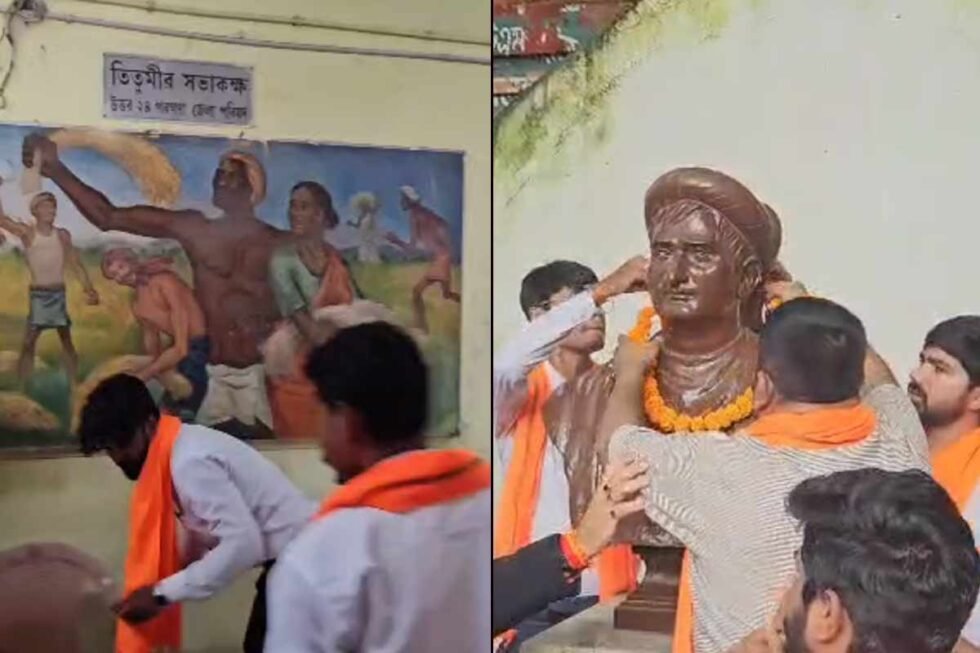
Titumeer Hall at the North 24 Parganas Zilla Parishad in Barasat has been renamed Shyama Prasad Bhavan, sparking a debate over history and politics in Bengal.
By Qalam Times News Network
BARASAT, August 20, 2026
A controversy has erupted in Barasat after the Titumeer Hall at the North 24 Parganas Zilla Parishad building was renamed Shyama Prasad Bhavan, with members of the Hindu Jagran Manch replacing the portrait of the 19th-century anti-colonial resistance figure with that of Shyama Prasad Mukherjee.
The change was carried out on Wednesday during a programme organised as part of the Hindu Jagran Manch’s Akhanda Bharat Sankalp Week.
According to those involved in the programme, the name change was intended to reflect their ideological commitment to the concept of an undivided India. Along with replacing the name, Titumeer’s portrait was reportedly removed from the hall and a portrait of Shyama Prasad Mukherjee was installed in its place.
Hindu Jagran Manch leader Sanjib Mahato said the move was linked to what he described as the continuing struggle for the social assertion of Hindus.
“Political change has taken place, but Hindus have not achieved social victory. With the resolve of Akhanda Bharat, the Titumeer Hall has been renamed Shyama Prasad Bhavan,” he said.
The decision has also triggered a political and historical debate after BJP representatives argued that Shyama Prasad Mukherjee made a greater contribution to India’s freedom struggle than Titumeer.
Nimai Ray, convenor of the legal cell of the BJP’s Barasat organisational district, claimed that Mukherjee’s contribution to the country and its struggle for freedom was greater than that of Titumeer.


Titumeer, whose real name was Syed Mir Nisar Ali, was a prominent 19th-century peasant leader from the region of present-day North 24 Parganas. He organised local peasants against the oppression of British authorities and sections of the zamindari system.
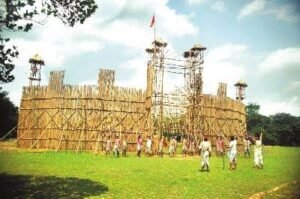
He is remembered for constructing the famous Bamboo Fort, widely known in Bengal as Titumeer’s Bamboo Fort, which became a symbol of resistance against colonial rule and exploitation.
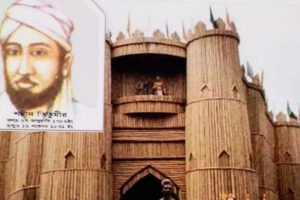
Bamboo Fort Make by Titumeer
The meeting hall at the North 24 Parganas Zilla Parishad had carried Titumeer’s name for decades. The district itself came into existence after the erstwhile undivided 24 Parganas district was divided into North and South 24 Parganas in 1986.
The removal of Titumeer’s portrait and the installation of Shyama Prasad Mukherjee’s image have added to the controversy surrounding the renaming.
Supporters of the move see it as a recognition of Mukherjee’s political legacy and his association with the idea of national unity. Critics, however, are likely to view the replacement as part of a broader contest over Bengal’s historical memory and the political interpretation of figures associated with the region’s past.
The development has once again brought Titumeer, the Bamboo Fort, Bengal’s anti-colonial resistance and Shyama Prasad Mukherjee’s legacy into the centre of a growing political debate.