



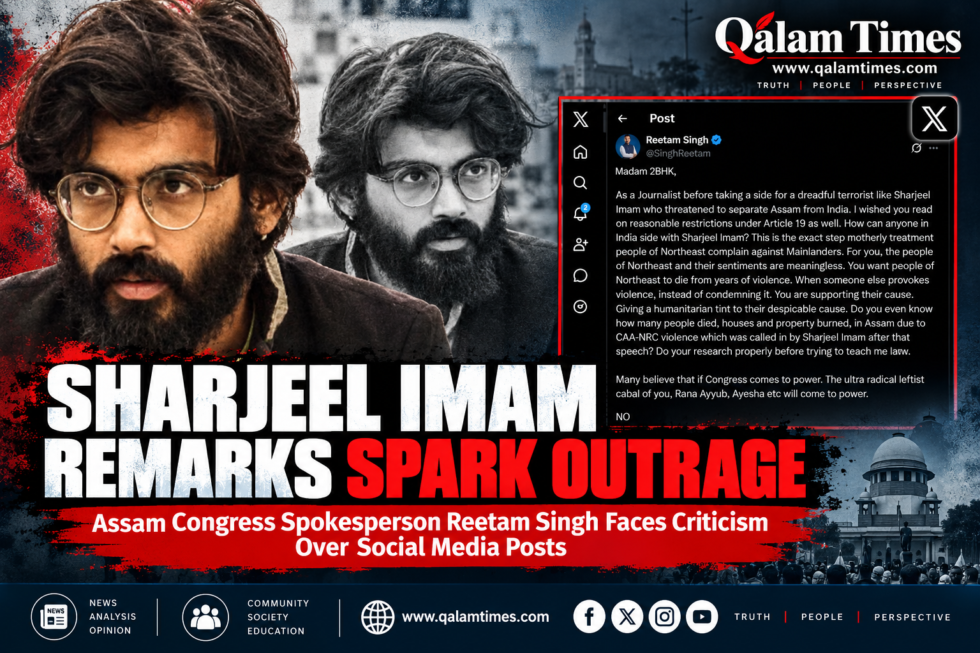
Congress Controversy intensifies after Assam spokesperson Reetam Singh’s remarks about Sharjeel Imam spark criticism over alleged police violence, constitutional rights and political accountability.
Qalam Times News Network
New Delhi, October 23, 2026
Congress Controversy Deepens as Assam Spokesperson’s Remarks Raise Questions About Constitutional Rights
Congress Controversy has intensified after Reetam Singh, a spokesperson for the Assam Pradesh Congress Committee and a lawyer, faced widespread criticism for his social media comments about Sharjeel Imam, the jailed Jawaharlal Nehru University (JNU) scholar and anti-Citizenship Amendment Act (CAA) activist. Singh reportedly described Imam as a “terrorist” and suggested that a terrorist could only be considered good when buried six feet underground. His remarks have triggered a wider debate over political intolerance, the treatment of undertrial prisoners, and the responsibility of public representatives to uphold constitutional principles.
The controversy erupted on social media following a debate over an opinion article published by ThePrint. Titled “Sharjeel Imam’s Islamist manifesto will be forgotten. The silence of liberals will not”, the article criticised Imam’s political positions and discussed a recent interview he gave to The Quint. The piece, written by the pseudonymous author Ibn Khaldun Bharati and published on October 17, was criticised by some commentators for its characterisation of the Muslim activist and the language used to describe his views.
Remarks on X Trigger Backlash
Responding to the discussion on X, Singh reportedly argued that if Imam were released, the Assam Police should give him the kind of “treatment they are infamous for”. He also labelled people who expressed sympathy for Imam’s views as “ISIS Sympathisers”. Singh described Imam’s statements as seditious and alleged that they threatened India’s unity and territorial integrity.
In another post, Singh wrote: “Sharjeel Imam is a Terrorist. A Terrorist, is only a good terrorist when he is 6 feet below the ground.” The statement was widely interpreted as suggesting that Imam should be killed and buried. The comments attracted particular attention because Imam has remained in custody as an undertrial prisoner for more than six years, according to the account provided in the original report.
Singh also compared expressions of sympathy for Imam with sympathy for fugitive gangster Dawood Ibrahim and Nathuram Godse, who assassinated Mahatma Gandhi. His posts further included hostile language directed at people who supported or empathised with Imam’s political positions.
The remarks have raised concerns about the distinction between criticising an individual’s ideology and advocating violence against that person. Critics argue that allegations of criminal conduct must be addressed through the judicial process rather than through calls for extrajudicial punishment.
Dispute Over Sharjeel Imam’s 2020 Speech

A central issue in the controversy is Imam’s speech during the anti-CAA protests in 2020. During the protests, Imam spoke about blocking the Siliguri Corridor, a strategically important stretch of land in northern West Bengal that connects mainland India with the northeastern states. The narrow passage is commonly known as the “Chicken’s Neck”.
Singh objected strongly to Imam’s remarks, arguing that they threatened the people of the Northeast and India’s territorial integrity. He also linked Imam’s speech to the violence surrounding the anti-CAA protests and argued that defending Imam’s position amounted to supporting the fragmentation of the country.
The speech and its interpretation have remained politically contentious. Supporters of strict legal action against Imam have pointed to the potential implications of his statements, while others have emphasised the importance of examining the precise words, context and applicable law through the judicial process.
The present dispute has consequently expanded beyond Imam’s political views to a broader question: can a person be condemned for controversial statements without undermining the legal protections available to an accused individual?
Journalist Rohini Singh criticised the Assam Congress spokesperson’s remarks, arguing that his response appeared to confuse opposition to Imam’s ideology with opposition to constitutional safeguards.
She maintained that people could strongly disagree with Imam’s political views without supporting violence against him or denying him the protection of the law.
“Disagreeing with his ideology does not require abandoning constitutional principles or endorsing extrajudicial violence,” she wrote on X.
She further stated: “The Constitution protects even those who reject it. That is precisely the point you seem to have missed.”
Her intervention highlighted a fundamental principle of constitutional democracy: the rights of an accused person do not depend on whether the public agrees with that person’s beliefs or political positions. Criminal allegations must be determined through lawful procedures, and punishment cannot legitimately be replaced by violence outside the judicial system.
Critics Question Singh’s Position Within the Congress
Activist and political commentator Prashant Pundir also criticised Singh’s conduct, reportedly describing him as sounding like a “cheap IT cell troll”. His comment added to the criticism surrounding the language used by the Assam Congress spokesperson.
Other commentators accused Singh of normalising Islamophobic rhetoric and questioned whether his statements reflected the official position of the Congress party. Their criticism focused not only on the remarks themselves but also on the implications of a political party representative appearing to endorse violent treatment of a person who has not been convicted in the relevant proceedings.
Saif Patel, an X user, directly questioned the party’s position and tagged Congress spokesperson Pawan Khera in his post.
“The Delhi riots happened a month after Sharjeel’s arrest. Sharjeel is in prison without trial for 6 years now, and your spokesperson is already labelling him a terrorist. How is it different from what BJP/RSS thinks about us?” he asked.
Patel argued that hostility towards Muslims who express assertive political or religious identities could extend across party boundaries. In another post, he criticised what he described as a lengthy statement wishing for Imam’s death in a police encounter.
He wrote: “A mile-long post wishing Sharjeel gets killed in a police encounter. The hatred for assertive Muslims cuts across political lines. They prefer Muslims who shed their identity and rally behind them blindly. The moment a Muslim asserts their identity, these people want them dead.”
These comments reflected a wider concern among critics that political affiliations do not always prevent the use of rhetoric that targets Muslims or other marginalised communities. They also raised questions about whether political parties consistently apply their stated commitments to civil liberties and constitutional rights.
Lyricist Hussain Haidry also joined the criticism of Singh’s posts. Expressing his anger over the language used, Haidry wrote: “May your average everyday Muslim blood-thirst drown you one day.”
His response added a cultural voice to the growing online debate, which had brought together journalists, activists, political commentators and social media users.
The criticism has largely centred on the perceived difference between holding Imam accountable for his statements and expressing a desire for his death. Those objecting to Singh’s comments argue that even serious allegations involving national security must be handled through legal procedures, not through public endorsements of police violence.
The dispute began with an argument over Imam’s political ideology, but it has developed into a larger discussion about the responsibilities of political representatives and the protection of civil liberties.
Imam’s statements, particularly those concerning the Siliguri Corridor, remain a subject of serious political and legal debate. However, critics of Singh’s comments maintain that the right to oppose an individual’s ideology does not provide justification for advocating an encounter killing or other punishment outside the legal system.
The distinction is especially significant in cases involving undertrial prisoners. An undertrial is a person whose criminal case has not yet reached a final judicial determination. Being accused of an offence is not the same as having been convicted of it, and the presumption of innocence remains a fundamental principle of criminal justice.
The controversy has also placed the Congress party under pressure to clarify whether Singh’s comments represent his personal views or reflect any official party position. No conclusion about the party’s institutional stance can be drawn from an individual spokesperson’s posts alone without an authoritative clarification.
Ultimately, the episode raises questions that extend beyond one political party or one activist: how should democratic societies respond to controversial political speech, what limits should govern public discourse, and how can political accountability be maintained without compromising the rule of law?
As criticism continues, the debate surrounding Reetam Singh’s statements and Sharjeel Imam’s legal position illustrates the tension between political condemnation and constitutional safeguards in India’s public life.