




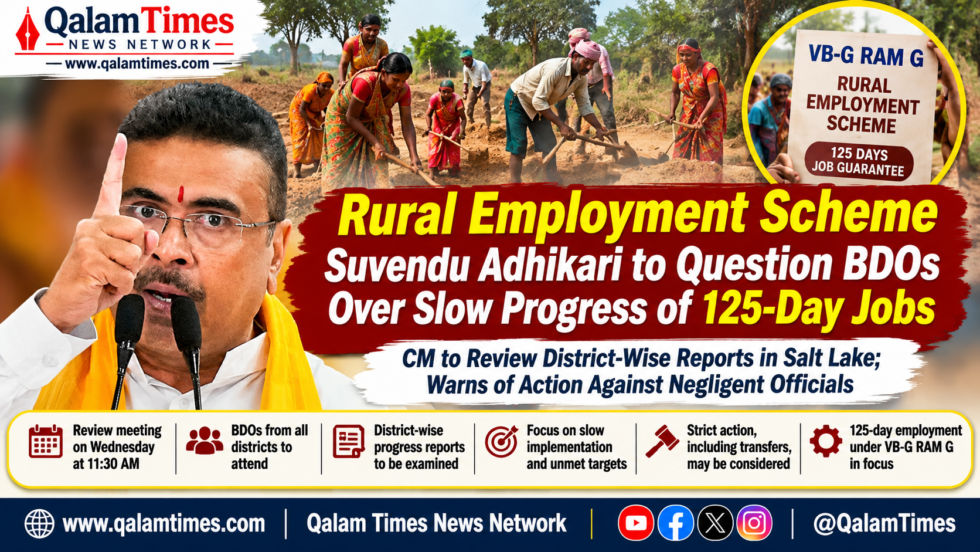
Rural Employment Scheme comes under scrutiny as West Bengal Chief Minister Suvendu Adhikari summons BDOs to Salt Lake to review the slow progress of the 125-day VB-G RAM G programme and demand district-wise explanations.
Chief Minister Calls Emergency Review Meeting in Salt Lake, Seeks District-Wise Progress Reports and Warns Officials Against Administrative Negligence
Qalam Times News Network
Kolkata, November 3, 2026
The Rural Employment Scheme has come under the direct scrutiny of West Bengal Chief Minister Suvendu Adhikari, who is preparing to hold a high-level review meeting with Block Development Officers (BDOs) from across the state to examine the slow progress of the newly introduced 125-day rural employment programme. The meeting, scheduled for Wednesday at 11:30 AM at the headquarters of the Panchayat and Rural Development Department in Salt Lake, is expected to focus on district-wise implementation, delays in project execution and the reasons behind the failure to achieve expected targets.

The Rural Employment Scheme, introduced under the Centre’s Viksit Bharat–Guarantee for Rozgar and Ajeevika Mission (Gramin), commonly known as VB-G RAM G, guarantees up to 125 days of wage employment in a financial year to every eligible rural household whose adult members volunteer to undertake unskilled manual work. Although the new framework became operational across the country on July 1, 2026, the West Bengal administration is reportedly concerned about the pace of its implementation at the grassroots level. The Chief Minister’s decision to interact directly with BDOs indicates that the government wants a clearer picture of the situation in individual districts and blocks.
Chief Minister to Examine District-Wise Performance
The review meeting will be attended by Panchayat and Rural Development Minister Dilip Ghosh and Minister of State for Panchayats Shantanu Pramanik. Officials from different districts are expected to present detailed accounts of the programme’s implementation and explain the challenges affecting its progress. The Chief Minister is likely to examine several important aspects of the scheme, including the number of projects initiated in each district, the pace of work at block level, employment opportunities generated for rural households and the reasons behind delays in meeting prescribed targets. Particular attention is expected to be given to blocks where implementation has reportedly remained slower than anticipated. BDOs may be asked to provide explanations for administrative bottlenecks, delays in project approvals, inadequate coordination and other difficulties affecting the delivery of employment opportunities. The meeting is significant because BDOs serve as an important administrative link between district authorities, Gram Panchayats and rural communities. Their performance directly influences how effectively government programmes reach intended beneficiaries.
The forthcoming review follows a meeting held last week with senior officials of the state administration, during which the Chief Minister reportedly expressed dissatisfaction over the progress of rural employment-related projects. According to administrative sources cited in reports, the Chief Minister made it clear that delays and negligence in implementing government programmes would not be tolerated. He reportedly instructed senior officials to monitor the performance of field-level administrators more closely and ensure that responsibilities were fulfilled within the prescribed timelines. The possibility of administrative action, including the transfer of BDOs found to be persistently neglecting their responsibilities, was also reportedly discussed.Wednesday’s meeting is therefore expected to assess whether the earlier instructions have produced any improvement and whether additional intervention is necessary to accelerate implementation.
The emphasis on direct interaction with block-level officials suggests that the administration wants to move beyond general departmental reports and obtain explanations from those responsible for execution on the ground.
From 100 Days to 125 Days: Understanding the New Rural Employment Framework
The transition from the earlier Mahatma Gandhi National Rural Employment Guarantee Act (MGNREGA) framework to the new VB-G RAM G Act, 2025, represents a significant change in India’s rural employment policy.
Under the new legislation, the statutory employment guarantee has increased from 100 to 125 days in a financial year for every eligible rural household. The framework came into force nationally on July 1, 2026, replacing the earlier MGNREGA legislation.
The programme is intended not only to provide wage employment but also to strengthen rural infrastructure, improve water security, support sustainable livelihoods and create productive community assets.
The scheme places particular emphasis on four broad categories of development activities: water-related works, core rural infrastructure, livelihood-related infrastructure and measures to address extreme weather events.
For rural households, the additional 25 days of guaranteed employment could provide an important opportunity to strengthen their annual income and reduce dependence on seasonal migration.
However, the actual benefits depend on effective implementation, availability of approved projects, timely wage payments and the ability of local authorities to respond to employment demands.
The success of any rural employment programme depends considerably on the effectiveness of its local administrative machinery. BDOs play an important role in coordinating development activities, monitoring project implementation and ensuring that instructions from district and state authorities reach the Panchayat level. If administrative coordination is weak, even a well-designed employment guarantee may fail to deliver its intended benefits. Delays in identifying projects, preparing technical estimates, arranging materials, completing documentation and maintaining attendance records can affect the pace of work. The administration must also ensure that eligible workers are properly registered, employment demands are recorded and wages are transferred without unnecessary delays. For this reason, the Chief Minister’s proposed interaction with BDOs carries significance beyond a routine departmental meeting. It provides an opportunity to identify the specific obstacles preventing rural households from receiving the benefits promised under the new employment framework.
The Larger Challenge: Employment Security for Rural Bengal
Rural employment remains closely connected with poverty reduction, household income, agricultural livelihoods and migration. In several parts of West Bengal, families depend on seasonal employment opportunities to supplement agricultural income. When local work is unavailable, many workers are compelled to travel to other states in search of employment. A functioning employment guarantee programme can help reduce this economic pressure by creating work opportunities closer to workers’ homes.The state government has also been pursuing initiatives to bring migrant workers back to Bengal and connect eligible households with the new 125-day employment programme.The Indian Express reported in August 2026 that the state government had identified more than 22 lakh migrant workers and initiated a special enrolment drive to bring eligible households under the VB-G RAM G framework. This initiative highlights the wider economic importance of the programme. Its success will depend not simply on the number of administrative meetings held, but on whether workers actually receive employment and wages when they need them.
Accountability Must Translate into Employment Opportunities
The forthcoming meeting in Salt Lake is expected to send a clear message to the administrative machinery that the implementation of rural employment programmes requires continuous monitoring and measurable results. However, administrative accountability should ultimately be assessed through outcomes experienced by ordinary people. For a rural labourer, the most important questions are straightforward: Is work available when demanded? Are employment opportunities being provided within the legal framework? Are wages being paid on time? Are projects creating useful assets for villages?
These are the questions that will determine whether the new employment guarantee fulfils its purpose. The state government must also ensure that administrative pressure does not lead to superficial reporting or the manipulation of performance figures. Transparent records, independent verification and accessible grievance-redressal mechanisms are essential for maintaining public confidence.
Chief Minister Suvendu Adhikari’s proposed review meeting with BDOs comes at an important stage in the implementation of the 125-day rural employment guarantee. The transition to the VB-G RAM G framework has created new expectations among rural households. An enhanced statutory employment guarantee can make a meaningful difference only when the administrative system functions efficiently and workers receive the opportunities to which they are entitled. The Wednesday meeting may help the government identify administrative shortcomings, demand explanations from responsible officials and establish clearer implementation priorities. Yet the ultimate measure of success will not be the intensity of discussions inside the Salt Lake conference room. It will be the availability of work in villages, timely payment of wages and improved economic security for rural families.
For millions of rural workers, 125 days of guaranteed employment must become a practical opportunity rather than remain merely a promise written into legislation. The real responsibility of the administration begins where government announcements meet the everyday lives of ordinary people.