



CHINA remains central to Bangladesh’s evolving foreign policy as Dhaka balances growing ties with Beijing alongside renewed engagement from the United States and India on technology, investment and regional security.
Washington steps up technology and defence engagement while New Delhi seeks to restore diplomatic momentum amid Dhaka’s expanding partnership with Beijing.
By Qalam Times News Network
Dhaka | August 7, 2026
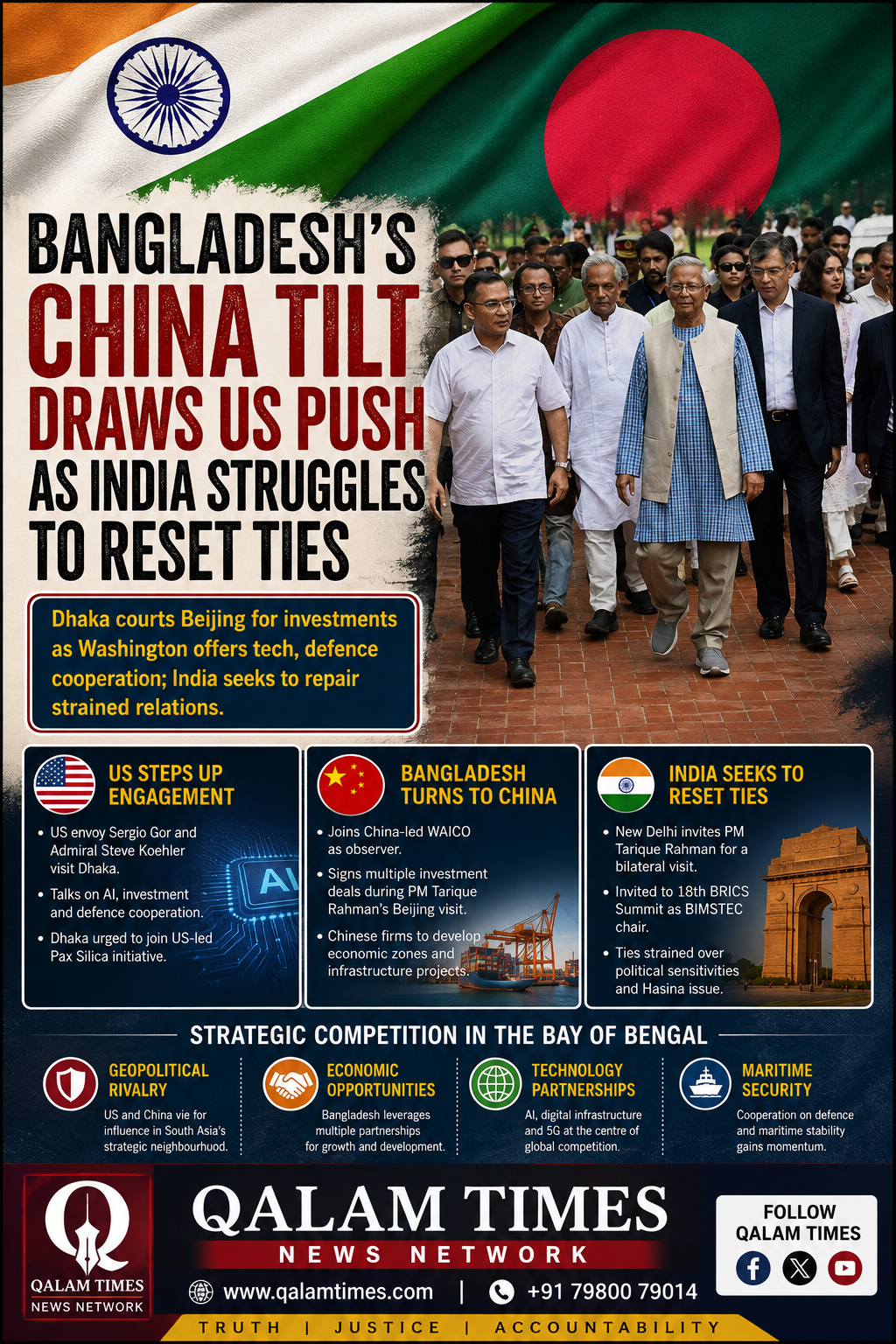
CHINA has become the focal point of Bangladesh’s evolving foreign policy as Dhaka carefully balances growing engagement with Beijing alongside renewed diplomatic outreach from the United States and India. A series of high-level visits, investment proposals, and technology initiatives over recent weeks has highlighted Bangladesh’s increasing importance in the strategic competition unfolding across the Bay of Bengal and the wider Indo-Pacific region.

Shortly after Prime Minister Tarique Rahman’s official visit to Beijing, the United States intensified its diplomatic engagement by sending senior representatives to Dhaka. US Special Envoy for South and Central Asia Ambassador Sergio Gor and Admiral Steve Koehler, Commander of the US Pacific Fleet, held discussions with Bangladesh’s leadership covering artificial intelligence, digital infrastructure, investment opportunities, maritime cooperation and defence collaboration. The visits reflected Washington’s broader effort to strengthen ties with Bangladesh at a time when Beijing is expanding its regional influence.
Technology, Investment and Regional Diplomacy Define Bangladesh’s New Foreign Policy
During discussions with Bangladeshi leaders, the United States encouraged Dhaka to participate in the American-backed Pax Silica initiative, a platform designed to promote trusted cooperation in artificial intelligence and digital technologies among partner nations. On the same day, however, Bangladesh announced that it would participate as an observer in the World Artificial Intelligence Cooperation Organization (WAICO), a China-supported international framework for AI cooperation. The nearly simultaneous announcements underscored Dhaka’s strategy of maintaining engagement with multiple global partners rather than aligning exclusively with any single geopolitical bloc.
Economic cooperation has emerged as another major pillar of Bangladesh’s relationship with China. During Prime Minister Rahman’s visit to Beijing, the two countries reached understandings on several infrastructure and industrial projects, including cooperation relating to the Teesta River, economic corridors and manufacturing investments. Bangladesh also advanced plans for Chinese participation in special economic zones and industrial parks, signalling its intention to attract additional foreign investment into strategic sectors.
Meanwhile, Washington has responded by expanding its own economic outreach. Bangladeshi officials have indicated that senior executives from numerous leading American companies are expected to visit the country to explore investment opportunities in manufacturing, technology and infrastructure, reflecting growing US interest in strengthening commercial ties with Dhaka.
India, at the same time, continues efforts to restore momentum in bilateral relations following months of diplomatic challenges. New Delhi has repeatedly invited Prime Minister Rahman to visit India and has also extended an invitation for him to attend the BRICS Summit in his capacity as the current Chair of BIMSTEC. While the invitation has generated considerable diplomatic attention, Bangladesh has yet to formally confirm its participation.
Regional analysts believe Bangladesh’s current approach reflects a broader strategy of strategic autonomy, allowing the country to deepen economic partnerships with China, maintain security and technological cooperation with the United States, and preserve historically significant ties with neighbouring India. As competition among major powers intensifies across South Asia and the Indo-Pacific, Dhaka’s diplomatic choices are expected to play an increasingly important role in shaping regional economic connectivity, maritime security and geopolitical stability.
With infrastructure investment, emerging technologies and regional trade becoming central to international competition, Bangladesh now finds itself at the centre of one of Asia’s most closely watched diplomatic balancing acts.