



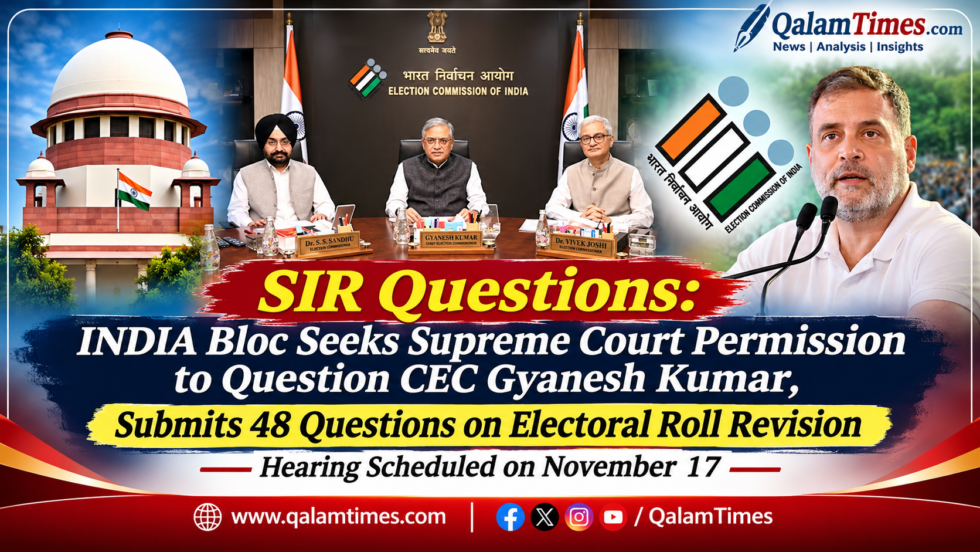
SIR Questions: INDIA bloc submits 48 questions to the Supreme Court seeking answers from CEC Gyanesh Kumar over voter list revision, Form 6 changes and ECINET.
Qalam Times News Network
New Delhi, November 16, 2026
SIR Questions have become the centre of a fresh legal confrontation between the Opposition INDIA bloc and the Election Commission of India (ECI), with opposition leaders approaching the Supreme Court seeking permission to question the country’s top election officials over alleged irregularities in the Special Intensive Revision (SIR) of electoral rolls.
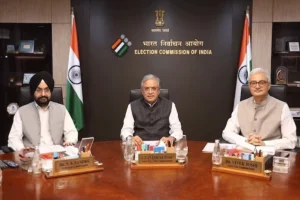
The INDIA bloc has submitted a detailed set of 48 questions before the Supreme Court, seeking explanations from Chief Election Commissioner (CEC) Gyanesh Kumar, Election Commissioners Sukhbir Singh Sandhu and Vivek Joshi, and the Commission’s Director General of Information Technology. The questions seek clarity on how important decisions concerning the voter-list revision were taken, who authorised them and whether all members of the constitutional body approved the decisions collectively.
The application was filed on Monday, November 16, ahead of the Supreme Court hearing scheduled for Tuesday, November 17. The Opposition maintains that the Election Commission’s earlier response has not adequately addressed several concerns raised about the SIR exercise.
Opposition Seeks Direct Answers on SIR Decisions, Form 6 and Election Commission’s Digital Systems
In its latest application, the INDIA bloc has argued that the Election Commission has responded to allegations of irregularities with counter-claims rather than providing sufficient documentary evidence to establish how the disputed decisions were made. The petitioners contend that questioning the senior officials is necessary to obtain detailed, verifiable information supported by official records. According to their submission, the relevant documents and technical information are primarily in the custody of the Election Commission, leaving the petitioners with no practical way to establish the facts without answers from the authorities concerned.
The 48 interrogatories are intended to examine the Commission’s decision-making procedures, the introduction of changes to voter registration processes and the management of digital platforms used in preparing and updating electoral rolls.
Who Approved the Nationwide SIR Exercise?
One of the central issues raised by the Opposition concerns the decision to conduct a nationwide Special Intensive Revision of electoral rolls. The petitioners want the Election Commission to disclose when the decision was taken, which official file recorded the approval, and whether the decision was made during a formal meeting, through circulation of documents or by electronic communication. They have also sought clarification on whether the three members of the Commission agreed unanimously or whether any differences of opinion emerged during the decision-making process. In particular, the questions seek details of any objections, dissenting opinions or reservations recorded by Election Commissioners Sukhbir Singh Sandhu and Vivek Joshi concerning the SIR exercise, ECINET, Form 6 and decisions relating to legal appeals. The Opposition wants copies and details of the relevant official records to establish how the decisions were authorised and whether the required procedures were followed.
Form 6 Changes Under Legal Scrutiny
Another important part of the application concerns Form 6, the application used by individuals seeking inclusion of their names in electoral rolls. The INDIA bloc has questioned the introduction of an additional declaration in the online version of the form. It wants the Commission to explain when the declaration was introduced, which officer or department authorised the change and whether the decision received formal approval from the Election Commission.
The petitioners have also sought information about applications that were rejected, kept pending or left unprocessed because applicants allegedly failed to submit the additional declaration or provide the required mapping details.
The Opposition has specifically sought clarification about an October 21 decision of the Electoral Registration Division and whether that decision was placed before the full Commission for consideration and approval.
Questions Over ECINET, ERONET and Voter Database Management

The 48 questions also examine the functioning of ECINET and ERONET, the digital platforms associated with electoral roll management. The petitioners want to know which authority is responsible for operating ECINET and which decisions approved its design, technical structure and implementation.
They have also raised concerns about whether changes to voter records could be made without specific orders from Electoral Registration Officers (EROs). The questions cover possible bulk modifications, system-level changes, removal of duplicate entries and data migration processes. Another important issue concerns the restoration of deleted or omitted voter entries. The Opposition wants to know whether Electoral Registration Officers have been provided with the necessary facilities to restore names removed during the SIR process.
The petitioners have further demanded information about audit trails maintained since June 24, 2025, including whether every alteration to electoral records is documented with the relevant user account, date, time and authorising order. They have also sought details of access granted to officials, private contractors and other entities that may have the ability to modify voter information.
Opposition Raises Questions About Differences Among Election Commissioners
The INDIA bloc has also sought information about the internal functioning of the Election Commission and whether disagreements emerged among its three members over important decisions.
The petitioners want the two Election Commissioners to disclose how many times they formally recorded objections or reservations concerning the SIR exercise, Form 6, ECINET or the filing of appeals.
They have also asked whether any decisions were approved through electronic communications, including official or personal emails, WhatsApp messages and the government’s e-Office system.
The application seeks details of such approvals and asks whether the corresponding communications, digital records and metadata have been preserved.
These questions are intended to establish whether the Commission’s major decisions were taken through a documented collective process or whether differences existed among its members.
West Bengal Voter Appeals and Goa Electoral Records Also Questioned
The Opposition’s application also focuses on specific developments in Goa and West Bengal.
In the case of Goa, the petitioners have sought clarification regarding 97 electors mentioned in the Election Commission’s counter-affidavit. They want to know how many of the 88 individuals who reportedly submitted Form 6 applications had their original entries restored and how many were enrolled as new voters.
In West Bengal, the INDIA bloc has raised questions about appeals filed by or on behalf of the Election Commission against orders passed by judicial officers allowing the inclusion of voters in electoral rolls.
The petitioners want to know how many such appeals were filed, which officials authorised them, what criteria were used to select the cases and what their present status is.
They have also sought state-wise information about voters excluded between the pre-SIR, draft and final electoral rolls, along with reasons for their exclusion, including death, migration, absence, duplication and alleged ineligibility.
Election Commission Maintains That Major SIR Decisions Were Unanimous
The Election Commission has previously defended its decision-making process before the Supreme Court.
In its counter-affidavit dated October 26, the Commission maintained that three major orders relating to the SIR, issued on June 24, 2025, October 27, 2025, and May 14, 2026, had received unanimous approval from all three Election Commissioners.
The Commission also maintained that Form 6 itself had not been amended, describing the additional declaration as a separate document rather than a modification to the prescribed form.
The INDIA bloc, however, wants the Commission to provide the underlying official records and further details supporting these explanations.
Supreme Court Hearing Scheduled for November 17
The latest application forms part of a wider legal challenge by opposition parties questioning the functioning of the Election Commission and various aspects of the SIR exercise. At the previous hearing on October 27, a three-judge Bench headed by Chief Justice of India Surya Kant, along with Justices Joymalya Bagchi and V. Mohana, granted the petitioners ten days to respond to the Election Commission’s counter-affidavit. The court subsequently scheduled the matter for November 17, following the Diwali vacation. The latest submission of 48 questions has added another dimension to the proceedings. The Supreme Court will now have to consider the Opposition’s request and the issues raised in the pending petitions. At the heart of the dispute are questions concerning transparency, institutional decision-making, access to voter information and the procedures followed during electoral roll revision.
Whether the court permits the requested questioning and what further disclosures, if any, it directs from the Election Commission will be important developments in the ongoing legal proceedings.