



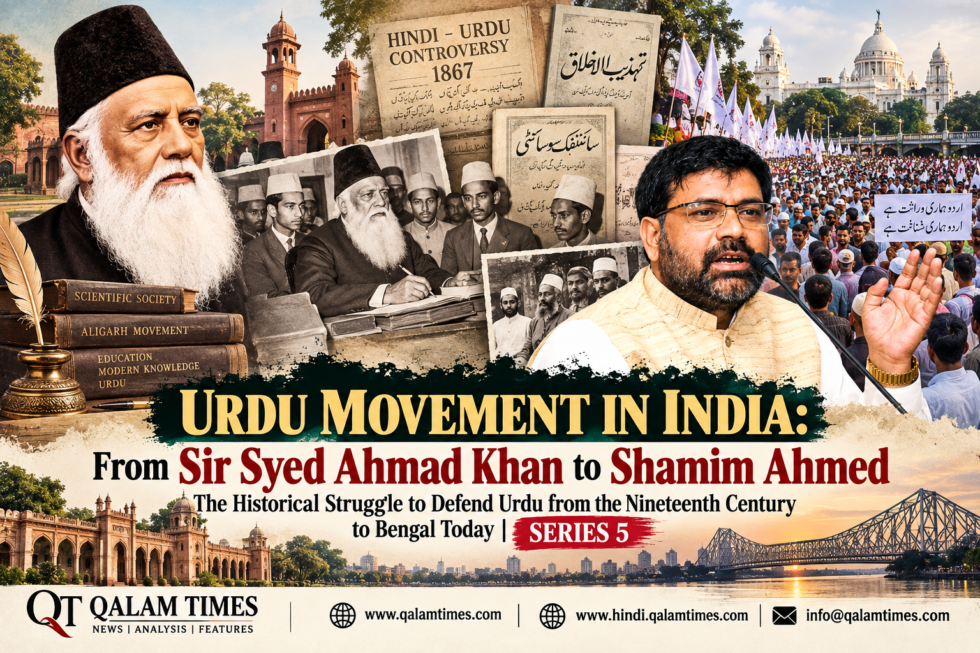
Explore Sir Syed Ahmad Khan’s role in the nineteenth-century Urdu movement, the Hindi–Urdu controversy of 1867, and its historical connection with Shamim Ahmed’s continuing Urdu movement in West Bengal.
From the Hindi–Urdu Controversy of 1867 to Shamim Ahmed’s Urdu Movement in Bengal: A Historical Journey of Language, Education and Identity
Qalam Times News Network
Kolkata | October 18, 2026
The Urdu Movement in India has developed through different historical periods, shaped by changing educational needs, linguistic debates, cultural aspirations and demands for public recognition. From nineteenth-century intellectual reformers to contemporary activists working at the regional level, generations of individuals have sought to preserve Urdu’s place in India’s diverse linguistic and cultural landscape.
Among the important figures in this history is Sir Syed Ahmad Khan (1817–1898), whose educational and intellectual initiatives helped shape modern debates about Urdu, scientific learning and the future of Indian society. His contribution cannot be understood solely through the question of language. It was also connected with educational reform, the translation of modern knowledge and the challenges faced by Indian society during British colonial rule. The Hindi–Urdu controversy that emerged prominently in 1867 marked a significant turning point in Sir Syed’s engagement with the language question. It brought into sharper focus the relationship between language, education, public administration and cultural identity.
More than a century later, the Urdu movement in West Bengal, associated in its contemporary phase with Shamim Ahmed, has addressed questions of linguistic recognition, public participation and the place of Urdu in the state’s social and administrative life.
Although Sir Syed Ahmad Khan and Shamim Ahmed belonged to different historical periods and worked under very different circumstances, their respective experiences can be examined within a broader history of efforts to protect and strengthen Urdu. The connection is historical and thematic, not a claim of direct organisational continuity.
Sir Syed Ahmad Khan: Education, Reform and the Urdu Language
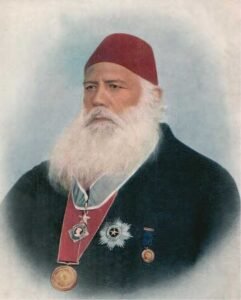
Sir Syed Ahmad Khan emerged as a prominent educational reformer during the nineteenth century, a period when Indian society was experiencing profound political and institutional changes under British rule. He believed that access to modern education and scientific knowledge was essential for social advancement. His reform programme encouraged engagement with contemporary learning while also drawing upon the intellectual and cultural traditions of the subcontinent. Language played an important role in this programme. Sir Syed and his associates recognised the value of communicating modern knowledge through languages accessible to Indian readers. Urdu consequently became an important medium for disseminating scientific and intellectual material.
The Scientific Society, established at Ghazipur in 1864 and subsequently associated with Aligarh, undertook the translation and publication of works on modern subjects. Through such initiatives, Sir Syed helped strengthen Urdu’s capacity to communicate knowledge beyond the traditional boundaries of literary and religious writing. His efforts demonstrated that a language’s development depends not only on poetry and literature but also on its ability to participate in education, scientific discussion, journalism and intellectual exchange.
This educational dimension is essential to understanding the nineteenth-century Urdu movement. The question was not simply whether Urdu should be preserved as a cultural inheritance; it was also whether the language could continue to serve as an effective medium of learning and public communication in a changing society.
The Hindi–Urdu Controversy of 1867: A Turning Point
The year 1867 occupies an important place in the history of the Hindi–Urdu controversy. In parts of northern India, demands emerged for Hindi written in the Devanagari script to receive official recognition alongside, or in place of, Urdu written in the Perso-Arabic script. The dispute involved competing linguistic preferences, administrative practices and wider questions about the cultural significance of language. Sir Syed Ahmad Khan came to regard the controversy as a serious challenge to the future position of Urdu. It contributed to his growing concern about the relationship between language, education and the social prospects of the communities for whom Urdu was an important language of communication. The controversy also illustrated how linguistic questions could become entangled with wider social and political divisions. Differences that involved script and official usage increasingly acquired cultural significance.
However, the history should not be reduced to a simple opposition between two communities. Hindi and Urdu both developed within the multilingual environment of the Indian subcontinent, and their histories include extensive cultural interaction. The political circumstances of the nineteenth century contributed to the sharpening of divisions that were neither inevitable nor uniform across every region. For Sir Syed, the controversy reinforced the importance of educational organisation, intellectual debate and the development of institutions capable of responding to the changing circumstances of Indian society. It also established an enduring question for later generations of Urdu advocates: how could a language maintain a meaningful place in education and public life when administrative and political priorities were changing?
The Aligarh Movement and the Expansion of Modern Education
Sir Syed’s work for Urdu was closely connected with his wider educational reform programme. He established the Muhammadan Anglo-Oriental School at Aligarh in 1875, which developed into the Muhammadan Anglo-Oriental College in 1877. The institution later became Aligarh Muslim University in 1920.
The Aligarh Movement promoted modern education, intellectual debate and engagement with contemporary knowledge. Its influence extended beyond the classroom, encouraging discussions about social reform, journalism and the future of education in India.
Urdu played an important role in the intellectual environment surrounding Sir Syed’s activities. Publications associated with his reform programme helped circulate new ideas and made educational questions part of a wider public discussion.
Nevertheless, it is important to distinguish between the Aligarh educational movement and the broader Urdu movement. They overlapped in significant ways, but they were not identical. Sir Syed’s priorities evolved over time, and his views on education, language and social reform were complex. His historical significance lies partly in demonstrating that the future of a language is closely connected with the institutions that support it. Literary achievement alone cannot guarantee a language’s continued presence in education, public administration or intellectual life.
This lesson would remain relevant to Urdu advocates in later periods, including those working in regions far removed from nineteenth-century Aligarh.
From Nineteenth-Century Debate to Regional Urdu Movements
The Urdu movement in India did not develop as a single, centrally directed campaign. Its history consists of numerous initiatives undertaken by educators, writers, journalists, political representatives and community activists in different regions.
In some periods, the principal concern was the development of Urdu literature and modern knowledge. In others, campaigners concentrated on educational opportunities, official-language recognition, public administration or the preservation of regional Urdu histories. The circumstances differed from state to state. The challenges facing Urdu in northern India during the nineteenth century were not identical to those encountered in post-independence Bihar or West Bengal.
Yet a recurring concern connected these experiences: the need to ensure that Urdu remained a living language of education, communication, cultural expression and public participation.
This wider perspective allows the contribution of Sir Syed Ahmad Khan to be examined alongside later regional movements without suggesting that every subsequent campaign emerged directly from his leadership.
It also helps explain why the history of Urdu cannot be confined to a few prominent institutions or literary centres. Regional histories, local organisations and individual campaigners are equally important to a fuller understanding of the language’s development.
West Bengal: A Distinct Chapter in the History of Urdu
West Bengal has its own long and significant association with Urdu. Kolkata, in particular, has been a centre of Urdu journalism, literature and cultural activity. The language’s regional history includes writers, teachers, publications, educational institutions and organisations that contributed to its presence in Bengal. After independence, questions concerning Urdu’s educational opportunities and official recognition continued to concern Urdu-speaking communities in the state.
The development of the Urdu movement in West Bengal must be understood through these local circumstances. Its history cannot simply be treated as an extension of the experience of Aligarh, Bihar or northern India. The state’s linguistic environment, the position of Bengali in public life, the distribution of Urdu-speaking populations and the evolution of state language policies all shaped the particular demands raised by Urdu advocates. In this context, the efforts of Professor Syed Haider Hasan Kazmi and the contemporary movement associated with Shamim Ahmed form important subjects for regional historical study. Their contributions belong to different phases and should be documented in their own contexts.
The larger historical lesson is that Urdu’s place in India has been shaped not only by national debates but also by regional campaigns that responded to local educational, administrative and cultural concerns.
Shamim Ahmed and the Contemporary Urdu Movement in Bengal
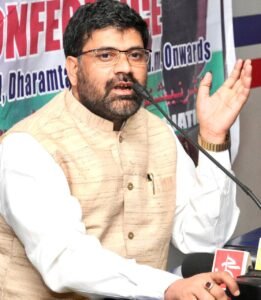
A prominent contemporary chapter of the Urdu movement in West Bengal is associated with Shamim Ahmed, whose campaign gained momentum from the mid-2000s.
As documented in Qalam Times’ earlier coverage, his work sought to bring the Urdu question beyond literary gatherings and established institutional circles and into wider public discussion. The movement emphasised linguistic rights, public awareness, cultural dignity and the importance of democratic participation.
Public programmes, awareness initiatives and peaceful protests formed part of this campaign. The 36-hour sit-in held in Kolkata in June 2008 was one of the significant events associated with the movement. The slogan “No Urdu, No Vote” later became part of its political messaging. The campaign also highlighted the importance of presenting Urdu as an integral part of India’s shared cultural history rather than as the exclusive possession of any one religious community.
A major legislative development came with the West Bengal Official Language (Amendment) Act, 2012, which expanded the framework for the official use of Urdu and certain other languages in designated areas. The provisions and their practical implementation should be assessed through the text of the legislation and relevant government records.
The movement’s significance therefore extends beyond a single protest or legislative milestone. It raises questions about how linguistic rights are communicated to the public, how regional histories are preserved and how official recognition can be translated into meaningful institutional practice.
For Qalam Times, documenting this chapter also helps bring greater attention to the regional history of Urdu in Bengal and to the people who worked to keep the language’s public concerns visible.
Sir Syed Ahmad Khan and Shamim Ahmed: A Historical and Thematic Connection
At first glance, Sir Syed Ahmad Khan and Shamim Ahmed appear to belong to very different worlds. Sir Syed worked in nineteenth-century British India, amid debates about modern education, colonial institutions and the changing position of languages in public administration. Shamim Ahmed’s campaign developed in independent India, within the constitutional and political framework of a modern state and in response to the specific conditions of West Bengal. Their methods, institutions and immediate objectives should not be treated as interchangeable. Nevertheless, examining their work together reveals several themes that recur throughout the history of Urdu.
- Language and dignity
For Sir Syed, Urdu formed part of an intellectual and cultural environment that could support education and public debate. In the Bengal movement, the question of Urdu has likewise been associated with cultural dignity and the right of communities to maintain their linguistic heritage.
- Education and the future of Urdu
Sir Syed’s educational initiatives highlighted the importance of modern knowledge and institutions. Contemporary Urdu advocacy in Bengal has also drawn attention to the language’s educational and institutional presence. The historical circumstances differ, but both experiences demonstrate that a language’s future depends partly on the opportunities available to younger generations.
- Institutions and public participation
Sir Syed worked through educational institutions, publications and intellectual initiatives. Shamim Ahmed’s contemporary campaign, as described in Qalam Times’ reporting, placed considerable emphasis on public mobilisation, awareness programmes and peaceful demonstrations.
These were different approaches to different circumstances. Their comparison illustrates the range of methods through which Urdu advocates have sought to influence public life.
- Historical memory
Sir Syed’s legacy is widely associated with educational reform and the development of modern intellectual institutions. The Bengal movement presents another historical record that requires careful documentation, including the work of regional activists and the events through which Urdu’s position was debated.
The task of preserving these histories is itself important. Without reliable records, the contributions of local campaigners can be overlooked in accounts that focus primarily on nationally recognised personalities.
The connection between Sir Syed Ahmad Khan and Shamim Ahmed is therefore one of historical themes, not direct organisational succession. There is no basis here to claim that Shamim Ahmed’s movement was organisationally descended from Sir Syed’s initiatives. Rather, both can be studied as part of the wider, diverse history of efforts to strengthen Urdu’s place in Indian society.
The history of the Urdu movement is often narrated through prominent figures, major institutions and well-known controversies. These are essential elements of the story, but they do not represent its entirety.
A more complete account must also examine regional campaigns, local educators, journalists, language organisations, public demonstrations and the implementation of language policies.
The experiences of Bihar and West Bengal demonstrate why this approach matters. The Bihar movement associated with Ghulam Sarwar brought together journalism, political advocacy and demands for official recognition. The Bengal movement associated with Shamim Ahmed developed within a different regional context, with public mobilisation and the demand for linguistic recognition playing prominent roles.
Sir Syed Ahmad Khan’s nineteenth-century initiatives provide an earlier point of reference for examining the relationship between Urdu, education and changing public institutions.
These histories should not be collapsed into one continuous campaign. Each had its own leadership, historical circumstances and limitations. Their comparison is valuable precisely because it shows the different ways in which Urdu advocates responded to the challenges of their times.
For researchers and journalists, this also creates an important responsibility: historical claims should be supported by reliable sources, dates and documentary evidence, while differences between regions and periods should remain visible.
The story of the Urdu Movement in India extends from nineteenth-century debates over language and education to contemporary campaigns for linguistic recognition and public participation.
Sir Syed Ahmad Khan’s contribution belongs to an important formative period in this history. His educational initiatives, promotion of modern knowledge and response to the Hindi–Urdu controversy helped make language a significant part of wider discussions about education and social change.
More than a century later, the Urdu movement associated with Shamim Ahmed in West Bengal reflects a different set of circumstances, shaped by the constitutional framework of independent India and the specific linguistic environment of the state.
The two experiences cannot be equated, nor should a direct organisational connection be assumed. Yet studying them together helps reveal a broader historical concern: how can Urdu retain its place in education, cultural life and public institutions while India continues to negotiate its linguistic diversity?
For Qalam Times, this historical journey is not merely an account of past controversies. It is also an effort to document the people, institutions and regional movements that have shaped Urdu’s place in India.
From Sir Syed Ahmad Khan’s educational and intellectual initiatives to Shamim Ahmed’s contemporary campaign in Bengal, the story remains one of changing circumstances, diverse methods and an enduring debate over language, learning and cultural recognition.
Series 5 of the Qalam Times Urdu Movement series thus returns to the nineteenth century to examine an important formative chapter in the history of Urdu—and to understand how its questions continue to resonate in regional movements today.