



TMC Symbol dispute between the Mamata Banerjee and Ritabrata Banerjee factions reaches a crucial stage as the Election Commission weighs organisational control and the party’s legal identity ahead of the West Bengal by-elections.
Qalam Times News Network – Editorial Desk
September 13, 2026
TMC Symbol has now become much more than a question of an election emblem. The bitter dispute between the camps led by Mamata Banerjee and Ritabrata Banerjee has developed into a larger test of how a political organisation defines itself, who has the legitimate authority to speak for it, and, most importantly, whether internal democracy can survive when a party faces a serious leadership crisis.
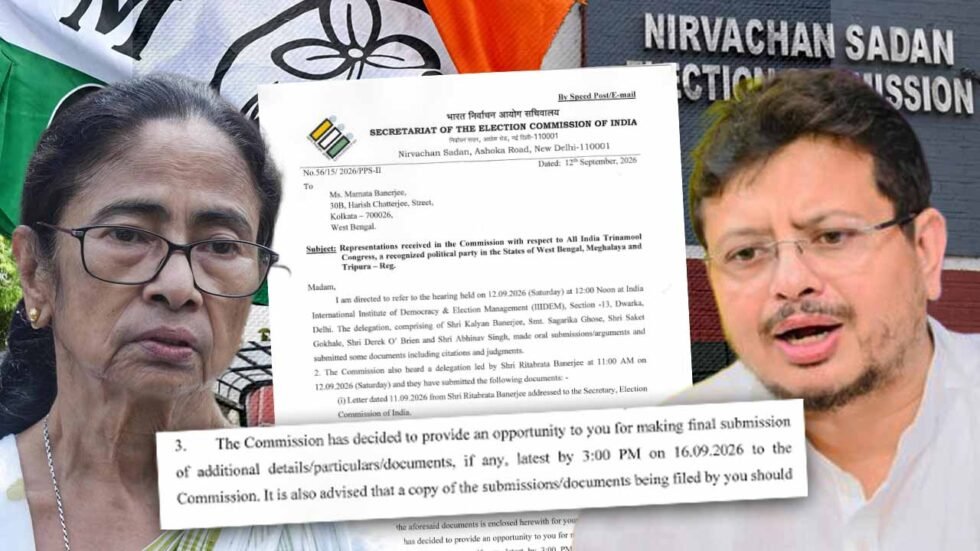
The TMC Symbol dispute has reached a decisive stage before the Election Commission. After hearing representatives of both factions in New Delhi on Saturday, the Commission has given Mamata Banerjee until September 16 to submit any further documents or arguments she wishes to place on record. If the Commission considers it necessary, another hearing could be held on September 17, after which a decision on the party’s organisational control and election symbol may follow.
The temptation in a dispute of this nature is to reduce everything to one familiar question: Who gets the grass-flower symbol? That is important, particularly because two Assembly by-elections are approaching in Nandigram and Rejinagar. But the deeper question is far more consequential: what constitutes the legitimate identity of a political party?
The Election Commission cannot decide such a matter merely on the basis of who founded the party, who currently commands greater public recognition, or who makes the louder political claim. Its decision has to rest on the evidence placed before it, the party’s constitution, organisational records, recognised procedures and the applicable legal framework.
That is precisely why the present proceedings deserve public scrutiny.
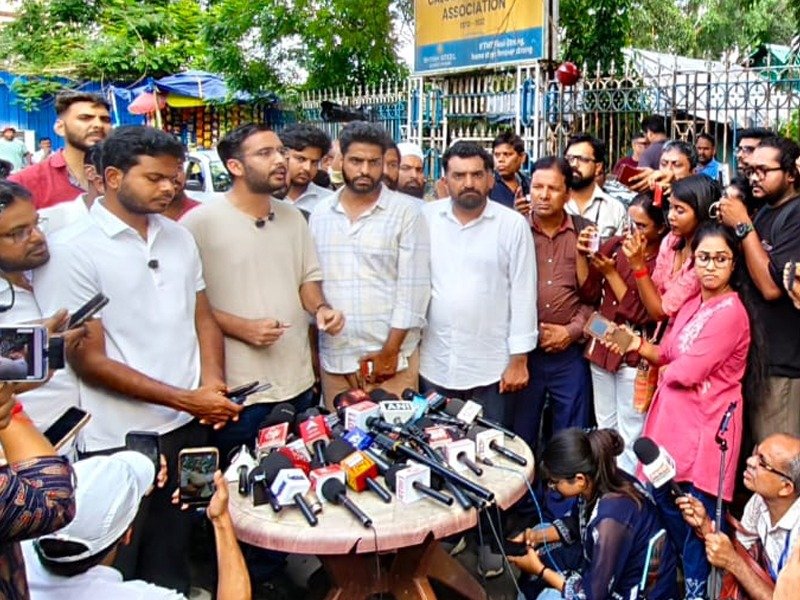
The Ritabrata-led faction has argued that the party cannot function as the personal property of an individual or family. Its representatives have reportedly submitted documents concerning the functioning of the party’s working committee, minutes of meetings and other organisational records. Their central argument appears to be that numerical and organisational support, rather than personality or legacy, should determine which faction represents the genuine party.
The Kalighat camp, on the other hand, has a fundamentally different argument. Its representatives maintain that Mamata Banerjee created the party, designed the distinctive grass-flower emblem and built the political organisation around her leadership. They argue that candidates subsequently contested elections under that identity and won on its strength. From this perspective, challenging Mamata’s authority is not simply an internal disagreement but an attempt to appropriate an organisation and symbol created through her political movement.
Both arguments carry political weight. But political weight and legal entitlement are not necessarily the same thing.
TMC SYMBOL : The Commission Must Follow Evidence, Not Emotion
This is where the Election Commission’s responsibility becomes particularly important. The Commission should neither be influenced by Mamata Banerjee’s enormous political legacy nor by the claims of those challenging her leadership. It must examine the documentary record impartially and determine which side satisfies the relevant legal and organisational tests. The dispute should therefore not be turned into a referendum on personalities.
Mamata Banerjee’s contribution to the creation and growth of Trinamool Congress cannot simply be erased from political history. At the same time, the existence of a founder does not automatically answer every question about the present-day organisational structure of a political party. If a rival faction genuinely possesses evidence demonstrating majority support within the recognised organisational framework, that evidence deserves serious consideration. Conversely, if the opposing faction can establish that the organisation’s constitution, elected bodies and established procedures clearly recognise its authority, that evidence must carry corresponding weight. The principle should be simple: documents before slogans, rules before personalities and evidence before political pressure. There is also a larger democratic lesson here. Indian political parties frequently revolve around powerful personalities. Founders become synonymous with organisations, and party structures can sometimes become secondary to individual leadership. Such a system may be politically effective, but it creates enormous difficulties when a serious succession dispute emerges.

The present TMC crisis illustrates that problem with unusual clarity. Ritabrata Banerjee’s criticism that a democratic party cannot operate solely according to the wishes of one leader reflects a legitimate democratic concern. Yet the counterargument from the Mamata camp—that the party’s very existence and electoral identity are inseparable from its founder—also reflects an important political reality. The Commission’s job is not to settle that philosophical argument. Its job is to determine the legal and organisational facts. The approaching by-elections add urgency. Voters in Nandigram and Rejinagar need clarity about which candidates are officially entitled to contest under the recognised party identity and symbol. Candidates, election officials and voters cannot be left in prolonged uncertainty.
At the same time, urgency must not become an excuse for sacrificing due process. The September 16 deadline and the possibility of a September 17 hearing suggest that the Commission is attempting to give both sides an opportunity to complete their submissions before moving towards a decision. That is the correct approach. Whatever decision ultimately emerges, the Commission must explain it clearly enough to withstand public and judicial scrutiny. A politically explosive decision requires an especially transparent reasoning process. For the two factions, the message should also be clear. A political party is not merely an office, a flag or an election symbol. It is an organisation built through workers, voters, elected representatives, institutions and years of political activity.
If the dispute is ultimately decided by organisational evidence, both sides will have to accept the result if they genuinely believe in democratic institutions. If either faction instead treats an unfavourable decision as automatically illegitimate, the dispute will not end with the Commission’s order. The TMC Symbol controversy, therefore, should be viewed as a test not only for one party but for India’s broader political culture. The grass-flower emblem may appear on a ballot paper, but the question behind it is much larger: can a political organisation remain democratic when its founder’s personality has become inseparable from its identity?
The answer should not come from political rhetoric in Kolkata or Delhi. It should come from the party’s constitution, its organisational record, the evidence submitted by both sides and the law. That is the standard the Election Commission must uphold. And whatever the final verdict may be, democracy will be better served if the decision is based on rules rather than relationships, evidence rather than emotion, and institutions rather than individuals.