



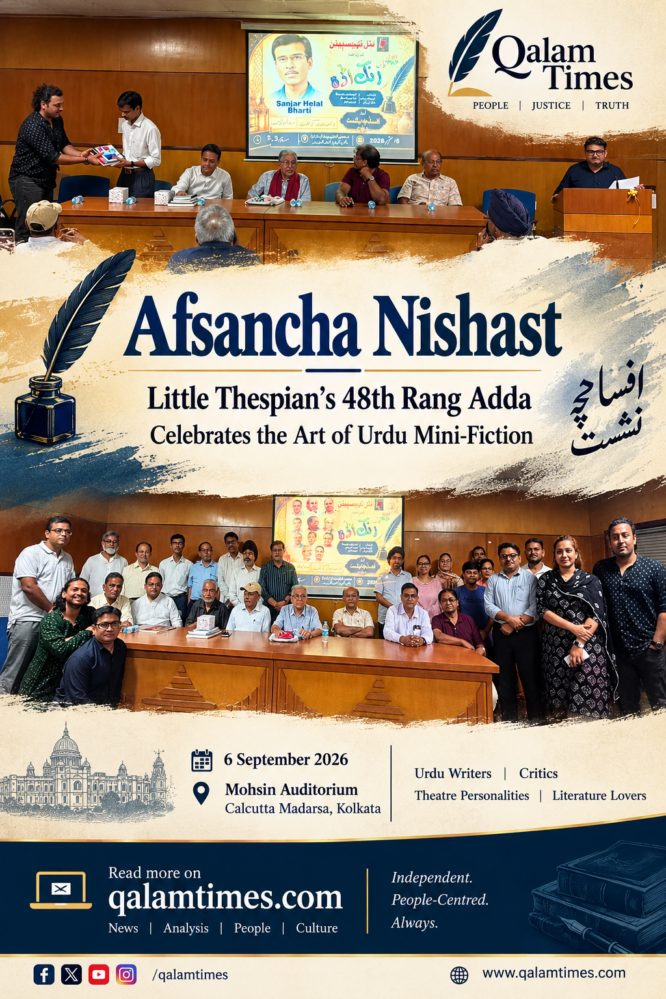
Afsancha Nishast, Little Thespian’s 48th Rang Adda in Kolkata, celebrated Urdu mini-fiction with prominent writers, critics and theatre personalities.
Qalam Times News Network
Kolkata | September 9, 2026
Afsancha Nishast, the 48th edition of Little Thespian’s celebrated Rang Adda series, brought the delicate and powerful tradition of Urdu mini-fiction to the centre of Kolkata’s literary and theatrical landscape. The special literary gathering was held on September 6, 2026, at the Mohsin Auditorium of the Anglo-Persian Department, Calcutta Madarsa, drawing writers, critics, theatre personalities and lovers of Urdu literature.
Afsancha Nishast Creates a Dedicated Platform for Urdu Mini-Fiction
Afsancha Nishast emerged as a significant extension of Little Thespian’s continuing exploration of short-form literature. Kolkata’s well-known Hindi theatre group had previously devoted its 46th and 47th Rang Adda programmes to Hindi Laghu Katha, presenting them as “Laghu Katha Sangoshthi – 1” and “Laghu Katha Sangoshthi – 2.” Taking that literary journey forward, the organisation turned its attention to Urdu’s equally fascinating tradition of the Afsancha.
An Afsancha may occupy only a small space on the page, but its impact can extend far beyond its length. Through a carefully compressed narrative, a writer can capture an emotion, social reality, human conflict or moment of revelation in just a few lines. It was this distinctive quality of the form that inspired Little Thespian to bring Urdu mini-fiction before a wider audience.
With Afsancha Nishast, Little Thespian presented what the organisers described as a pioneering initiative in Bengal: an entire literary programme devoted exclusively to Afsanchas. The event offered the audience an opportunity to experience the genre not merely as a form of short writing but as a literary expression capable of conveying complex ideas and emotions with remarkable economy.
The programme commenced at 3 pm on September 6, 2026, at the Mohsin Auditorium, Anglo-Persian Department, Calcutta Madarsa.
The literary session featured presentations by a distinguished group of Urdu writers associated with the genre. Ahmad Kamal Hashami, Jawed Nehal Hashami, Sanjar Helal Bharti, Md. Ali Siddiqui, Abdus Sattar Fikr, Mubarak Ali Mubarki, Asgar Shamim and Shamim Jhangiri presented their respective Afsanchas before the audience.
The pieces reflected the diversity and expressive potential of mini-fiction, demonstrating how brevity can coexist with literary depth. The presentations also provided the audience with an opportunity to engage with contemporary Urdu writing through a form that depends heavily on precision, suggestion and the effective use of language.
The 48th Rang Adda was chaired by Uma Jhunjhunwala, President of Little Thespian and a renowned theatre personality. In her address, she reflected on theatre’s continuing relationship with society and discussed the changing role and responsibilities of theatre in the contemporary cultural environment.
At the request of the audience, Jhunjhunwala also presented one of her own Afsanchas, described as a piece of flash fiction. Her contribution added an unexpected and engaging dimension to the programme, bringing together the worlds of theatre and ultra-short fiction in a particularly direct manner.
The gathering was honoured by the presence of renowned senior poet, writer and critic Fay Seen Ejaz, who attended as the Distinguished Guest. He delivered the keynote address and shared his observations on the literary significance of the form and the wider cultural context in which such creative initiatives take place.
A critical evaluation of the Afsanchas presented during the programme was delivered by noted poet, writer and critic Kaleem Hazique. His analysis focused on the literary qualities of the works, examining their depth, narrative structure and contemporary relevance.
The programme was convened by Nasim Faiq and efficiently moderated by Md. Asif Ansari and Md. Aftab Alam.
The evening concluded as an important literary gathering that connected Urdu writers, critics, theatre practitioners and audiences through the compact yet expressive form of the Afsancha. By dedicating an entire Rang Adda to Urdu mini-fiction, Little Thespian has expanded the scope of its literary initiatives while drawing attention to a form whose brevity often conceals considerable emotional and intellectual depth.
Afsancha Nishast thus became more than another edition of the Rang Adda series. It offered a dedicated space for Urdu mini-fiction and highlighted the continuing possibilities of literary experimentation, dialogue and cultural exchange in Kolkata.