



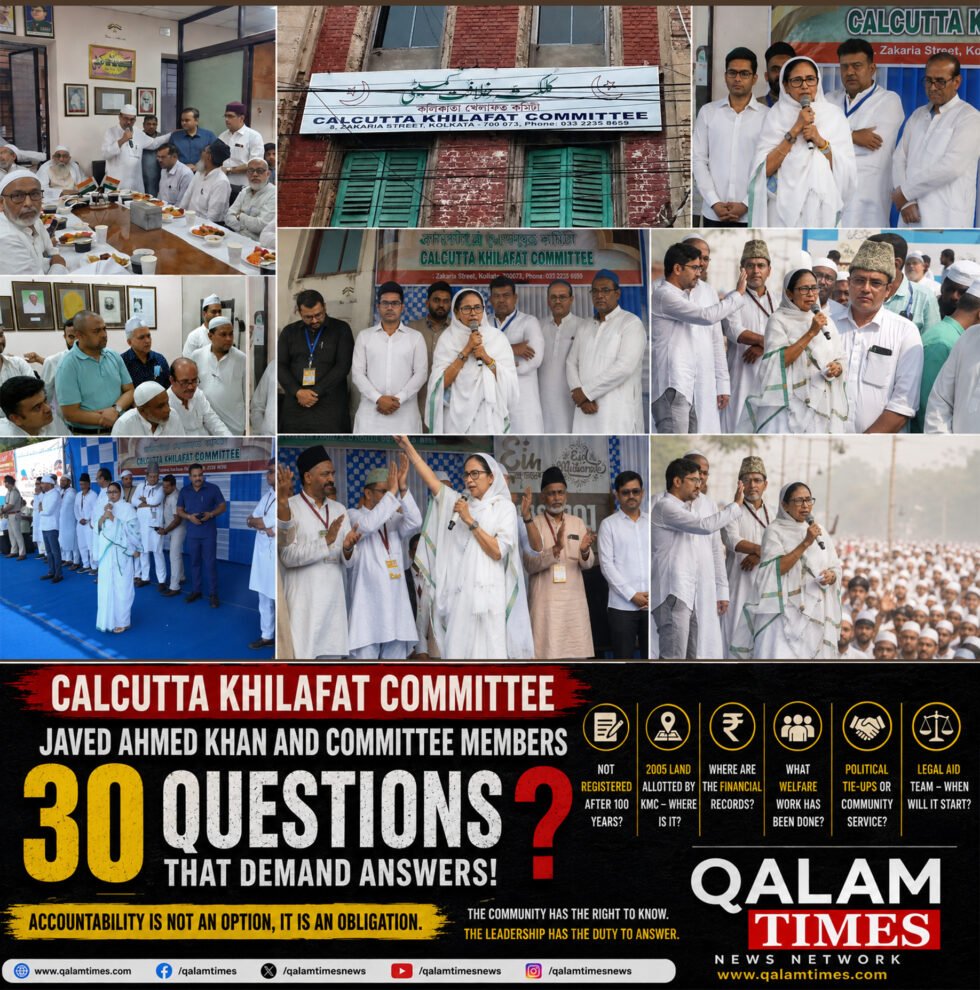
Calcutta Khilafat Committee under intense scrutiny: A comprehensive investigative report exposing decades of political subjugation, complete operational failure, and 30 hard-hitting questions demanding legal, financial, and institutional accountability.
Qalam Times Special Investigative Bureau
KOLKATA, September 1, 2026
The Calcutta Khilafat Committee, once a historic bastion of India’s anti-colonial struggle and the premier socio-political platform for Bengal’s Muslims, has been reduced to an empty, spineless political instrument. Under the self-serving and authoritarian leadership of Javed Ahmed Khan, this century-old institution has traded its sacred heritage for political patronage.
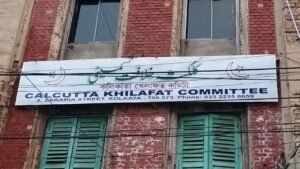
However, following the regime change on May 9, 2026, and the formation of the BJP government, Javed Ahmed Khan has taken opportunism to a new low by betraying Trinamool Congress and Mamata Banerjee to forge a tactical alliance with the BJP. This sudden political realignment raises a disturbing question for the community: Will he now trade off the century-old Calcutta Khilafat Committee to the BJP for his own political survival? Previously, he had turned the historic office of the committee at 8 Zakaria Street into an unblushing political sanctuary for the Trinamool Congress, Chief Minister Mamata Banerjee, and her political syndicate.
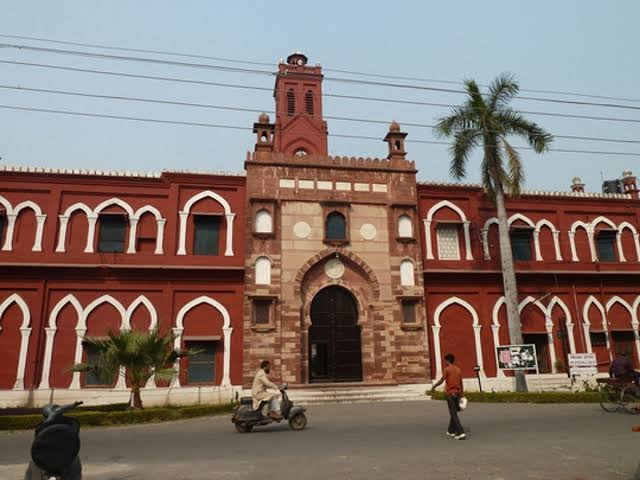
Established in 1920 in the wake of the Jallianwala Bagh massacre, the Calcutta Khilafat Committee once provided leadership under legendary patriots like Mulla Jan Mohammad and hosted tall freedom fighters including Mahatma Gandhi, Netaji Subhash Chandra Bose, Deshbandhu Chittaranjan Das, Maulana Abul Kalam Azad, and the Ali Brothers. In its golden era, it laid the foundations for major community assets like Kolkata’s Islamia Hospital and spearheaded emergency relief during the 1964 Kolkata riots and the Bhagalpur violence. Today, however, the institution suffers from total administrative paralysis, absolute financial opacity, and shameless political servitude.
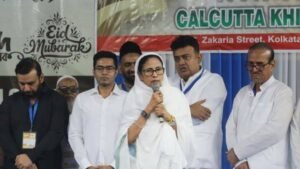
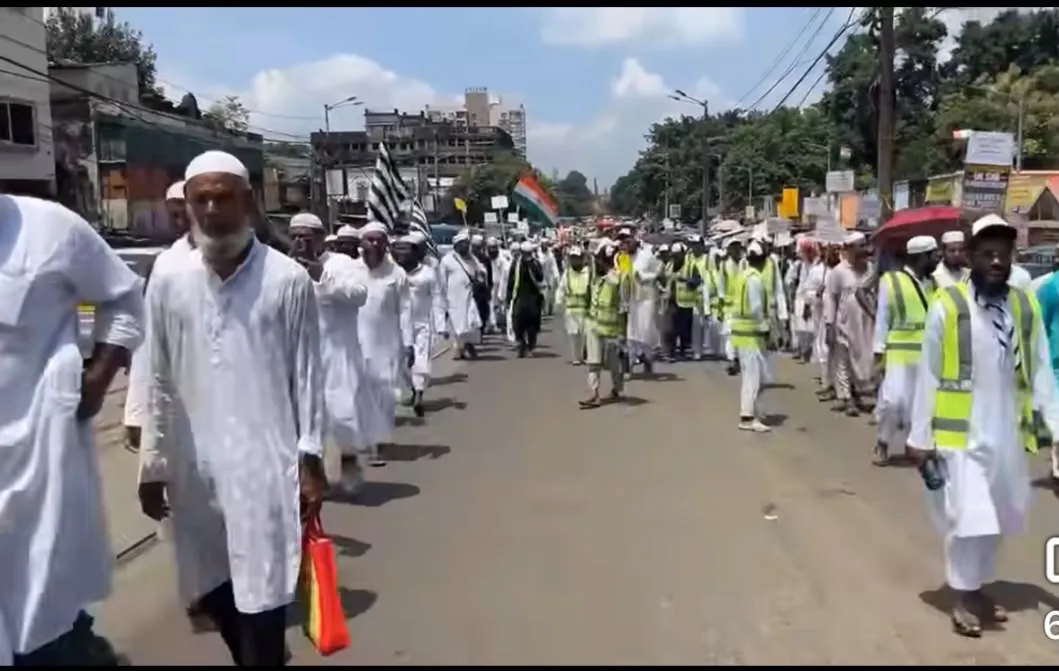
The complete stripping of the committee’s perceived authority was laid bare during the recent Bakrid celebrations. Historically, Kolkata Police and state authorities permitted Eid prayers on Red Road under special arrangements. However, this time, Eid prayers were not held at Red Road. Instead, the Eid namaz was offered at the Brigade Parade Ground. The Kolkata Police had formally informed the Calcutta Khilafat Committee of the mandatory change, to which the leadership quietly capitulated. Sources further confirmed that the Indian Army had already granted the No Objection Certificate (NOC) to utilize the defense-owned land strictly as per their operational needs.
Congress, the Left Front (CPM), and the Trinamool Congress (TMC) cumulatively governed West Bengal for around 79 years continuously since Independence, treating the Calcutta Khilafat Committee as a convenient bargaining chip while delivering zero structural progress or legal stability for Muslim welfare. Yet, what these ruling alliances couldn’t achieve in 79 years, the BJP-led framework accomplished in just 10 days through firm administrative action. It proved beyond doubt that political and administrative will dictates outcomes, exposing the political leadership and Javed Ahmed Khan as mere opportunistic spectators who held no real leverage when challenged.
The 30 Uncompromising Questions for Javed Ahmed Khan and the Khilafat Committee Management
To hold Javed Ahmed Khan, the executive committee, and their political backers accountable, Qalam Times News Network presents the complete, consolidated list of 30 sharp investigative questions demanding public answers:
- On Legal Status: What is the present legal status of the Calcutta Khilafat Committee? If it is registered, under which law, when was the registration obtained, and what is the registration number?
- On Failure to Register: If the committee remains unregistered, why has an institution with a history dating back to the early twentieth century not completed the registration process?
- On Asset Ownership: Who legally owns or controls the committee’s property, office premises, records, and other assets?
- On the Colootola Land Allotment: What happened to the land reportedly allotted by the Kolkata Municipal Corporation in 2005 at Colootola? Is the allotment still valid, and who currently has physical possession of it?
- On Abandoned Infrastructure Projects: Was the proposed committee office ever formally sanctioned, designed, or constructed on that Colootola land? If not, what prevented the project from progressing for more than two decades?
- On Leadership Transparency: Can the committee publish its complete list of office-bearers and governing-body members for the last twenty years?
- On Audited Accounts: Where are the committee’s audited financial statements? How much money does it receive annually, from what sources, and how is that money spent?
- On Revenue Generation: How much revenue is generated from the Eid prayers, Eid market, Ramadan market, and other commercial/event activities associated with the committee?
- On Public Disclosure of Funds: Is there a publicly available record of expenditure relating to these seasonal events? If not, why has such vital information been deliberately hidden from the community?
- On Concrete Welfare Delivery: What measurable welfare work has the committee undertaken during the past ten years? Can the committee provide a verified, year-wise list rather than vague, general statements?
- On Proposed Legal-Aid Services: The committee has repeatedly discussed establishing a legal-aid team for poor Muslims. When will that service actually become operational, who will run it, and how will beneficiaries be selected?
- On Direct Beneficiaries: How many people have received direct financial, medical, or educational assistance from the committee during the last five years? Can this number be supported by verifiable records?
- On Operational Staff: How many full-time or part-time staff members does the committee currently employ, and who pays their salaries?
- On Governance & Minutes: How frequently does the governing body meet, and are official minutes of those meetings maintained and archived?
- On Organizational Elections: When was the last proper, democratic organizational election held? If elections have not been held regularly, why?
- On Public Accountability Mechanisms: What mechanism exists for ordinary members of the Muslim community to question the leadership or demand financial and administrative transparency?
- On Exploitation of Religious Identity for Political Gain: Given that Javed Ahmed Khan is a long-standing Trinamool Congress (TMC) leader, current MLA, and former Cabinet Minister, how does the committee justify allowing its historic platform—built on religious and anti-colonial struggle—to be routinely exploited as a political springboard for electoral leverage and vote-bank consolidation rather than serving the community’s core developmental needs
- On Institutional Safeguards: What safeguards exist to ensure that the committee’s platform is not converted into an electoral campaign platform for any political party?
- On Political Hijacking of Events: Was Mamata Banerjee’s appearance at a committee event organized purely as a religious/community program, or was there an explicit political objective? Who invited her and who approved the program schedule?
- On Endorsement of Political Appeals: Does the committee endorse the controversial political appeals and vote-bank consolidation speeches made from its platform by political leaders? If not, why has it not publicly clarified its position?
- On Loss of Representative Mandate: Does the present leadership truly believe the committee still represents Kolkata’s wider Muslim community? If so, what empirical evidence supports that claim?
- On Institutional Affiliations: How many recognized Muslim organizations, mosques, educational institutions, professionals, and community representatives are currently affiliated with or formally consulted by the committee?
- On Archival Preservation: The committee’s historical record is repeatedly invoked. What concrete steps have been taken to preserve its historical archives, official correspondence, membership registers, and rare documents?
- On Documentary Proof of Freedom Struggle: If the committee claims a legacy connected to the Indian freedom movement, where is the physical documentary archive proving and preserving that legacy for future generations?
- On Institutional Roadmaps: If the Calcutta Khilafat Committee wants to regain the central influence it once enjoyed, what is its five-year institutional strategic plan—and where can the public read it?
- On Administrative Incompetence: Why has a 100-year-old entity been allowed to function without basic corporate or trust governance while maintaining control over prime socio-historical capital?
- On Political Servitude: Why has the committee allowed itself to be turned into a de facto branch office of political ruling parties?
- On The Red Road Debacle: How does the committee justify its complete failure to maintain its historical arrangements on Red Road during Bakrid after decades of boasting about its state-level clout and government influence?
- On Lack of Community Infrastructure: Beyond managing seasonal street stalls on Zakaria Street, what single concrete legal, medical, or educational facility has the committee built or funded over the last 20 years?
- On Demands for Resignation: When will Javed Ahmed Khan and his non-performing executive body step down to surrender control of the committee to an elected, transparent, and non-partisan trust of independent citizens?
Qalam Times News Network welcomes an on-record response from Javed Ahmed Khan and the Calcutta Khilafat Committee to each of the questions raised in this report. Any substantive response received will be considered for publication.