



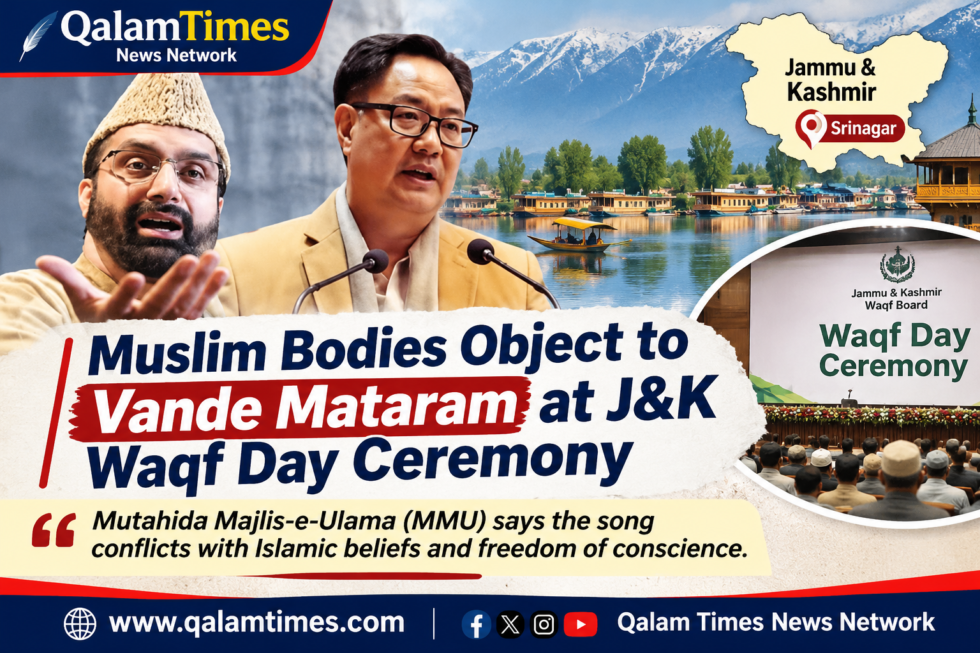
Vande Mataram Controversy intensifies after the Mutahida Majlis-e-Ulama objects to the song being played at a Jammu and Kashmir Waqf Board event in Srinagar, citing religious freedom and constitutional rights.
Qalam Times News Network
Srinagar, November 26, 2026
Vande Mataram Controversy : MMU Says Compulsory Singing Conflicts with Islamic Beliefs and Freedom of Conscience
The Vande Mataram Controversy has emerged in Jammu and Kashmir after the Mutahida Majlis-e-Ulama (MMU), an organisation representing different schools of Islamic thought, objected to the playing of the song during a Waqf Day programme organised by the Jammu and Kashmir Waqf Board in Srinagar.
The ceremony took place on November 23 at the Convention Centre of Sher-i-Kashmir University of Agricultural Sciences and Technology of Kashmir (SKUAST-K). Union Minister for Minority Affairs Kiren Rijiju attended the event. The Vande Mataram Controversy has since drawn attention to questions of religious belief, freedom of conscience and the use of national songs at official functions.
MMU Explains Its Religious Objection
In a statement, the MMU referred to the Islamic concept of Tawheed, which affirms the absolute Oneness of Allah. According to the organisation, Islamic teachings do not permit attributing divine status to any human being, object, territory or other creation.
The organisation clarified that Islam encourages affection and loyalty towards one’s homeland. However, it argued that patriotism must remain distinct from religious worship. Any practice that presents the motherland as a divine entity, the MMU maintained, conflicts with the principle of Tawheed and is therefore religiously impermissible for Muslims.
The organisation also pointed out that the All India Muslim Personal Law Board had previously raised objections to making the singing of Vande Mataram compulsory, citing both religious considerations and constitutional principles.
Objection to Song Being Played at Waqf Board Function
The MMU expressed particular disappointment that the song was played at an event organised by the Waqf Board, an institution entrusted with protecting Muslim religious endowments.
According to the organisation, there was no legal requirement to include the song in the programme. It argued that the decision disregarded the religious sentiments of Kashmiri Muslims and caused considerable hurt among members of the community.
The organisation also voiced concern over what it described as an increasing practice of including Vande Mataram at official programmes in Jammu and Kashmir, a region with a Muslim-majority population.
Legal Representation Under Consideration
The MMU argued that imposing religiously objectionable practices at public events could raise questions about constitutionally protected freedom of religion and conscience.
It said it was considering obtaining legal advice and preparing a formal representation to the authorities. The proposed representation would seek an end to what the organisation describes as the compulsory inclusion of Vande Mataram at government programmes, educational institutions and other public functions across the region.
The organisation urged the authorities to respect constitutional guarantees and ensure that participation in public events does not require individuals to act against their religious convictions.
Debate Over Religious Freedom and Public Ceremonies
The objection has brought renewed attention to the relationship between national symbols, religious beliefs and constitutional freedoms in public institutions.
While the MMU has presented its position on religious grounds, its proposed representation is expected to focus on the constitutional rights of individuals to follow their faith and exercise freedom of conscience.
The organisation has called upon the authorities to take these concerns into consideration when organising official events in Jammu and Kashmir.