



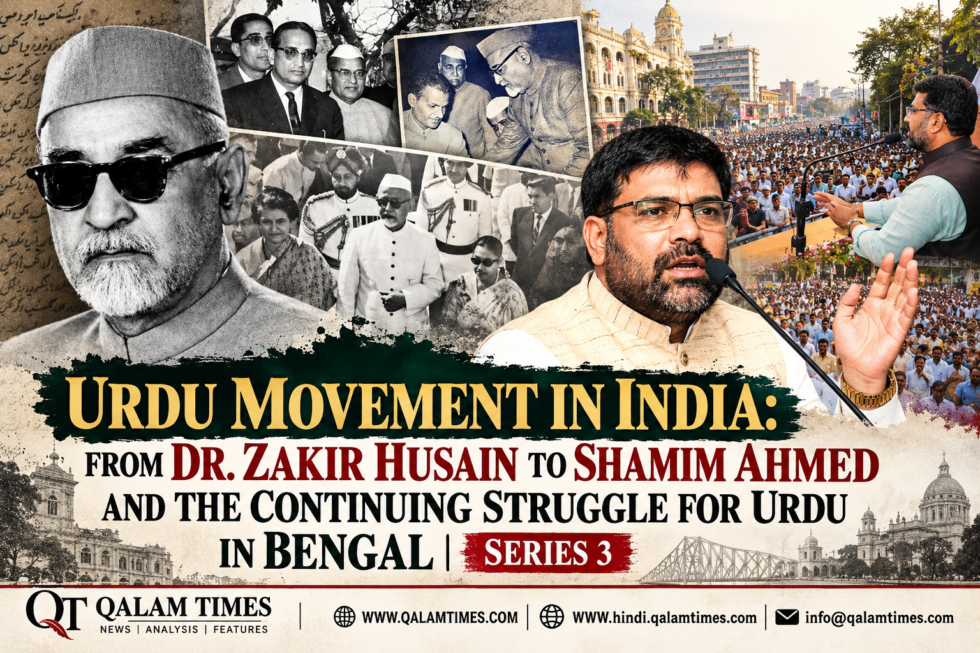
Urdu Movement in India traces Dr. Zakir Husain’s 1952 Urdu campaign and connects its legacy with Shamim Ahmed and the continuing Urdu Movement in Bengal.
By Qalam Times News Network
Kolkata | October 4, 2026
The Urdu Movement in India has never been the story of one individual, one organisation or one particular decade. It has passed through different historical periods, taken different forms and responded to changing political, educational and social circumstances. From the constitutional and educational campaign associated with Dr. Zakir Husain in the early years of the Republic to the continuing efforts in West Bengal associated with Shamim Ahmed, the movement reflects a persistent concern: how can Urdu retain its educational, cultural and historical place within India’s multilingual society?
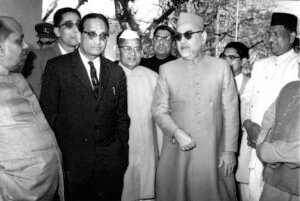
Dr. Zakir Husain occupies an important position in this history. The third President of India was not merely a statesman; he was an eminent educationist whose career was closely connected with the development of modern education in India. His involvement with Jamia Millia Islamia, his contribution to educational reform and his later association with Aligarh Muslim University reflected a lifelong engagement with the question of education and national development.
But for the history of Urdu, one of his most significant interventions came in the early 1950s.
In 1952, Dr. Zakir Husain launched an organised campaign seeking safeguards for Urdu as a regional language under Article 347 of the Constitution of India. The movement sought to establish a legitimate educational and institutional space for Urdu-speaking citizens who had remained in India after Partition and continued to regard Urdu as their mother tongue.
The importance of this intervention becomes clearer when it is placed within the larger history of Urdu in India.
Dr. Zakir Husain: Education, Nationalism and Urdu
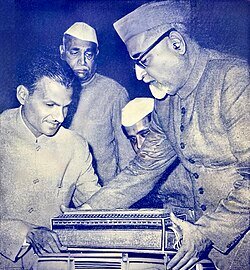
Dr. Zakir Husain’s commitment to Urdu was closely connected with his wider philosophy of education.
Soon after completing his studies, he became deeply involved in educational work. He was associated with the establishment and development of Jamia Millia Islamia, which emerged as a nationalist educational institution during the struggle against colonial rule.
His educational vision was not limited to one community.
He believed that education could play a central role in building a modern India in which different communities could participate in a shared national life. This perspective was particularly important after independence, when the country was attempting to create institutions capable of accommodating enormous linguistic, religious and cultural diversity.
Zakir Husain’s understanding of Urdu reflected this wider outlook.
For him, Urdu could not simply be reduced to the language of a particular religious community. Its history was deeply embedded in the cultural development of India. It had evolved through interaction among different linguistic traditions and had become an important medium of Indian literature, communication and cultural expression.
The circumstances following Partition, however, made the position of Urdu increasingly difficult.
Because of the language’s strong association with Muslim cultural identity and its political associations during the years surrounding Partition, Urdu was increasingly subjected to interpretations that linked it with the politics of the Muslim League and Pakistan.
The result was a narrowing of the space in which Urdu could be discussed as an Indian language.
Zakir Husain’s intervention challenged this approach.
His response was to place Urdu within the framework of education, constitutional rights and India’s multilingual character.
The 1952 Urdu Campaign
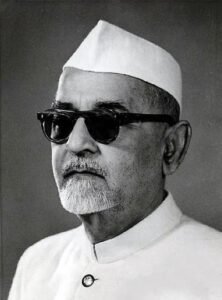
The year 1952 marked a major stage in the post-independence Urdu Movement. Dr. Zakir Husain sought constitutional safeguards for Urdu and supported the demand that Urdu should receive recognition as a regional language in areas where substantial Urdu-speaking populations existed. The campaign was especially significant because it did not present Urdu merely as a matter of literary preference.It connected the language with education and citizenship.The demand was that Urdu-speaking Indians should have meaningful opportunities to study their mother tongue and to preserve it within the formal educational system. The campaign also called attention to the wider question of regional recognition. The source material records that a memorandum submitted in connection with the movement carried the signatures of more than two and a half million people.The scale of the campaign demonstrated the depth of concern surrounding the future of Urdu in the early years of independent India. It was not simply a literary campaign organised by poets and writers.It involved public mobilisation around language, education and constitutional recognition. That distinction is crucial.The movement understood that a language cannot survive institutionally if it is removed from schools, curricula and public life.
Urdu and the Politics of Partition
The post-independence Urdu question cannot be understood without considering the political atmosphere created by Partition. During the late nineteenth and early twentieth centuries, Hindi and Urdu increasingly became associated with competing cultural and political identities in parts of northern India. The linguistic debate was gradually transformed into a wider struggle over cultural representation.
Partition deepened this process. Urdu’s association with Muslim identity and the Muslim League enabled its opponents to portray the language as connected with Pakistan. In some political narratives, Urdu was consequently treated as though it were a foreign or exclusively communal language.
The Urdu Movement rejected this interpretation. Its argument was that Urdu had developed in India and had become part of India’s cultural history over several centuries. Its literature reflected Indian places, traditions and social life. Its vocabulary reflected multiple linguistic influences. Its speakers belonged to different social and cultural backgrounds. The language therefore could not simply be removed from the Indian national story because of the political events surrounding Partition. This was one of the central intellectual foundations underlying the campaign associated with Zakir Husain.
The Educational Dimension
At the heart of the movement was education. The survival of Urdu required schools, teachers, textbooks and students. Without educational institutions, the language could remain present in poetry and private conversation but gradually lose its position in formal public life. The source material emphasises the importance of including Urdu in the educational system and argues that the language should have a place in the syllabi of secular education. This was a particularly important concern because the decline of Urdu from formal education had consequences beyond language.
When children cannot study their mother tongue through the mainstream education system, families often face a choice between maintaining their linguistic identity and pursuing educational opportunities through another language. The result can be a gradual separation between language and education. Zakir Husain’s campaign recognised this problem at an early stage. His intervention therefore needs to be understood not merely as a defence of Urdu literature but as an attempt to preserve the educational ecosystem necessary for a language to survive.
Urdu as Part of India’s Composite Culture
The wider historical significance of the campaign lies in its understanding of India’s composite culture. Urdu developed through cultural interaction. It absorbed influences from Persian and Arabic while developing within the linguistic environment of India. Over time, it became a language of poetry, prose, journalism, administration and everyday communication across different parts of the country. Its literary traditions developed in the Deccan as well as northern India. Sufis, scholars, poets, rulers and ordinary speakers all contributed to its growth. This history makes it difficult to treat Urdu simply as an imported language.
The argument advanced by the Urdu movement was therefore broader than a demand for linguistic preference. It was an argument for recognising the historical reality of India’s cultural plurality. For Zakir Husain, protecting Urdu did not require rejecting Hindi. It required ensuring that one Indian language did not have to disappear for another to flourish.
The Constitutional Question
The reference to Article 347 was particularly significant. The campaign sought to bring Urdu’s demand for recognition within the constitutional framework of India. This was important because it transformed the debate from a cultural appeal into a question of rights and institutional recognition. The central issue was straightforward: If a significant linguistic population existed in a particular region, could that community legitimately seek recognition and educational facilities for its language?
The Urdu movement’s answer was yes. The demand was not presented as a rejection of national unity. It was presented as an expression of India’s multilingual character. This approach remains important when examining the history of language rights in India.
The Movement Did Not End With Zakir Husain
The campaign associated with Dr. Zakir Husain represented one major stage in the history of the Urdu Movement, but it did not bring the language question to an end. Urdu continued to face educational and institutional challenges in different parts of India.
The language movement consequently entered new phases. Different individuals, organisations and regional initiatives began addressing the problem according to their own circumstances. Some concentrated on education.Others worked through literature, journalism, cultural organisations or public mobilisation. Still others attempted to preserve historical records and document the contributions of Urdu-speaking communities. This changing character of the movement is essential to understanding its contemporary relevance. The Urdu Movement in India should not be seen as a single campaign frozen in the 1950s. It is better understood as a continuing historical process.
From Zakir Husain to Bengal
This is where the story moves from the national campaign of Dr. Zakir Husain to the regional experience of West Bengal. The connection between the two periods should not be misunderstood. The contemporary Bengal Urdu Movement associated with Shamim Ahmed is not being presented here as an organisational continuation of Zakir Husain’s 1952 campaign.The historical circumstances are different.Zakir Husain was working in the early years of the Republic, when the immediate consequences of Partition, the constitutional development of India and the political status of Urdu were central concerns.
Shamim Ahmed belongs to a much later period.His engagement with the Bengal Urdu Movement is associated with a different task: drawing attention to the history, identity, institutions and continuing presence of Urdu in West Bengal and bringing this regional story into wider public discussion. The connection between the two therefore lies in a continuing concern for the preservation and recognition of Urdu, rather than in a direct organisational chain.
Why Bengal Matters
The history of Urdu in India is often narrated through Delhi, Uttar Pradesh, Bihar, Hyderabad and other traditional centres.Bengal, however, also has its own Urdu history.Urdu has existed within Bengal’s complex linguistic and cultural environment for generations. It has been connected with literature, education, journalism, social organisations and community life.Yet regional histories do not always receive equal attention in national narratives.This creates a particular responsibility for contemporary researchers, writers and cultural activists.The Bengal Urdu story needs to be documented on its own terms. It needs to identify the institutions that supported Urdu, the writers and educators who contributed to it, the communities that maintained it and the campaigns that sought to protect its educational and cultural presence.This is the context in which the work associated with Shamim Ahmed becomes relevant to the continuing story of the Urdu Movement.
Shamim Ahmed and the Bengal Urdu Movement
The inclusion of Shamim Ahmed in this series represents a contemporary effort to bring the Bengal chapter of the Urdu story into wider public consciousness.His engagement with the Bengal Urdu Movement draws attention to a basic historical reality: the history of Urdu in West Bengal should not be treated as a footnote to the history of Urdu elsewhere in India.
It deserves independent documentation.The work associated with Shamim Ahmed highlights the importance of remembering the regional history of Urdu and examining how the language developed and survived within Bengal’s predominantly Bengali linguistic environment.This is particularly important for younger generations. A language can lose its historical visibility even when speakers continue to use it.If its institutions are not recorded, if its educators are forgotten and if its cultural contributions are not documented, future generations may inherit the language without understanding the historical struggles that shaped its position. Documentation therefore becomes a form of cultural preservation. And this is one of the key ways in which the contemporary Bengal chapter connects with the earlier Urdu movements led by figures such as Zakir Husain.
Different Generations, Similar Questions
The distance between Zakir Husain and Shamim Ahmed is considerable.
Their historical circumstances were different.Their methods were different.Their institutional environments were different. But some of the questions remain remarkably similar.
How can Urdu remain connected with education?
How can its history be preserved?
How can Urdu-speaking communities maintain their linguistic identity within India’s multilingual society?
How can the language be protected without turning the language question into communal confrontation?
These questions have appeared repeatedly in the history of the Urdu Movement. In the 1950s, the emphasis was strongly placed on constitutional recognition, educational rights and public mobilisation. In the contemporary Bengal context, the emphasis also includes historical documentation, regional awareness, preservation of institutional memory and connecting younger generations with the language’s past.The methods may change.The underlying concern remains.
From Hifzur Rahman Seoharwi to Zakir Husain
The previous instalment of this Qalam Times series examined the contribution of Maulana Hifzur Rahman Seoharwi, whose political and parliamentary interventions demonstrated how the Urdu question entered the national debates of independent India. Seoharwi’s work represented one dimension of the movement: political advocacy and parliamentary intervention.
Dr. Zakir Husain represents another: educational leadership, constitutional mobilisation and the effort to secure a formal place for Urdu in the institutional life of the Republic. The contemporary Bengal chapter represented by Shamim Ahmed adds another dimension: regional historical documentation and the effort to ensure that Bengal’s contribution to the Urdu story is not forgotten. These should not be presented as identical movements or as a single organisation operating continuously across decades. They are different chapters. But together they help reveal the changing character of the Urdu Movement in India.
From Constitutional Rights to Historical Memory
There is an important shift in emphasis between the early post-independence movement and contemporary regional efforts. The generation of Zakir Husain was confronting the question of recognition. The contemporary generation also faces the question of memory. Recognition asks:
Does Urdu have a legitimate place in India’s educational and institutional system?
Historical memory asks:
What is the history of Urdu in each region, and who preserved it?
Both questions matter. A language can possess constitutional recognition and still lose institutional strength. Likewise, a language can have a rich historical legacy and still become disconnected from younger generations.That is why documentation, education and institutional support need to be considered together. The source material itself stresses that Urdu’s future requires a feasible educational strategy and meaningful inclusion in secular education. The Bengal experience adds another necessary element: the preservation of regional history.
Why the Bengal Story Deserves Wider Attention
The Bengal chapter of the Urdu Movement also challenges a narrow geographical understanding of Urdu. Urdu’s history in India was never confined to a single linguistic belt.
Its cultural networks crossed regions. Its literature travelled between cities. Its speakers lived in diverse linguistic environments. Its institutions developed under different social and political circumstances. West Bengal therefore deserves to be studied not simply as a place where Urdu exists alongside Bengali, but as a region with its own Urdu history. This history includes educational institutions, literary activity, journalism, cultural organisations and individuals who contributed to the language’s development. The effort associated with Shamim Ahmed seeks to bring greater attention to this regional dimension. For Qalam Times, this is important because the national history of Urdu becomes incomplete when regional histories remain undocumented.
The Continuing Struggle for Urdu in Bengal
The phrase “continuing struggle” should not be understood only in terms of confrontation.
The contemporary struggle for Urdu also includes preservation. It includes teaching.
It includes research. It includes documenting institutions and personalities. It includes encouraging young people to read and write Urdu. It includes recovering forgotten chapters of regional history. And it includes placing Urdu within the broader story of India’s multilingual cultural heritage. In this sense, the Bengal Urdu Movement represents a contemporary form of language activism. Its methods may differ from the signature campaigns and constitutional interventions of the 1950s, but the objective of keeping Urdu visible, meaningful and connected with future generations remains relevant.
A Legacy That Moves From Generation to Generation
Dr. Zakir Husain’s contribution to the Urdu Movement must therefore be understood within the wider trajectory of India’s linguistic history. He belonged to a generation that confronted the immediate consequences of Partition and attempted to establish a constitutional framework for a newly independent, multilingual country. His 1952 campaign brought Urdu’s educational and regional recognition into national discussion. Later generations inherited both the achievements and unresolved questions of that period. Maulana Hifzur Rahman Seoharwi’s parliamentary interventions formed another part of that continuing story.
And today, the Bengal chapter associated with Shamim Ahmed demonstrates that the Urdu question continues to have regional dimensions that deserve careful historical study.
The story has therefore moved from constitutional mobilisation to regional documentation, but it has not lost its central concern.
The Future of the Urdu Movement
The future of the Urdu Movement in India cannot depend only on remembering its historic personalities. Remembering Zakir Husain is important. Remembering Hifzur Rahman Seoharwi is important. Documenting the Bengal Urdu Movement and the work associated with Shamim Ahmed is also important. But history becomes meaningful only when it informs the present. The future of Urdu will depend on education, research, publishing, journalism, literary activity and the willingness of younger generations to remain connected with the language. The challenge is particularly significant in regions where Urdu exists within a multilingual environment. Bengal is one such region. The task is not to place Bengali and Urdu in opposition. It is to recognise that a multilingual society can accommodate both. The preservation of one language does not inherently require the weakening of another. That principle lies close to the heart of the broader history of linguistic diversity in India.
From Zakir Husain to Shamim Ahmed
The journey from Dr. Zakir Husain’s 1952 campaign to the contemporary Bengal Urdu Movement is therefore not a straight line. It is a historical continuum made up of different people, different organisations, different regions and different challenges. Zakir Husain’s intervention demonstrated that the Urdu question could be articulated through education, constitutional rights and India’s plural cultural identity. Hifzur Rahman Seoharwi’s parliamentary work demonstrated the political dimension of the struggle. The contemporary Bengal chapter associated with Shamim Ahmed brings the question of regional history and cultural memory into focus. Taken together, these chapters show that the Urdu Movement in India has continually changed its form. The language has faced political pressures, educational challenges and institutional difficulties. Yet it has also produced generations of advocates, writers, educators and cultural workers who have attempted to keep it connected with Indian public life. The Bengal story is therefore not separate from the national story. It is one of its regional chapters. And documenting that chapter is important not only for Urdu speakers in Bengal but for anyone seeking to understand India’s linguistic and cultural history.
The Qalam Times Perspective
The purpose of this series is not to present the Urdu Movement as a single uninterrupted campaign. It is to recover the different chapters that together explain how Urdu has survived and evolved in India. From Hifzur Rahman Seoharwi’s parliamentary interventions to Dr. Zakir Husain’s educational and constitutional campaign, and from those national struggles to Shamim Ahmed’s contemporary engagement with the Bengal Urdu Movement, the story demonstrates how the concerns surrounding Urdu have changed from generation to generation.
The historical circumstances are not identical. The political environments are not identical.
The methods are not identical. But the need for education, recognition, documentation and cultural continuity remains. This is why the Bengal chapter matters. A national history becomes stronger when its regional histories are brought into the record. The history of Urdu in Bengal deserves to be documented with the same seriousness given to the language’s better-known centres elsewhere in India. The work associated with Shamim Ahmed represents one contemporary effort in that direction.
For Qalam Times, documenting such efforts is part of a larger responsibility: to ensure that the history of Urdu in India is not reduced to a story of Partition, communal politics or literary nostalgia. It is also a story of education. It is a story of constitutional rights. It is a story of cultural survival. And it is a story of people who, across generations, have attempted to ensure that Urdu remains part of India’s diverse linguistic landscape. The journey from Zakir Husain to the contemporary Bengal Urdu Movement therefore remains unfinished.
The questions have changed. The generations have changed. The methods have changed. But the historical conversation continues.
The Urdu Movement in India is not merely a chapter of the past; it is a continuing story of language, education, identity, memory and India’s multilingual cultural heritage. And in that continuing story, Bengal—and the contemporary efforts associated with Shamim Ahmed—deserves its own place.